AI Fabric Topologies: Rail-Optimized & Scheduled Designs
Match the topology to the GPU count: a rail-optimized leaf-spine pod up to about 1,000 GPUs, a 3-stage Clos to 16,000+, and coherent DCI to span sites. Pick the smallest non-blocking design that keeps every GPU's link saturated during collectives. All three run on OcNOS-DC over a lossless RoCEv2 (PFC + ECN) L3 fabric, sized here in concrete port-counts on Broadcom Tomahawk 4 and Tomahawk 5.
The smallest non-blocking design that fits your GPU count
An AI fabric topology has one job: keep every GPU's outbound link saturated during a collective without creating tail-latency outliers. The right topology is the smallest one that does this for your GPU count, with a fall-back path for the next size up. Four reference points, with concrete port maths on Broadcom Tomahawk silicon.
The two-tier leaf-spine ceiling is about 2,048 GPUs at one 800G fabric port per GPU; beyond it, add the super-spine tier. The same OcNOS-DC image runs every tier, so the fabric scales out with the cluster instead of being redesigned at each step.
Sizing your own cluster? The AI Fabric Design Suite gives a fast first cut: it sizes a non-blocking two-tier leaf-spine pod assuming one fabric NIC per GPU, and flags when you cross into three-tier scale. The reference designs below use the same non-blocking leaf/spine math and extend it to a 3-stage Clos at scale, so the switch counts line up with the tool. Rail-optimized here is the wiring discipline of an 8-NIC GPU server (one rail per leaf, so intra-rail AllReduce stays on the leaf) layered on that non-blocking fabric: it changes traffic locality, not the switch count. Use the tool for a ballpark; use these designs for the build.
Rail-optimized, scheduled Clos, and coherent DCI
OcNOS-DC ships against three reference topologies that cover single-pod, multi-pod, and multi-site AI fabrics. Each is a concrete build, sized on HCL-listed Broadcom hardware, not a whiteboard sketch.
Rail-optimized single pod
Each GPU server's 8 NICs land on 8 dedicated rail leaves, so same-rail AllReduce stays on one leaf and never traverses the spine. A non-blocking spine carries cross-rail flows. The single-pod scalable unit, up to about 1,000 GPUs.
Scheduled 3-stage Clos
Leaf, spine, and super-spine tiers scale from 4,096 to 16,384 GPUs. Non-blocking within each pod, with the super-spine plane setting the cross-pod ratio. DLB at every hop, GLB end-to-end on the OcNOS 7.1 train.
Coherent multi-DC DCI
When a training run spans data halls, extend the fabric with 400G ZR / ZR+ coherent optics on the spine. Transponder-free DCI between sites, with the in-site 3-stage Clos unchanged.
Rail-optimized single pod
Each GPU server has 8 NICs, one per rail (a dedicated xCCL (NCCL / RCCL / oneCCL) collective channel). Each rail is its own dedicated leaf, so all 8 NICs on every server land on a different leaf. AllReduce across rail-N stays inside leaf-N, so there is no east-west pressure on the spine for the dominant collective pattern.
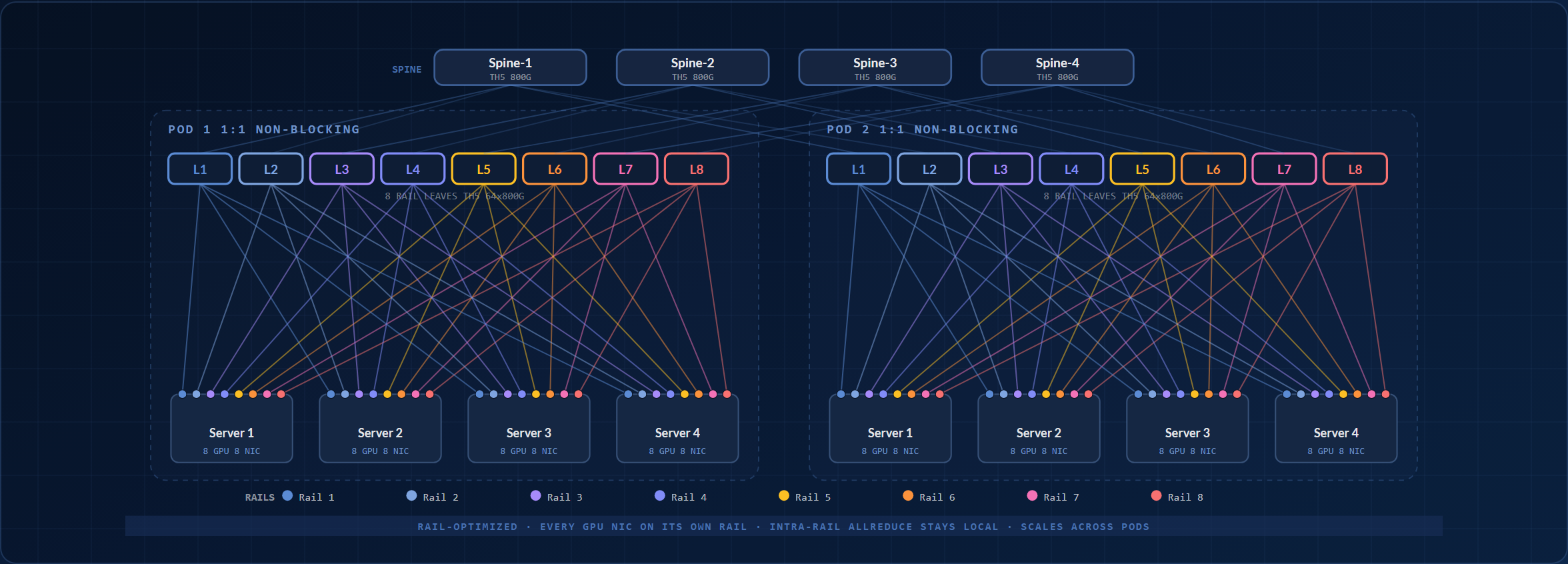
OcNOS pieces: BGP-unnumbered L3 underlay, RoCEv2 lossless (PFC + ECN) on every leaf, DLB at the spine tier. Built on HCL-listed hardware: the 800G scalable unit uses TH5 64x800G leaves and spines (Edgecore AIS800-64D or UfiSpace S9321-64E); the entry 256-GPU pod uses Edgecore AS9736-64D (TH4, 64x400G).
3-stage Clos scheduled fabric: 4,096 to 16,384 GPUs
Rail-optimized stops scaling somewhere between 1k and 2k GPUs: you run out of leaf radix, or the spine tier becomes too oversubscribed. Above that, most modern AI fabrics move to a 3-stage Clos: leaf, spine, super-spine. Any two GPUs are at most four switch hops apart; same-leaf and same-pod peers are closer.
The hard part on a Clos is spreading flows evenly so no link becomes a hot spot. Approaches run from per-flow ECMP, through adaptive (dynamic) load balancing, to per-packet spray, the model Ultra Ethernet uses with reordering handled at the NIC. A separate family, cell-based scheduled fabrics such as Broadcom DDC, segments traffic into cells and schedules it inside the fabric. OcNOS keeps the GPU plane balanced with DLB today and adds fabric-wide GLB on the 7.1 train, and is UEC-ready as UEC NICs arrive.
The diagram is schematic: it draws a reduced tier count. The 4,096-GPU build is 128 leaves / 64 spines / 32 super-spines on TH5 800G.
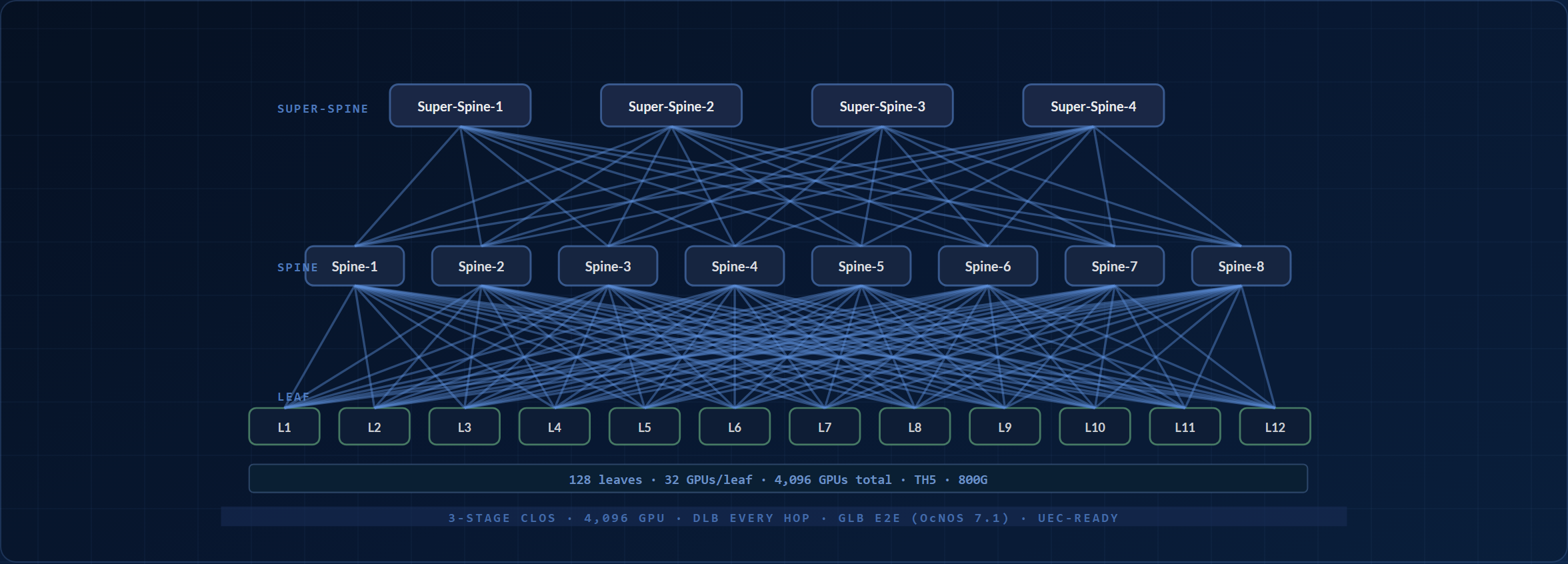
OcNOS pieces: eBGP-unnumbered L3 underlay, RoCEv2 lossless (PFC + ECN), DLB at every tier, GLB end-to-end on the OcNOS 7.1 train, and gNMI streaming telemetry to your observability stack. Built on HCL-listed TH5 64x800G chassis throughout.
Subscription is a dial, not a fixed rule. These counts make each 1,024-GPU pod 1:1 non-blocking and use a cost-optimized ~2:1 super-spine for cross-pod traffic, the rail-optimized approach hyperscale Ethernet fabrics rely on (published large-scale designs oversubscribe the top tier far more, because collective traffic stays pod-local). Want maximal any-to-any headroom instead? A fully non-blocking 1:1 build is 128 / 128 / 64 at 4,096 GPUs and 512 / 512 / 256 at 16,384; only the spine and super-spine counts change. Model either in the AI Fabric Design Suite.
Multi-DC AI fabric: coherent DCI
When a single training run spans more than one data hall, increasingly common for trillion-parameter models, the fabric extends across the WAN. OcNOS-DC supports 400G ZR / ZR+ coherent optics directly on the spine for transponder-free DCI across sites. The underlying 3-stage Clos in each site is unchanged.
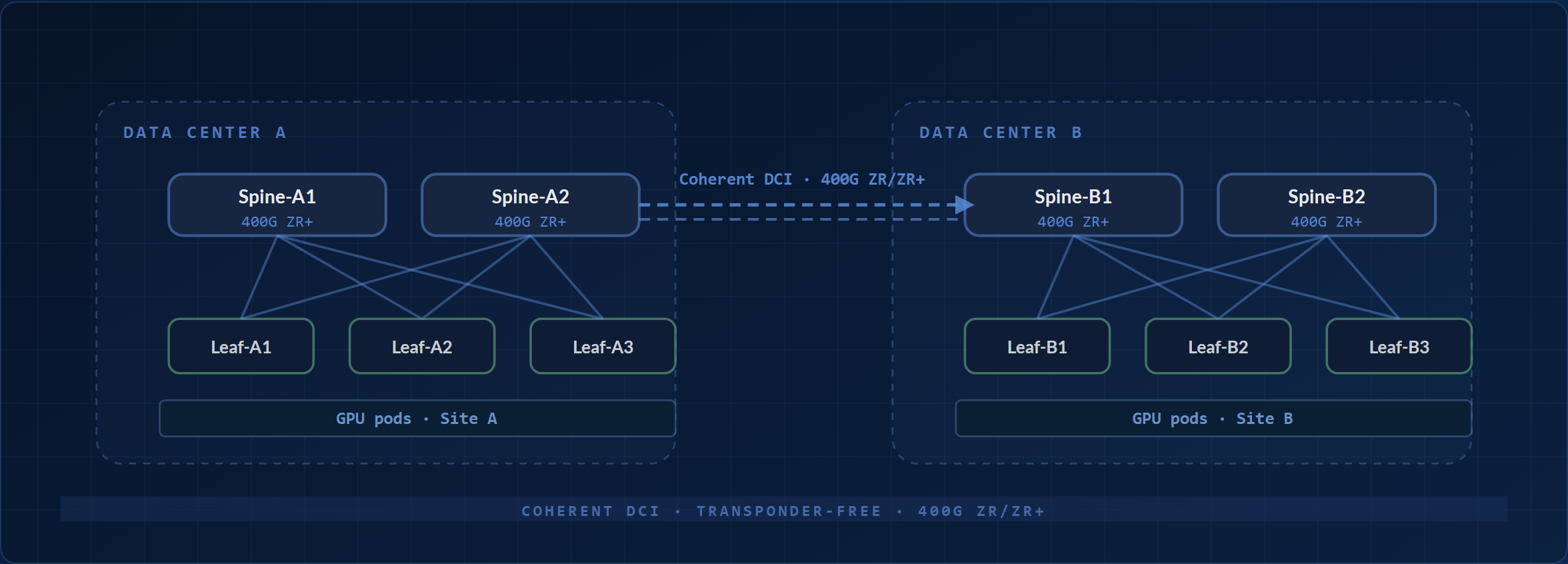
OcNOS pieces: 400G ZR/ZR+ pluggable coherent optics on a DWDM-capable spine or border-leaf port, with gNMI telemetry across sites. No external transponders required. Reach: 400ZR to roughly 120 km amplified; OpenZR+ reaches farther on oFEC.
Design rules of thumb
A handful of rules keep an AI fabric on the right side of the performance and cost curve, whichever reference design you build from.
- Match the topology to the GPU count. Smallest pods (under one leaf's NIC radix): rail-only is enough. Single-pod scale: rail-optimized leaf-spine. Multi-pod: 3-stage Clos is the only design that scales without oversubscription compromises.
- Always 1:1 subscription on the AI plane. Storage and CPU racks can run higher oversubscription ratios. The GPU plane should not.
- Plan the rail count from xCCL, not from cabling convenience. 8 rails is the current de-facto standard for 8-NIC GPU servers. Do not combine rails into fewer leaves.
- Pick the silicon by power and density, not the badge. TH4 (25.6T) and TH5 (51.2T) are the workhorses; the choice between them is rack power and breakout-cable cost.
- Plan for GLB / UEC at design time. Build the telemetry plane in from day one, even on a 7.0 fabric, so the OcNOS 7.1 GLB upgrade is purely a software step. See GLB and Ultra Ethernet.
- Validate against the HCL. Every reference here is built on hardware listed in the OcNOS Hardware Compatibility List; pick from there for first-class support.
AI fabric topology FAQ
What is a rail-optimized topology, and how is it different from rail-only?
How many GPUs can a 3-stage Clos scale to?
Should I use Tomahawk 4 or Tomahawk 5?
Do I need InfiniBand, or is Ethernet enough?
Where does scale-up end and scale-out begin?
Go deeper. Take it with you.
The product datasheet plus short, technical downloads that go further than this page.
OcNOS-DC Datasheet
Full OcNOS-DC specification: the EVPN-VXLAN and Ethernet for AI feature set, software SKUs, supported hardware platforms, and the solution ordering guide.
Get the datasheetOcNOS 800G Lossless AI Fabric
Non-blocking RoCEv2 fabric on Broadcom Tomahawk 4/5 spines: SKU tiers, validated platforms, and deployment architecture.
Get the briefEVPN-VXLAN Data Center Fabric
Carrier-grade leaf-spine data center fabric: symmetric IRB, Type-2/Type-5 routes, and distributed anycast gateway.
Get the briefOcNOS-DC Datasheet
Quick form. Your PDF opens in a new tab immediately after submit.
✓ Opening your PDF in a new tab…
If it didn't open, use the link below.
OcNOS 800G Lossless AI Fabric
Quick form. Your PDF opens in a new tab immediately after submit.
✓ Opening your PDF in a new tab…
If it didn't open, use the link below.
EVPN-VXLAN Data Center Fabric
Quick form. Your PDF opens in a new tab immediately after submit.
✓ Opening your PDF in a new tab…
If it didn't open, use the link below.
Designing your AI fabric? We'll do the port-count maths with you.
Tell us the workload and the GPU scale, and an IP Infusion engineer will size the leaf, spine, and super-spine tiers with you, or start with a first-pass layout in the AI Fabric Design Suite.
Design the whole AI fabric with OcNOS
From the business case to the port-count maths, pick up wherever you are in the build.