Is Ethernet ready for AI? The proof is shipping
The four sections below each answer it with something already in production, not a roadmap: shipping 800G silicon, a hyperscale Ethernet cluster, the closed utilization gap, and a moving standard. Every figure is sourced to a hardware spec or a named third party.
The hardware is here
Open 800G AI switches are not a preview. They are on the hardware compatibility list and shipping. OcNOS-DC runs on Broadcom Tomahawk 5 and Tomahawk 4 platforms from Edgecore and UfiSpace, the same merchant silicon the rest of the industry builds AI fabrics on, so you keep switch, NIC, and GPU choices open. These are on-chip, shared-buffer switches built for lossless RDMA at 800G.
800G spine and leaf
Edgecore AIS800-64D and UfiSpace S9321-64E / S9321-64EO, the latter with 400G ZR+ coherent ports. On-chip shared buffering for lossless RoCEv2. Both platforms are HCL-listed.
400G leaf
Edgecore AS9736-64D for 400G leaf roles and smaller fabrics, on the same lossless RoCEv2 primitives as the 800G tier, breaking out to 100G and 25G.
Supported as a system
With OcNOS Systems, one IP Infusion contract covers OcNOS-DC and the qualified switch hardware together, so there is one TAC and one SLA across the whole fabric.
The scale is proven
The most common objection to Ethernet for AI is scale, and the industry has already answered it in production. You do not have to take a switch vendor's word for it, because the hyperscalers publish their designs.
Meta runs a 24,576-GPU AI training cluster on an Ethernet-based fabric. That is industry proof that standard Ethernet carries hyperscale AI training at scale, in production, today. It is the reference point that settles the readiness question: the fabric is not the limit.
On OcNOS-DC the same physics apply to your build. A two-tier Tomahawk 5 design reaches 4,096 GPUs at 800G per GPU and a 1:1 subscription ratio. Above that, a super-spine tier extends to 16,000 or more. See the AI fabric topologies for the port math behind each tier.
The utilization gap is closed
The old knock on Ethernet was load balancing: standard ECMP pins each large flow to one uplink, so during a collective some links jam while parallel paths sit idle and the sync waits on the slowest link. That gap is now closed on the same switches, and the proof is a hardware feature, not a promise.
How the gap closes. Static ECMP pins each large flow to one uplink; dynamic load balancing rebinds flows on real-time congestion so a well-run AI fabric targets utilization in the 90 percent range on Tomahawk 4 and Tomahawk 5, on the same switches, with no extra uplinks. OcNOS-DC ships DLB on those platforms.
DLB deep-dive →The standard is moving
Ethernet for AI is not a single vendor's proprietary detour. The Ultra Ethernet Consortium published the UEC 1.0 specification to adapt Ethernet transport for AI and HPC scale, backed by the companies that build the silicon, the NICs, and the clouds. IP Infusion is a member of the Ultra Ethernet Consortium.
UEC 1.0 defines a multipath transport that spreads one flow across many paths instead of pinning it to a single ECMP hash, with that endpoint behavior running on UEC-capable NICs. OcNOS-DC runs lossless RoCEv2 with PFC, ECN marking, and DLB in production today on Broadcom Tomahawk 4 and Tomahawk 5 switches. DCQCN runs on the NICs and reacts to those ECN marks. See the Ultra Ethernet deep-dive for how packet spray and multi-path RDMA change the transport.
What OcNOS-DC ships today
Underneath the proof points is a fabric you can turn up now. OcNOS-DC provides the lossless Ethernet fabric that RoCEv2 requires, so your training collectives move GPU-to-GPU over RDMA without loss. DCQCN is the end-to-end loop between the NICs and the switches; the switch role in that loop is early ECN marking. Every primitive below is verified and shipping, not a roadmap item.
PFC
Priority flow control, including over L3, with DCBX and LLDP.
ECN and Dynamic ECN
Early congestion marking, the switch side of the DCQCN loop.
ETS
Enhanced transmission selection to keep RDMA flows ahead.
WRED
Weighted random early detection for queue management.
DLB
Dynamic load balancing with Reactive Path Rebalance and Random Flow.
PFC Deadlock Detection and Recovery
Detects paused-queue cycles and auto-drains before jobs hang.
Buffer tuning
Switch packet buffer tuning on the on-chip shared buffer.
RTAG7 hashing
Fine-grained hashing for even spread across the fabric.
gNMI / OpenConfig telemetry
Streaming telemetry over OpenConfig YANG for closed-loop tuning.
What is coming next
The items below are roadmap and upcoming-silicon, labeled as such. They are not shipping capabilities today, and none of the figures are IP Infusion performance numbers.
Global Load Balancing (GLB)
Extends DLB fabric-wide: spines publish path-quality telemetry back to ingress leaves so routing scores the full multi-hop path.
Latency-based ECN
Congestion marking driven by measured latency, adding to the existing ECN and Dynamic ECN behavior.
LLR, CBFS, packet trimming
Link-level retry, credit-based flow control, and packet trimming, for loss recovery and congestion handling at the link and switch.
Broadcom Tomahawk 6
BCM78910 / BCM78914, 102.4 Tbps, 3nm. Announced by Broadcom. OcNOS support planned.
Follow the evidence further
Each proof point above has a deeper technical page. Compare the transports head to head, size a fabric for your GPU count, or read how the lossless behavior is built.
AI fabric proof FAQ
Is Ethernet ready for production AI fabrics?
Can Ethernet match InfiniBand for AI workloads?
What scale is proven on Ethernet for AI training?
What does OcNOS-DC support today for AI fabrics?
Where does OcNOS-DC stand on Ultra Ethernet (UEC)?
Can I deploy an open Ethernet AI fabric now?
Design the whole AI fabric with OcNOS
From the business case to the port-count maths, pick up wherever you are in the build.
Go deeper. Take it with you.
Two short, technical downloads that go further than this page: the full OcNOS-DC datasheet and the lossless 800G AI fabric architecture.
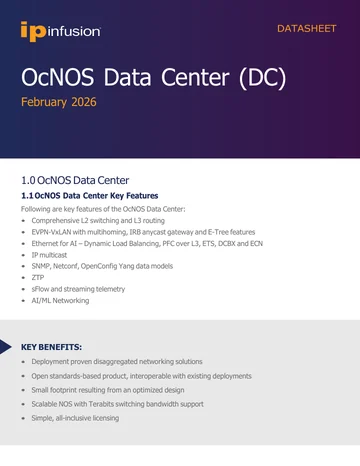
OcNOS-DC Datasheet
Full OcNOS-DC specification: the EVPN-VXLAN and Ethernet for AI feature set, software SKUs, supported hardware platforms, and the solution ordering guide.
Get the datasheet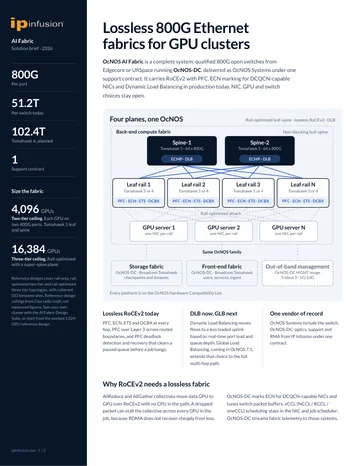
OcNOS 800G Lossless AI Fabric
Lossless RoCEv2 fabric on Tomahawk 5 spines: SKU tiers, qualified platforms, and deployment architecture.
Get the briefOcNOS-DC Datasheet
Quick form. Your PDF opens in a new tab immediately after submit.
✓ Opening your PDF in a new tab…
If it didn't open, use the link below.
OcNOS 800G Lossless AI Fabric
Quick form. Your PDF opens in a new tab immediately after submit.
✓ Opening your PDF in a new tab…
If it didn't open, use the link below.