Networks for neocloud and GPU cloud operators
IP Infusion delivers the networks a GPU cloud runs on: OcNOS-DC on qualified switches for the lossless GPU fabric, the storage network, the tenant front-end and out-of-band management, under one support contract.
One GPU server, four networks
A GPU cloud connects every server to four networks: the GPU back-end fabric, storage, the tenant front-end and management. OcNOS-DC runs all four, so one team can operate one software family across the cloud.
Pick a network to see what it carries
GPU back-end. GPU collectives run on their own routed fabric. PFC and ECN over Layer 3 keep RoCEv2 traffic lossless, and dynamic load balancing moves flowlets to less-loaded uplinks. Tomahawk 5 switches carry 64 × 800G.
Storage. Storage traffic gets its own network, kept lossless with PFC and ECN. Where storage shares an EVPN-VXLAN fabric, PFC and ECN also run over VXLAN on supported switches.
Front-end. Customers reach their GPUs through the front-end network. EVPN-VXLAN gives each tenant its own VRF and VNIs, with MAC limits and route-target filtering, on supported Trident 3 and Trident 4 switches.
Management. Out-of-band management runs on 1G switches with a management VRF and zero touch provisioning, so management traffic stays off the production networks.
Illustrative.
Training and inference ask different things of the network
Neoclouds serve both. Training fills a few large clusters with steady, synchronized traffic. Inference traffic spans many sites and arrives in bursts.
| What the network sees | Trainingthe AI factory | Inferencethe real-time service |
|---|---|---|
| Footprint | A few large GPU clusters | Many regional and edge sites |
| Traffic | Bulk, synchronized GPU-to-GPU collectives | Small, latency-critical requests |
| Load profile | Sustained, near full GPU utilization for long runs | Bursty and elastic, spikes in seconds |
| The network has to be | Lossless under sustained bandwidth | Low-latency and redundant at every layer |
What OcNOS-DC runs in a GPU cloud
The features each network relies on, from the OcNOS Feature Matrix.
| Capability | What it does | Where |
|---|---|---|
| PFC and ECN over Layer 3 | Lossless RoCEv2 across a routed fabric, with ETS between traffic classes | All OcNOS-DC |
| Dynamic load balancing | Moves flowlets to less-loaded uplinks | Selected switches |
| PFC deadlock detection and recovery | Detects a stalled priority queue and recovers it | Selected switches |
| EVPN-VXLAN | Layer 2 EVPN over VXLAN, with a VRF and VNIs per tenant | Trident 3 and 4 |
| Tenant limits | MAC limits per tenant and route-target filtering | Selected switches |
| PFC and ECN over VXLAN | Lossless storage traffic on an EVPN-VXLAN fabric | Selected switches |
| MLAG and EVPN multihoming | MLAG in active/active mode; EVPN in single-active or port-active mode | Selected switches |
| Coherent optics in the switch | 400G and 800G ZR and OpenZR+ links between sites | Selected switches |
| Management VRF and ZTP | Out-of-band management and zero touch provisioning | All OcNOS-DC |
Support varies by switch model and license. Check the OcNOS Feature Matrix.
Switches by network
Each network uses a switch suited to its traffic, all running OcNOS-DC.
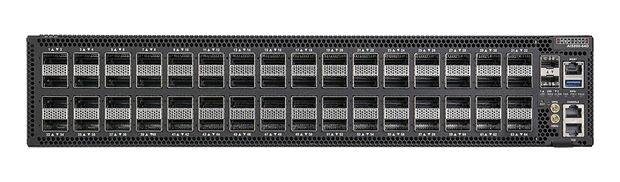
GPU fabric spine and leaf
Edgecore AIS800-64D
Tomahawk 5 · 51.2 Tbps
64 × 800G
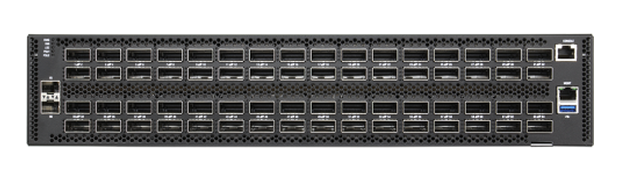
400G GPU rail leaf
Edgecore AS9736-64D
Tomahawk 4 · 25.6 Tbps
64 × 400G
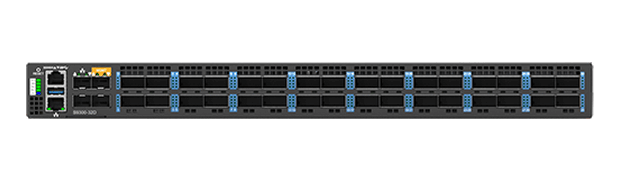
Front-end and storage leaf
UfiSpace S9300-32D
Trident 4 · 12.8 Tbps
32 × 400G
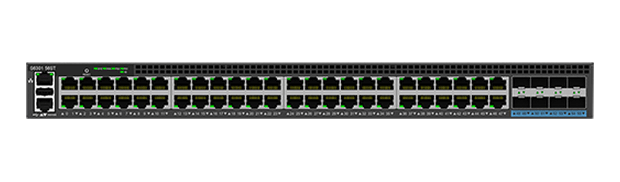
Out-of-band management
UfiSpace S6301-56ST
Trident 3 · 120 Gbps
48 × 1G, 8 × 10G
OcNOS on open switches carries the AI fabric at 40 to 60% lower hardware cost than proprietary platforms at comparable port speeds and radix. See how the lossless AI fabric works. See the full list of qualified switches on the OcNOS Hardware Compatibility List.
Operators running OcNOS in the data center
IzarLink
An EVPN-VXLAN core that aggregates 25G access into a redundant 100G core and interconnects its data centers and peering locations.
Read the story →Nextlink Internet
OcNOS-DC for core data center operations and OcNOS-SP for middle-mile transport, on Edgecore hardware across 11 states.
Read the story →Scott Data
OcNOS runs on UfiSpace, Edgecore and Celestica hardware across a Tier III certified data center campus with colocation services.
Read the story →“IP Infusion OcNOS provided the technical depth and improved network economics that enabled us to timely upgrade our data center core with future-proof scale, security, and resilience.”
Alexis Guirlé, CEO of IzarLink
Questions about neocloud networking.
What network do neocloud and GPU cloud providers need for AI?
Can one platform support both AI training and inference?
How do GPU clouds keep customers isolated?
How does the fabric keep inference available when a link or switch fails?
How do I evaluate network vendors for AI training and inference?
How does a neocloud connect its sites?
Datasheet and solution briefs.
The OcNOS-DC datasheet and two briefs to share with your team. Quick form, and the PDF downloads immediately.
OcNOS 800G Lossless AI Fabric
Lossless RoCEv2 fabric on Tomahawk 5 spines: SKU tiers, qualified platforms, and deployment architecture.
Get the briefEVPN-VXLAN Data Center Fabric
Leaf-spine data center fabric on EVPN-VXLAN: a VRF and VNIs per tenant, EVPN multihoming, BGP unnumbered and route-target filtering.
Get the briefOcNOS-DC Datasheet
Full OcNOS-DC specification: the EVPN-VXLAN and Ethernet for AI feature set, software SKUs, supported hardware platforms, and the solution ordering guide.
Get the datasheetOcNOS 800G Lossless AI Fabric
Quick form. Your PDF opens in a new tab immediately after submit.
✓ Opening your PDF in a new tab…
If it didn't open, use the link below.
EVPN-VXLAN Data Center Fabric
Quick form. Your PDF opens in a new tab immediately after submit.
✓ Opening your PDF in a new tab…
If it didn't open, use the link below.
OcNOS-DC Datasheet
Quick form. Your PDF opens in a new tab immediately after submit.
✓ Opening your PDF in a new tab…
If it didn't open, use the link below.
Plan your GPU cloud network.
Tell us your GPU scale, tenants and sites. An IP Infusion engineer will map each network to qualified switches.
Would you like us to reach out?
Leave your details and an IP Infusion engineer will help you design one open fabric for AI training and inference. We'll only be in touch if you'd like us to.