
Broadband aggregation on the open hardware you choose.
The broadband aggregation router carries FTTx, PON, WISP, and fixed-wireless subscriber traffic from the OLT and tower edge back to the IP core. IP Infusion delivers it complete on validated open Edgecore or UfiSpace hardware with OcNOS-SP, per-subscriber shaping, deep-buffer silicon for PON microbursts, and an SR-MPLS middle mile, supported under one contract.
Operators aggregating broadband on complete open routers.
Rural ISPs, WISPs, and municipal operators aggregate broadband on complete open routers in production today, across the FTTx, WISP, MDU, and middle-mile scenarios.
“OcNOS and UfiSpace hardware provided the perfect balance of price, performance, and availability for our rural broadband expansion. RocNet’s expertise and hands-on support made the transition seamless, and the solution’s rich feature set ensures we can meet the needs of our communities.” TJ Scott, Chief Operating Officer and General Manager, Broadlinc
OcNOS-SP runs in production in 600+ operator networks across 60+ countries, on a routing stack with 26 years of production history.
Where broadband aggregation sits in the network.
The aggregation router sits between the subscriber edge and the IP core. It carries FTTx and PON traffic from the OLT and WISP and fixed-wireless traffic from the tower, shapes each subscriber service, and hands it to the SR-MPLS middle mile toward the core and the internet edge.
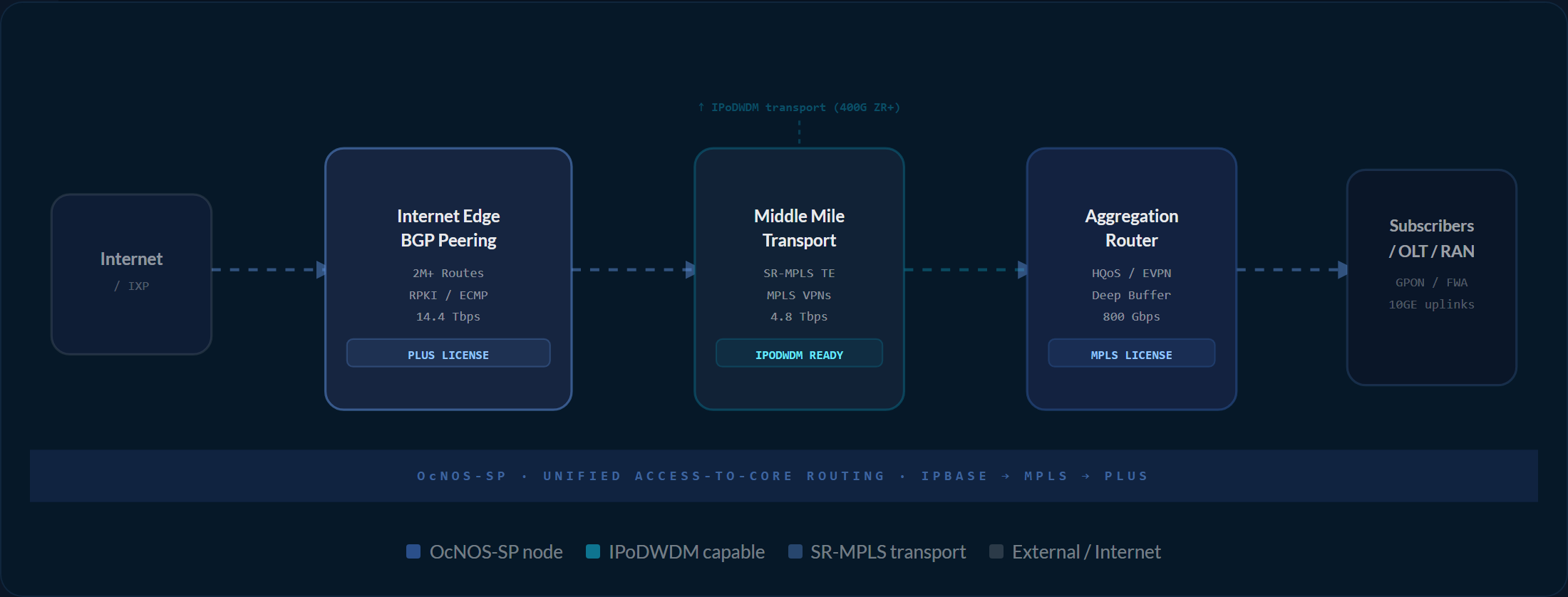
Open the vector view to hover each node for role and protocol details.
The aggregation router carries four access scenarios. Each is a standalone build the same router image supports, licensed and sized per access edge.
OLT-uplink aggregation
The router aggregates FTTx and XGS-PON traffic on the OLT uplink, applying per-service VLAN shaping so each subscriber service is shaped, with deep-buffer silicon absorbing PON microbursts. DIGI runs OcNOS for OLT aggregation.
Tower and POP aggregation
A WISP keeps forwarding even when one backhaul path degrades. The router concentrates each tower’s fixed-wireless traffic into the POP, load-shares the POP-to-core uplinks with SR ECMP, and detects a failing backhaul in milliseconds with BFD. For the 5G-FWA angle, see mobile transport.
Middle-mile handoff
The router carries rural and municipal traffic over an SR-MPLS middle mile that reroutes around a failed link in the data plane. For routed-optical 400G ZR and ZR+ links, see the IPoDWDM solution.
Peering handoff
At the internet edge the aggregation router hands off to the peering layer. The full internet BGP table, transit, and peering are the IP core and peering solution.
Shape subscriber traffic on the OLT uplink.
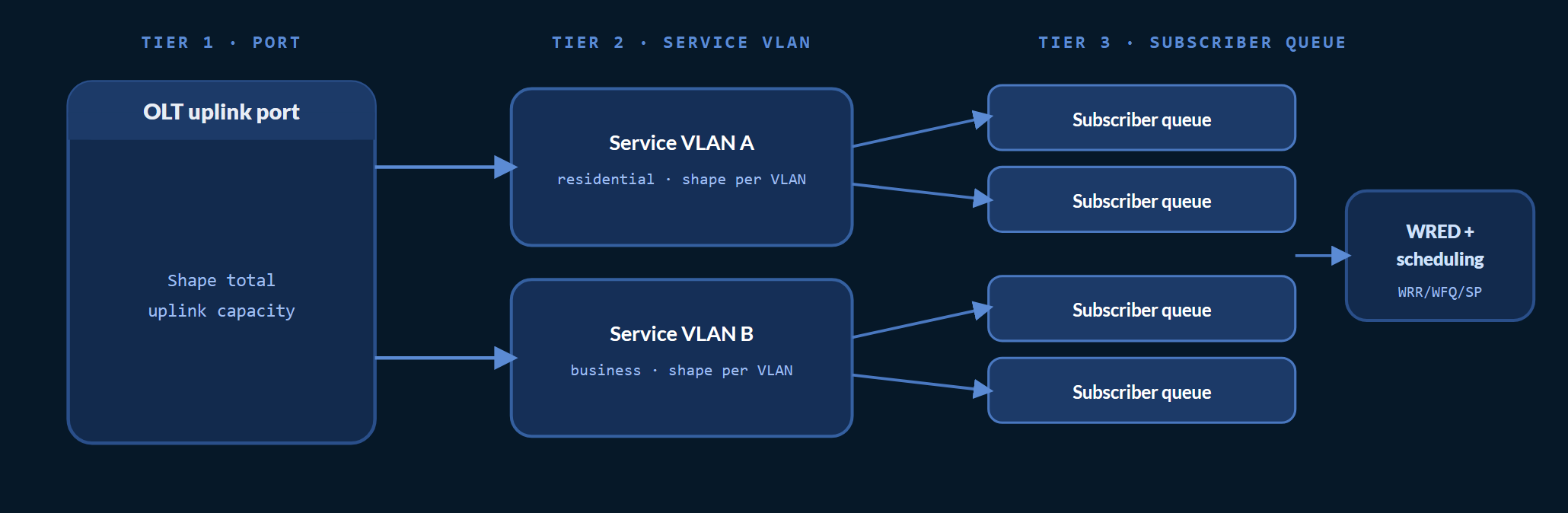
The router shapes traffic in three tiers on the OLT uplink: the physical port, each service VLAN, and each subscriber queue inside the VLAN. OcNOS-SP handles the shaping and scheduling, and the deep-buffer merchant silicon absorbs PON microbursts between tiers.
Three tiers of shaping on one OLT uplink.
Shaping nests in three tiers on the aggregation router: the physical port sets total uplink capacity, each service VLAN under it is shaped, and each subscriber queue inside a VLAN is shaped and scheduled.
Per-port and per-service VLAN shaping
The router applies per-queue and per-port shaping on the uplink, then per-service VLAN shaping that maps services to VLANs and shapes each VLAN, so a residential, business, or wholesale service each gets its committed rate.
WRED and per-queue scheduling
Latency-sensitive subscriber traffic keeps its priority even when the uplink is congested. Weighted Random Early Detection (WRED) eases congestion before the buffer fills, and the router schedules each subscriber queue with WRR, WFQ, or strict priority, so voice and interactive sessions stay ahead of bulk traffic under load.
Deep-buffer silicon for PON bursts
The aggregation tier uses deep-buffer merchant silicon from the Jericho and Qumran class, so the bursty upstream traffic of GPON and XGS-PON subscribers is absorbed rather than dropped when many subscribers transmit at once.
QoS as a single policy on the router
One shaping design covers every service, however it arrives at the router. Layer 2 and Layer 3 QoS, subinterface QoS, and class-map statistics share one consistent policy model, so a service on a VLAN, a subinterface, or a routed port is shaped the same way.
Match the shaping and QoS features to your hardware in the feature matrix →
Aggregation capabilities, each in the feature matrix.
One router carries the whole subscriber edge into the core, so there is no separate box per access type. It aggregates over EVPN-VXLAN and MPLS pseudowires, hands off to an SR-MPLS middle mile, and keeps WISP and FWA backhaul resilient. Every capability below is verifiable in the feature matrix, and the bare metro aggregation and L3-switch role is the metro Ethernet solution.
EVPN-VXLAN and MPLS aggregation
Every subscriber service rides one aggregation fabric back to the core, whatever the access edge. The router folds FTTx, OLT, and tower uplinks into EVPN-VXLAN or MPLS L2/L3 pseudowires (VPLS, VPWS, L3VPN) toward the core. See EVPN, or the bare metro aggregation and L3-switch role in metro Ethernet.
Handoff to the SR-MPLS middle mile
The aggregated subscriber traffic hands off to an SR-MPLS middle mile that carries it to the core with fast, data-plane failure recovery. The middle-mile transport is covered below.
WISP and FWA backhaul resilience
A WISP or fixed-wireless network keeps forwarding when one backhaul path degrades. SR ECMP load-shares across multiple tower and POP uplinks, BFD detects a failing path in milliseconds, and VRRP with graceful restart holds the gateway up. BGP here is WISP and FWA multi-uplink only; the full internet BGP table is the IP core and peering layer.
Concentrate every tower into the POP
Each tower backhauls its fixed-wireless subscribers to the POP, and the aggregation router concentrates those tower feeds onto the POP-to-core uplinks. The same router image and QoS design carries a WISP POP that carries an FTTx OLT site, so an operator running both access types builds on one platform.
ECMP across uplinks, BFD on each path
SR ECMP spreads the POP-to-core traffic across every available uplink rather than pinning it to one, and BFD (single-hop, multi-hop, and over IS-IS, OSPF, and BGP) watches each path so a degraded backhaul is detected and steered around in milliseconds. Celerity and WispWest upgraded a MikroTik and Juniper network to OcNOS-SP on UfiSpace across three states this way.
| Access scenario | Role the router plays | Owned capability | Platform tier |
|---|---|---|---|
| FTTx / XGS-PON | OLT uplink aggregation | Per-service VLAN shaping, deep-buffer silicon | Edgecore / UfiSpace aggregation tier |
| WISP / FWA | Tower / POP aggregation | SR ECMP multi-uplink, BFD | Edgecore / UfiSpace |
| Municipal / rural | Middle-mile handoff | SR-MPLS middle-mile transport (details →) | UfiSpace S9500-22XST / S9600-56DX or Edgecore CSR310 / AGR400 |
| ISP internet edge | Peering handoff | See IP core & peering (details →) | Owned by IP core & peering |
Juniper, MikroTik, and other names are trademarks of their respective owners. IP Infusion is not affiliated with or endorsed by them. Match each capability to hardware in the feature matrix.
Reach rural and municipal subscribers over open middle-mile transport.
The router runs an SR-MPLS middle mile with TI-LFA fast reroute, so a rural or municipal build carries subscriber traffic to the core with data-plane recovery. Broadlinc runs this pattern on OcNOS-SP MPLS and UfiSpace for a rural fixed-wireless build in Kentucky.
SR-MPLS with sub-50ms TI-LFA
IS-IS with SR extensions carries the aggregated subscriber traffic to the core, and TI-LFA precomputes a loop-free backup path so a middle-mile link failure reroutes in under 50ms. For routed-optical 400G ZR and ZR+ links, see IPoDWDM.
Open supply chain for funded builds
A rural or federally funded operator can source the aggregation router from more than one US-compatible open vendor, Edgecore or UfiSpace, so a build is not tied to one vendor’s supply chain or lead times. The hardware and the OcNOS-SP software refresh on independent cycles.
Grow licensing as subscribers connect
OcNOS-SP licensing steps up from IPBASE to MPLS to PLUS as a network adds MPLS and more services, with no hardware swap, so a small ISP starts light and grows the router in place as subscriber counts rise.
Open platforms, one supported system
IP Infusion validates, pre-loads, and supports the router as one system across a wide set of open platforms, so a funded build ships as a supported combination rather than a self-integration project. This is the service provider networks approach at the access edge.
Size the aggregation router to the access edge.
IP Infusion delivers the aggregation router on 43 validated platforms from Edgecore and UfiSpace, each lab-qualified per ASIC stepping with OcNOS-SP pre-loaded. A WISP or rural POP sizes on a compact tier; regional FTTx and converged metro aggregation size up on capacity and deep-buffer silicon.
| Access tier | Validated router | Silicon and capacity | Why it fits the tier |
|---|---|---|---|
| WISP / rural POP |  UfiSpace S9500-22XST UfiSpace S9500-22XST |
Broadcom Qumran AX (BCM88470), 300 Gbps, temperature-hardened | Compact, temperature-hardened aggregation for a tower, POP, or rural cabinet where space and environment are constrained. |
| WISP / rural POP | 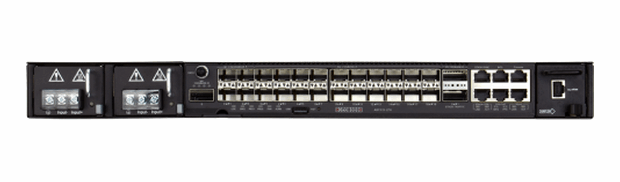 Edgecore AS7315-27X (CSR310) Edgecore AS7315-27X (CSR310) |
Broadcom Qumran AX (BCM88470), 300 Gbps, 20×10G + 4×25G + 3×100G | The Edgecore compact aggregation router on the same Qumran AX silicon for a POP or rural cabinet. |
| Regional FTTx / OLT aggregation | 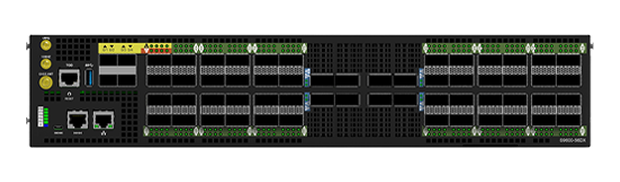 UfiSpace S9600-56DX UfiSpace S9600-56DX |
Broadcom Qumran 2C (BCM88820), 4.8 Tbps, 8×400G + 48×100G | Aggregates many OLT uplinks with 400G to the core. Also the metro aggregation tier, see metro Ethernet. |
| Regional FTTx / OLT aggregation | 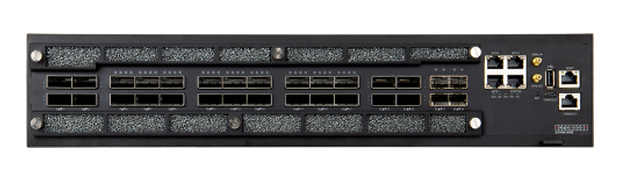 Edgecore AS7946-30XB (AGR400) Edgecore AS7946-30XB (AGR400) |
Broadcom Qumran 2C (BCM88820), 2.4 Tbps, 4×400G + 22×100G | The Edgecore Qumran 2C aggregation router with 400G handoff to the core, for regional FTTx and OLT sites. |
| Converged metro aggregation | 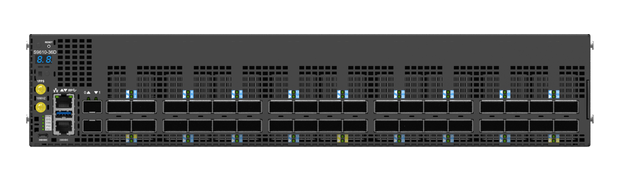 UfiSpace S9610-36D UfiSpace S9610-36D |
Broadcom Jericho2C+ (BCM88850), 14.4 Tbps, 36×400G, deep-buffer silicon | Highest capacity with deep-buffer silicon for PON microbursts and redundant hot-swappable power and fans for a converged aggregation site. |
| Converged metro aggregation | 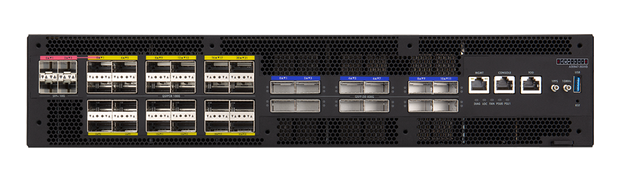 Edgecore AS9947-36XKB (AGR560) Edgecore AS9947-36XKB (AGR560) |
Broadcom Jericho2C+ (BCM88850), 7.2 Tbps, 12×400G + 24×100G, deep-buffer silicon | The Edgecore deep-buffer aggregation router on the same Jericho2C+ silicon for a converged metro site. |
See every validated platform in the hardware compatibility list, and match features to hardware in the feature matrix.
How to size the aggregation router
- Small ISP or WISP POP. Size a compact 300 Gbps tier for a tower, POP, or rural cabinet, temperature-hardened where the environment calls for it.
- Regional FTTx and OLT aggregation. Size the 4.8 Tbps tier to aggregate many OLT uplinks with 400G handoff to the core.
- Converged metro aggregation. Size the 14.4 Tbps tier with deep-buffer silicon where PON microbursts and multiple access types converge on one site.
- Grow licensing in place. Start on IPBASE and step up to MPLS and PLUS as the network adds services, with no hardware swap.
- One contract. IP Infusion validates, pre-loads, and supports the router as one system, and the hardware and software refresh on independent cycles.
Shape a subscriber service on the uplink.
Shaping a subscriber service follows one pattern on the router: classify the service, set a shaped rate and a scheduler in a policy, then apply the policy to the uplink. The skeleton below shows the shape of that policy; use the exact commands and options for your release from the OcNOS-SP QoS guide.
! Representative OcNOS-SP queuing policy for Qumran deep-buffer platforms.
! Queue ids, rates and thresholds vary by platform and release.
! 1. Classify the subscriber service by its egress queue
class-map type queuing subscriber-service
 match queue <queue-id>
! 2. Shape that service
policy-map type queuing shape-subscriber
 class type queuing subscriber-service
  shape <committed-rate> mbps
! 3. Apply the policy to the OLT uplink in the output direction
interface <uplink>
 service-policy type queuing output shape-subscriber
What each step does
- Classify. A queuing
class-mapselects the subscriber service by its egress queue withmatch queue, so each service can be shaped on its own. Classes can also match oncosorvlan. - Shape. A queuing
policy-mapsets the shaped rate for that class withshape, in kbps, mbps or gbps. - Apply. A
service-policy type queuing outputbinds the policy to the OLT uplink in the output direction, so every subscriber service on that port is shaped as designed. - Per-service VLAN. Repeat the class and policy per service VLAN to shape residential, business, and wholesale traffic independently on the same uplink.
- Congestion avoidance and scheduling. On the port default queuing policy, WRED is set per queue with
random-detect <min> mbytes <max> mbytes drop-probability <percent>, and strict-priority scheduling withpriority level <0-7>.
These commands follow the OcNOS-SP 7.0 QoS Configuration Guide. Queue ids, rates, thresholds and the number of supported queues vary by platform and release; confirm the exact form for your platform at documentation.ipinfusion.com. For how policing, shaping, WRED and hierarchical QoS work, see QoS and traffic management.
Modernize a legacy L2 ring to IP/MPLS.
You phase an installed Layer 2 ring onto IP/MPLS and EVPN-VXLAN on open hardware, interoperating with the installed network so subscriber services keep running during the cutover. Race Communications is migrating an L2 ring to IP/MPLS on OcNOS this way.
Join the installed ring
A new open aggregation router forms standards-based adjacencies with the installed network, so it participates in the existing ring without a redesign. Race chose OcNOS for the robust protocol implementations its network already relied on.
Add EVPN-VXLAN and MPLS transport
The router adds EVPN-VXLAN and MPLS L2/L3 transport alongside the legacy L2 ring, so new services ride IP/MPLS while the installed ring keeps carrying its traffic. The two coexist through the transition.
Convert the ring segment by segment
Convert each ring segment to IP/MPLS in turn, validating each before it carries production subscriber traffic. Graceful restart and TI-LFA keep services forwarding through each swap, and IP Infusion supports the router at every step.
Cisco IOS-XR to OcNOS CLI translation assistance is available to speed configuration conversion during a migration.
Open broadband aggregation router vs a proprietary chassis.
Operators ask whether an open box can shape subscriber traffic as cleanly as a proprietary edge chassis. It can, with per-service-VLAN hierarchical QoS at aggregation scale, aggregation transport, and middle-mile reroute, and the hardware comes from more than one vendor on one support contract.
| Capability / model | Open aggregation router (OcNOS-SP) | Proprietary chassis (Cisco / Juniper / Nokia) |
|---|---|---|
| Per-subscriber / per-service shaping | Per-queue, per-port and per-service-VLAN shaping, WRED, WRR/WFQ/SP | Vendor-specific QoS, vendor hardware |
| PON microburst absorption | Deep-buffer Jericho / Qumran merchant silicon | Vendor buffer, vendor pricing |
| Aggregation transport | EVPN-VXLAN and MPLS L2/L3 (VPLS / VPWS / L3VPN) | Proprietary equivalents |
| Middle-mile transport | SR-MPLS with sub-50ms TI-LFA | Proprietary SR / MPLS |
| WISP / FWA backhaul | SR ECMP multi-uplink, BFD, VRRP, graceful restart | Vendor equivalents |
| Hardware sourcing | 43 validated Edgecore / UfiSpace platforms, refresh independently | Single-vendor chassis and lifecycle |
| Licensing | Progressive IPBASE to MPLS to PLUS, no hardware swap | Vendor licensing bundles |
| Support model | One vendor owns software, hardware, and RMA under one contract | Separate NOS and hardware vendors, or one closed stack |
Cisco, IOS-XR, Cisco 8000, Juniper, Junos, Nokia, and SR OS are trademarks of their respective owners. IP Infusion is not affiliated with and does not endorse these vendors; the comparison reflects OcNOS-SP capabilities verifiable in the feature matrix. Subscriber termination is out of scope; see the BNG question in the FAQ below.
Datasheet and solution brief.
The OcNOS-SP datasheet and the SR-MPLS upgrade brief to share with your team. Quick form, and the PDF downloads immediately.
Questions an ISP architect asks.
Put the aggregation router on your own hardware.
Download the OcNOS VM and validate the broadband aggregation features you need on the hardware you choose.
OcNOS-SP Datasheet
Quick form. Your PDF will download immediately after submit.
✓ Opening your PDF in a new tab.
If it did not open, use the link below.
SR-MPLS Upgrade with OcNOS
Quick form. Your PDF will download immediately after submit.
✓ Opening your PDF in a new tab.
If it did not open, use the link below.
Related from the blog
Why Service Providers Are Deploying Open Networking: 5 Drivers
Operator-side business case for building broadband aggregation on open disaggregated routers
Read the post →Segment Routing: SR-MPLS and SRv6 in the Core
SR-MPLS is the middle-mile transport that carries aggregated broadband traffic to the core
Read the post →