
Segment Routing MPLS
Source-initiated traffic engineering on an MPLS data plane. No RSVP-TE state, no per-LSP signaling overhead: just a label stack computed at the head-end from a distributed topology database.
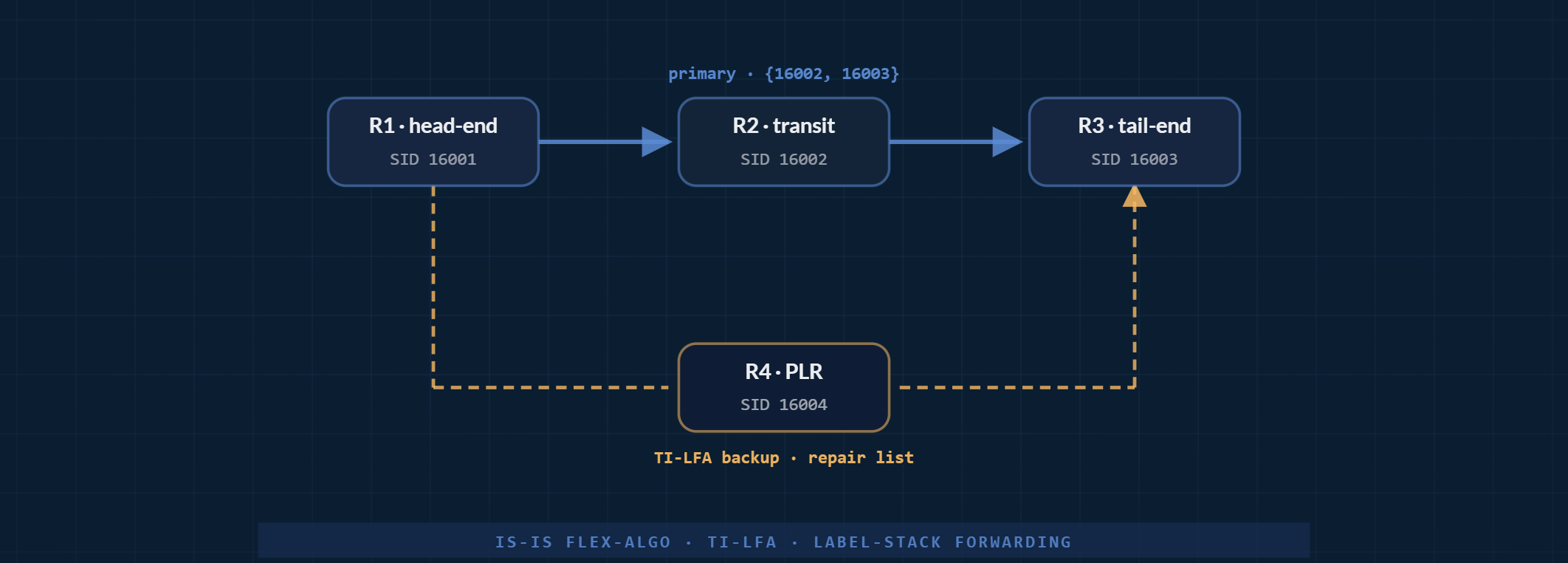
SR-MPLS Underlay with TI-LFA
Four routers in a ring. The primary path between R1 and R3 takes the upper hop; if R2 fails, TI-LFA pre-programs a repair label stack via R4.
What SR-MPLS Is
Segment Routing (SR), defined in RFC 8402, distributes a set of topological instructions, segments, through standard IGP extensions (IS-IS: RFC 8667, OSPF: RFC 8665). Each segment is represented as an MPLS label. The head-end router imposes a label stack that encodes the complete explicit path; no per-LSP signaling state is maintained at midpoints.
The result is a simplified data plane: transit nodes perform standard MPLS forwarding with no RSVP adjacency databases, no LDP FECs per prefix, and no optical-style path setup latency. All traffic engineering intelligence moves to the source, enabling policies per flow class, per VPN, or per application without control-plane churn.
SR-MPLS coexists with and progressively replaces LDP in brownfield cores. RFC 8661 defines LDP-SR interworking so operators can migrate incrementally: SR-capable nodes advertise both SR SIDs and LDP labels, enabling end-to-end LSPs across mixed networks without a flag-day cutover.
Fast Reroute: TI-LFA
Topology-Independent Loop-Free Alternate (TI-LFA, RFC 9855) computes pre-programmed backup paths that are loop-free by construction, without the coverage gaps of classic LFA. TI-LFA protects node, link, and SRLG failures: the backup path is encoded as a repair segment list pushed at the PLR before the primary path is removed from the forwarding table.
Flexible Algorithm (Flex-Algo)
IGP Flexible Algorithm (RFC 9350) lets one physical topology carry several logical planes. Each Flex-Algo definition sets a metric type, IGP cost, minimum unidirectional link delay, or TE metric, plus a set of link constraints, and the IGP computes shortest paths under those rules. OcNOS-SP advertises each algorithm through IS-IS SR, and every prefix-SID resolves per algorithm, so traffic follows the low-delay or affinity-limited plane natively. A latency-sensitive service and a best-effort service ride the same links on different planes with no SR-TE policy and no external controller.
Flex-Algo and TI-LFA work together. The fast-reroute backup for a prefix is computed inside the same algorithm as the primary path, so a delay-optimized flow reroutes onto another low-delay path rather than dropping back to the default shortest path.
OcNOS-SP Implementation
OcNOS-SP implements SR-MPLS across the Broadcom Qumran and Jericho service-provider silicon families, from Qumran2a and Qumran2u compact edge platforms through Qumran2c and Qumran2c+ aggregation to Jericho2c+ core routers. The implementation covers the full SP edge and core feature set:
Control Plane: IS-IS SR
IS-IS with SR extensions (RFC 8667). Node SID, Adjacency SID, Anycast SID. Prefix-SID advertisement with N and P flags. Flexible Algorithms (RFC 9350) for topology-aware SID assignment.
Traffic Engineering: SR-TE
SR-TE policies with explicit segment lists. Head-end steering by color + endpoint. PCE-delegated path computation via PCEP (RFC 8231). ODN (On-Demand Next-hop) for automatic SLA-aware path selection.
Fast Reroute: TI-LFA
TI-LFA enabled per interface. Protects node and link failures. Backup path pre-installed in hardware forwarding table.
ECMP & Load Balancing
SR ECMP over multiple next-hops with 5-tuple flow hashing. Equal-cost paths resolved per SID via MPLS forwarding table. Per-flow entropy label support for load-balance visibility.
LDP Interworking
RFC 8661 LDP-SR interworking for brownfield migration. Mapping server for prefix SID to LDP label binding. SR-LDP border node functionality: no flag-day core migration required.
BFD for SR
Segment Routing BFD (RFC 7880).
SRv6
OcNOS-SP PLUS has initial SRv6 support on selected routers, with more in development. The Feature Matrix lists SRv6 coverage per router.
OcNOS-Qualified Hardware
For reference only. The platforms below are a representative subset of SR-MPLS-qualified hardware. The complete, current list of qualified platforms, with ASIC, port density, and version coverage, is maintained in the OcNOS Hardware Compatibility List.
Related Technologies & Solutions
Compare SR-MPLS support across all OcNOS-qualified platforms
Open Feature Matrix →Frequently asked questions
What is SR-MPLS?
How does SR-MPLS use IS-IS or OSPF?
What is the SRGB in SR-MPLS?
What is the difference between SR-MPLS and SRv6?
Does SR-MPLS still need LDP?
How is SR-MPLS different from traditional MPLS with LDP or RSVP-TE?
What is IS-IS segment routing?
What is TI-LFA in SR-MPLS?
What is Flex-Algo (IGP Flexible Algorithm)?
Can EVPN run over SR-MPLS?
Go deeper. Take it with you.
The product datasheet plus short, technical downloads that go further than this page.
OcNOS-SP Datasheet
Full OcNOS-SP specification: the access, cell site and aggregation feature set, software SKUs, supported hardware platforms, and the solution ordering guide.
Get the datasheetSR-MPLS Upgrade with OcNOS
Migrate SR-MPLS onto OcNOS on open hardware: Flex-Algo, TI-LFA, and a node-by-node cutover path.
Get the briefCloud & Service Provider WAN Transport
Cloud and service-provider WAN transport on open hardware: SR-MPLS, EVPN, and scale-tested forwarding.
Get the briefOcNOS-SP Datasheet
Quick form. Your PDF opens in a new tab immediately after submit.
✓ Opening your PDF in a new tab…
If it didn't open, use the link below.
SR-MPLS Upgrade with OcNOS
Quick form. Your PDF opens in a new tab immediately after submit.
✓ Opening your PDF in a new tab…
If it didn't open, use the link below.
Cloud & Service Provider WAN Transport
Quick form. Your PDF opens in a new tab immediately after submit.
✓ Opening your PDF in a new tab…
If it didn't open, use the link below.