400G routed optical, with coherent optics in the router port
IP Infusion delivers the complete routed-optical router: OcNOS-SP preloaded on qualified routers that carry 100G and 400G coherent optics in the faceplate. The router lights its own DWDM wavelength, removing the need for a transponder shelf, while one CLI runs the routing and the optics under one support contract. Open hardware keeps the platform and the optics your choice.
What routed optical removes
In a classic DWDM build the router hands a grey client signal to a transponder shelf, and the transponder lights the wavelength. In routed optical, a coherent 100G or 400G optic sits in the router port and lights the wavelength itself. The transponder shelf comes out; the ROADM and EDFA line system stays as it is.
The same DWDM link, two ways to light it
4 boxes on the link
Each site runs a router and a transponder shelf, connected by a grey client optic.
2 boxes on the link
Each router lights its own wavelength over the same ROADM and EDFA line system, managed from the routing CLI.
Illustrative.
Operators running open 400G routed optical.
Regional and Tier-1 operators moved metro and backbone transport to open 400G IPoDWDM, collapsing the IP and optical layers onto the router. IP Infusion is in production with 900+ operators across 60+ countries since 1999.
“The shift to an open, OcNOS-driven 400G IPoDWDM backbone gives us the control, visibility, and operational efficiency we need to keep our services consistently stable and ahead of demand.” Christoph Ehmayer, Team Lead Network/System Engineer, eww ITandTEL
From 100G ZR to 400G OpenZR+: choosing the coherent pluggable.
Pick the 100G QSFP28 ZR optic for a single-wavelength 100G span in the smaller form factor. Pick OIF 400ZR when the span is a short amplified point-to-point link and you want the simplest fixed 400G optic. Pick OpenZR+ when the wavelength has to cross a ROADM as an alien wavelength or reach further, or when you want one multirate optic that carries 100G through 400G. To the router all three are pluggables managed from the same CLI.
| Attribute | 100G QSFP28 ZR | OIF 400ZR | OpenZR+ |
|---|---|---|---|
| Data rate | 100G | 400G | 100 / 200 / 300 / 400G |
| Form factor | QSFP28 | QSFP-DD | QSFP-DD |
| Modulation | Coherent DP-QPSK | DP-16QAM (fixed) | Selectable 16QAM / 8QAM / QPSK |
| FEC | Coherent FEC | cFEC | oFEC |
| Client signals | 100GbE, OTU4 | 400GbE, 100GbE | 100 / 200 / 400GbE, OTU4, OTUCn / FlexO |
| Reach class | Amplified single-span | Short-reach amplified | Long amplified |
| Line-system model | Point-to-point, fixed grid | Point-to-point | ROADM / alien wavelength |
| OcNOS-SP management | Same routing CLI | Same routing CLI | Same routing CLI |
OpenZR+ and 400ZR are MSA and OIF specifications. Reach is stated as a qualitative class.
Coherent transceivers with proven interoperability from multiple vendors.
OcNOS-SP has proven interoperability with 100G QSFP28 ZR and 400G OpenZR+ / OIF 400ZR coherent optics from more than one vendor, so the pluggable stays a competitive purchase rather than a single-source part.





The routed-optical router, sized to the ring
Qualified routers with coherent optics in the faceplate, OcNOS-SP preloaded, under one support contract.
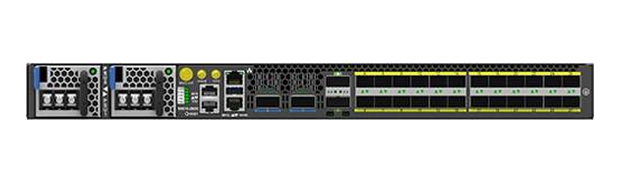
Cell site router
UfiSpace S9510-28DC
Qumran 2A · 800 Gbps
24 × 25G, 2 × 100G, 2 × 400G
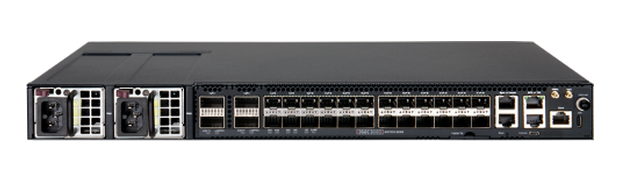
Aggregation edge
Edgecore AS7535-28XB (CSR440)
Qumran 2A · 800 Gbps
24 × 25G, 2 × 100G, 2 × 400G
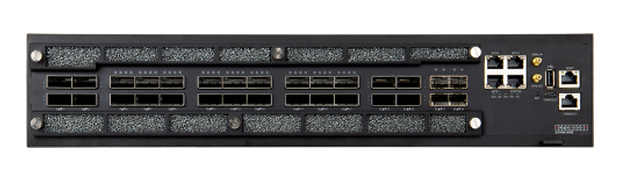
Metro and core
Edgecore AS7946-30XB (AGR400)
Qumran 2C · 2.4 Tbps
4 × 25G, 22 × 100G, 4 × 400G
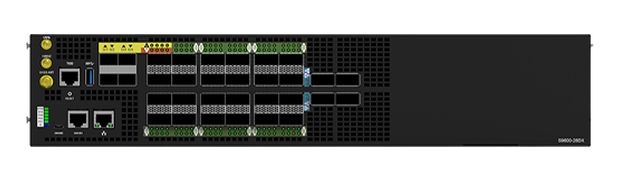
Metro and core
UfiSpace S9600-28DX
Qumran 2C · 2.4 Tbps
24 × 100G, 4 × 400G
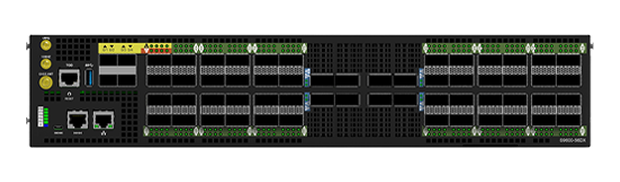
Metro edge
UfiSpace S9600-56DX
Qumran 2C · 4.8 Tbps
48 × 100G, 8 × 400G
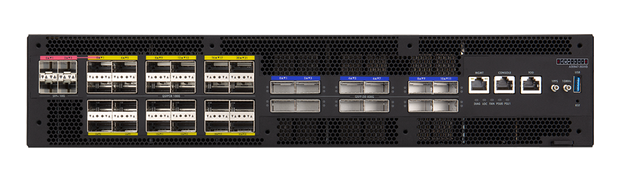
Core
Edgecore AGR560 (AS9947-36XKB)
Jericho2C+ · 7.2 Tbps
4 × 10G, 24 × 100G, 12 × 400G
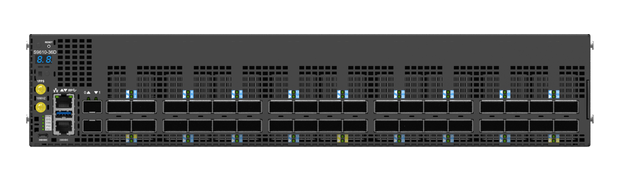
Core backbone
UfiSpace S9610-36D
Jericho2C+ · 14.4 Tbps
36 × 400G, 18 ZR+ capable
Data center interconnect on OcNOS-DC. 400G ZR and OpenZR+ run on the Edgecore AS9716-32D, AS9736-64D and AS9726-32DB and the UfiSpace S9300-32D, and 800G ZR runs on Tomahawk 5 with the Edgecore AIS800-64D and UfiSpace S9321-64E. See the data center fabric →
Coherent ports and 100G QSFP28 ZR support vary by model. Check coherent optics support per router in the OcNOS Feature Matrix. See every qualified platform in the hardware compatibility list.
Moving a wavelength from a transponder to the router.
The routed-optical router interoperates with the installed multi-vendor optical line system, so you add a coherent wavelength, cut a circuit over on your timeline, and retire the transponder shelf segment by segment.
Run alongside the installed transport
The routed-optical router interoperates with the existing multi-vendor optical line system, and the coherent wavelength is added as an alien wavelength. eww ITandTEL deployed 400G ZR+ circuits across a multi-vendor environment.
Move a circuit to a 400G wavelength
Move a 100G or legacy circuit to a 400G OpenZR+ wavelength on the router, on your own timeline. eww moved a 100G MPLS backbone to 400G IPoDWDM, and Adams Cable upgraded to a 400G network.
Retire the transponder shelf
Once circuits ride the router’s coherent optics, the standalone shelf is removed from that segment.
Datasheet, solution brief, and the webinar.
The IPoDWDM 400G OpenZR+ solution brief and the OcNOS-SP datasheet to share with your team, plus the on-demand webinar. The PDFs download after a quick form.
IPoDWDM with 400G OpenZR+
Routed optical on open hardware: choosing the coherent pluggable, what OcNOS-SP manages on the optic, and the routers, in two pages.
Get the briefOcNOS-SP Datasheet
The full OcNOS-SP overview: roles, protocols, coherent optics, and the qualified hardware, in one PDF.
Get the datasheetAI-Era Traffic: Fabrics and IP over DWDM
IP Infusion, RocNet Supply, and Smartoptics on Tier-1 style architecture for regional operators. Hosted by the Fiber Broadband Association.
Watch the webinarQuestions an optical architect asks.
Size routed optical for your metro.
See how IP Infusion delivers the routed-optical router complete, or contact us to map your metro ring to the right qualified platforms, coherent optics, and licensing.
IPoDWDM with 400G OpenZR+
Quick form. Your PDF will download immediately after submit.
✓ Opening your PDF in a new tab.
If it did not open, use the link below.
OcNOS-SP Datasheet
Quick form. Your PDF will download immediately after submit.
✓ Opening your PDF in a new tab.
If it did not open, use the link below.