
Routed optical on the open hardware you choose.
IP over DWDM (IPoDWDM) is a routed-optical architecture that seats a coherent pluggable optic directly in a router's QSFP-DD faceplate port, so a metro aggregation or edge router lights its own DWDM wavelength and the standalone transponder shelf is removed. OcNOS-SP manages 400G OpenZR+ and OIF 400ZR optics, including modulation, FEC, and optical monitoring, from the routing CLI over a third-party ROADM and EDFA line system.
Operators running open 400G routed optical.
Regional and Tier-1 operators moved metro and backbone transport to open 400G IPoDWDM, collapsing the IP and optical layers onto the router. OcNOS-SP runs in production across more than 600 operator networks in 60+ countries, on a routing stack with 26 years of development behind it.
"Der Wechsel zu einem offenen, OcNOS-gesteuerten 400G IPoDWDM-Backbone gibt uns die Kontrolle, Sichtbarkeit und operative Effizienz, die wir brauchen, um unsere Dienste durchgängig stabil und der Nachfrage immer einen Schritt voraus zu halten." Christoph Ehmayer, Team Lead Network/System Engineer, eww ITandTEL
The router lights its own wavelength over the metro ring.
On an OcNOS-SP router from IP Infusion, the operator seats a 400G OpenZR+ or OIF 400ZR coherent optic in a QSFP-DD faceplate port, and the router lights its own DWDM wavelength. That wavelength rides the operator's existing ROADM and EDFA line system as an alien wavelength, so the standalone transponder shelf comes out of the metro build and the router hands service traffic up to the PE at the ring edge.
Open the vector view to hover each node for role and optical detail.
Three stops define the routed-optical ring: the ring node, the line system it rides, and the PE handoff.
Routed-optical ring node
The OcNOS-SP router carries a 400G OpenZR+ or OIF 400ZR coherent optic in a QSFP-DD faceplate port, so the same box that routes the packet also lights its own DWDM wavelength.
Third-party ROADM and EDFA line system
The coherent wavelength rides the existing optical line system as an alien wavelength. OcNOS-SP reads the EDFA over digital diagnostic monitoring, and the line system stays a third-party choice.
PE handoff at the ring edge
At the ring edge, service traffic hands up to the provider edge and the IP core. The routed-optical ring carries the transport; the IP core spoke owns the PE role.
One box lights the wavelength and routes the packet.
A routed-optical router seats a 400G coherent pluggable in a QSFP-DD faceplate port, so the same box that routes the packet also lights the DWDM wavelength. The coherent wavelength rides your existing ROADM and EDFA line system as an alien wavelength, so the optical layer stays open and vendor-neutral.
The box carries the optic
The routed-optical router carries the 400G coherent pluggable itself, in a QSFP-DD faceplate port, so the same box that routes the packet lights its own DWDM wavelength. The optic is provisioned as part of the router.
Open over any line system
OcNOS-SP manages the pluggable and its tuning locally, and the wavelength runs as an alien wavelength across a third-party ROADM and EDFA line system.
OcNOS-SP reads the EDFA over digital diagnostic monitoring, so the optical layer stays open and vendor-neutral. EXATEL cites Open ZR+ interoperability that prevents optical lock-in.
The routed-optical link carries the transport under services such as MEF 3.0 Carrier Ethernet, delivered on the metro Ethernet spoke, within the wider service provider networks design.
OpenZR+ or OIF 400ZR: choosing the coherent pluggable.
Pick OIF 400ZR when the span is a short amplified point-to-point link and you want the simplest fixed optic. Pick OpenZR+ when the wavelength has to cross a ROADM as an alien wavelength or reach further, where selectable modulation and open FEC buy you the extra margin. To the router both are the same QSFP-DD pluggable managed from the same CLI.
| Attribut | OIF 400ZR | OpenZR+ |
|---|---|---|
| Data rate | 400G | 100 / 200 / 300 / 400G |
| Modulation | DP-16QAM (fixed) | Selectable 16QAM / 8QAM / QPSK |
| FEC | cFEC | oFEC |
| Reach class | Short-reach amplified | Long amplified |
| Line-system model | Point-to-point | ROADM / alien wavelength |
| OcNOS-SP management | Same routing CLI | Same routing CLI |
Cisco, Juniper, and Nokia are trademarks of their respective owners. IP Infusion is not affiliated with or endorsed by them. OpenZR+ and 400ZR are MSA and OIF specifications. Reach is stated as a qualitative class.
Coherent transceivers with proven interoperability from multiple vendors.
OcNOS-SP has proven interoperability with 400G OpenZR+ and OIF 400ZR coherent optics from more than one vendor, so the pluggable stays a competitive purchase rather than a single-source part.
The routed-optical router, sized to the ring.
IP Infusion delivers the routed-optical router complete: a validated open box with a 400G coherent faceplate, OcNOS-SP pre-loaded, supported under one contract, across 43 validated platforms.
| Router | Silicon | Kapazität | 400G coherent faceplate | Rolle |
|---|---|---|---|---|
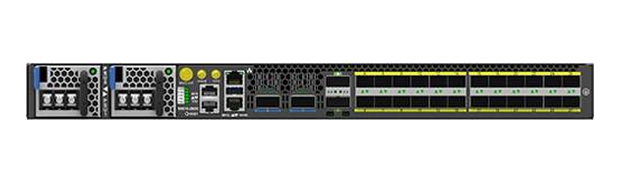 UfiSpace S9510-28DC UfiSpace S9510-28DC |
Qumran 2A (BCM88483) | 800 Gbps | 2×400G + 2×100G + 24×25G | Aggregation / IPoDWDM edge |
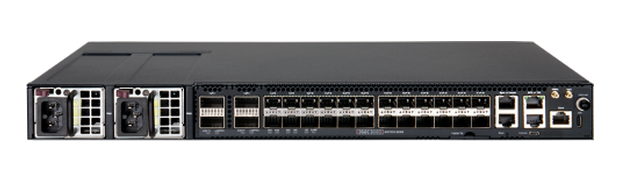 Edgecore AS7535-28XB (CSR440) Edgecore AS7535-28XB (CSR440) |
Qumran 2A (BCM88483) | 800 Gbps | 2×400G + 2×100G + 24×25G | Aggregation / IPoDWDM edge |
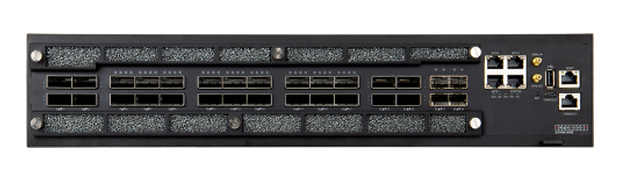 Edgecore AS7946-30XB (AGR400) Edgecore AS7946-30XB (AGR400) |
Qumran 2C (BCM88820) | 2,4 Tbps | 4×400G + 22×100G | Core / IPoDWDM |
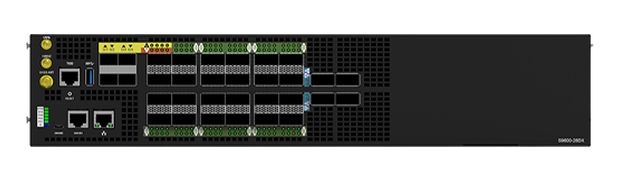 UfiSpace S9600-28DX UfiSpace S9600-28DX |
Qumran 2C (BCM88820) | 2,4 Tbps | 4×400G + 24×100G | Core / IPoDWDM |
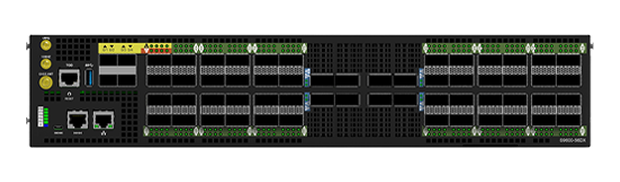 UfiSpace S9600-56DX UfiSpace S9600-56DX |
Qumran 2C (BCM88820) | 4.8 Tbps | 8×400G + 48×100G | Metro / IPoDWDM edge |
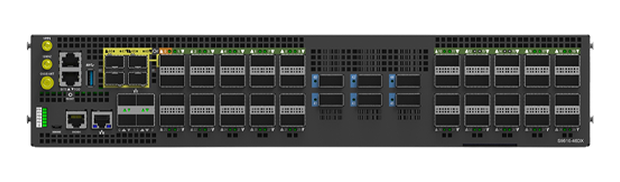 UfiSpace S9610-46DX UfiSpace S9610-46DX |
Qumran2c+ (BCM88840) | 7.2 Tbps | 6×400G + 40×100G | Core / IPoDWDM |
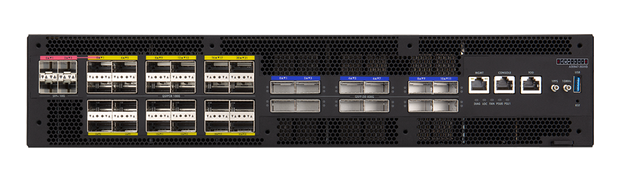 Edgecore AGR560 (AS9947-36XKB) Edgecore AGR560 (AS9947-36XKB) |
Jericho2C+ (BCM88850) | 7.2 Tbps | 12×400G | Core / IPoDWDM |
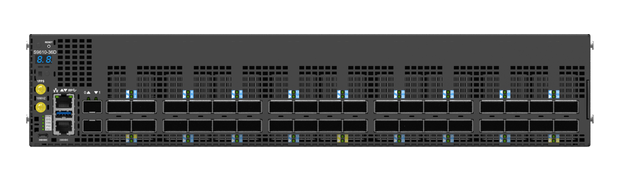 UfiSpace S9610-36D UfiSpace S9610-36D |
Jericho2C+ (BCM88850) | 14.4 Tbps | 36×400G QSFP-DD | Core backbone |
Silicon and capacity are the VM-verified platform seed. Deep buffer is available on the backbone router. See every validated platform in the hardware compatibility list, and match features to hardware in the Feature-Matrix.
Which routed-optical router
- Aggregation edge. The UfiSpace S9510-28DC and the Edgecore AS7535-28XB (CSR440) carry a 400G coherent port at the aggregation edge on an 800 Gbps, 1RU box.
- Metro and core. The Edgecore AS7946-30XB (AGR400) and the UfiSpace S9600-28DX run 400G coherent at 2.4 Tbps, and the S9600-56DX carries 8 by 400G at the metro edge on a 4.8 Tbps box.
- Higher-capacity coherent. The S9610-46DX and the Edgecore AGR560 (AS9947-36XKB) add 400G coherent capacity at 7.2 Tbps for the core and larger rings.
- Backbone. The S9610-36D carries 36 by 400G on a 14.4 Tbps backbone with deep buffering.
- Complete router. IP Infusion validates, pre-loads, and supports each router as one system across 43 validated platforms, and the hardware and software refresh on independent cycles.
Bringing up and monitoring a coherent wavelength.
The coherent pluggable seats in a QSFP-DD faceplate port and appears as a router interface. On that interface OcNOS-SP sets the wavelength, the modulation format, and the FEC, joins the routed underlay, and reads optical monitoring, so the same routing CLI provisions the optic and the packet forwarding together.
# 1. the coherent pluggable seats in a QSFP-DD
#    faceplate port and appears as an interface
interface <coherent-optic>

# 2. set the wavelength, modulation, and FEC
#    to match the OpenZR+ or OIF 400ZR plan
  center-frequency <value>
  modulation-format <value>
  fec <value>

# 3. the interface joins the SR-MPLS underlay
#    like any other routed link

# 4. read optical PM and stream it via gNMI
show interface <coherent-optic> optics
The optic is an interface on the router
- The coherent pluggable seats in a QSFP-DD faceplate port and appears as a router interface, so it is provisioned as part of the router.
- OcNOS-SP sets the center frequency (the wavelength), the modulation format, and the FEC to match the OpenZR+ or OIF 400ZR plan.
- The interface joins the SR-MPLS routed underlay like any other link. SR-MPLS is the routed underlay today; SRv6 availability depends on the platform and release.
- OcNOS-SP reads Pre-FEC and Post-FEC monitoring and transmit and receive optical power from the optic, and streams them as OpenConfig telemetry via gNMI. Available parameters depend on the coherent optic.
The coherent-interface bring-up above is conceptual. Exact command syntax follows the OcNOS Routed Optical Networks guide at documentation.ipinfusion.com and is release and platform specific.
800G coherent data center interconnect runs on OcNOS-DC, on data center hardware. See the data center interconnect solution for the 800G design.
Data center interconnect →Moving a wavelength from a transponder to the router.
The routed-optical router interoperates with the installed multi-vendor optical line system, so you add a coherent wavelength, cut a circuit over on your timeline, and retire the transponder shelf segment by segment.
Run alongside the installed transport
The routed-optical router interoperates with the existing multi-vendor optical line system, and the coherent wavelength is added as an alien wavelength. eww ITandTEL ran 400G ZR+ circuits across a multi-vendor environment this way.
Move a circuit to a 400G wavelength
Move a 100G or legacy circuit to a 400G OpenZR+ wavelength on the router, on your own timeline. eww moved a 100G MPLS backbone to 400G IPoDWDM, and Adams Cable upgraded to a 400G network.
Retire the transponder shelf
Once circuits ride the router's coherent optics, the standalone shelf is removed from that segment. Cisco IOS-XR to OcNOS CLI translation assistance is available to speed configuration conversion.
Open routed optical versus a proprietary chassis.
The routed-optical decision comes down to the coherent link, and an open router matches a proprietary IP-optical chassis on every part of it. What changes is sourcing: the operator buys the coherent optic from more than one vendor, refreshes hardware and software on separate timelines, and keeps one support contract.
| Funktion | Open routed-optical router (OcNOS-SP) | Proprietary chassis (Cisco / Juniper / Nokia) |
|---|---|---|
| Coherent optic sourcing | Multiple vendors, proven interoperability | Single-vendor optic |
| Hardware and software economics | Bought and refreshed on independent cycles | Bundled to the chassis lifecycle |
| Supportmodell | One contract for validated hardware, OcNOS-SP, and RMA | Single-Vendor-Support |
| 400G coherent pluggable in the faceplate | ✓ QSFP-DD OpenZR+ / OIF 400ZR | Vendor-integrated |
| Alien wavelength over a third-party ROADM | ✓ Open coherent standard | Vendor-dependent |
| Wavelength managed from the routing CLI | ✓ | ✓ |
| Optical PM via gNMI / OpenConfig | ✓ details → | Vendor telemetry |
| SR-MPLS routed underlay | ✓ SR-MPLS today; SRv6 per platform and release | ✓ |
Cisco, Juniper, and Nokia are trademarks of their respective owners. IP Infusion is not affiliated with and does not endorse these vendors; the comparison reflects OcNOS-SP capabilities verifiable in the Feature-Matrix. Last verified: Jul 2026.
Datasheet and solution brief.
The IPoDWDM 400G OpenZR+ solution brief and the OcNOS-SP datasheet to share with your team. Quick form, and the PDF downloads immediately.
IPoDWDM mit 400G OpenZR+
The routed-optical design on open hardware: coherent pluggables, alien wavelengths, and the metro build, in one PDF.
Brief anfordernOcNOS-SP Datenblatt
The full OcNOS-SP overview: roles, protocols, coherent optics, and the validated hardware, in one PDF.
Datasheet abrufenQuestions an optical architect asks.
Size routed optical for your metro.
See how IP Infusion delivers the routed-optical router complete, or contact us to map your metro ring to the right validated platforms, coherent optics, and licensing.
IPoDWDM mit 400G OpenZR+
Kurzes Formular. Ihr PDF wird unmittelbar nach dem Absenden heruntergeladen.
✓ Opening your PDF in a new tab.
If it did not open, use the link below.
solution-brief-ipodwdm-400g-open-zr-plus.pdfOcNOS-SP Datenblatt
Kurzes Formular. Ihr PDF wird unmittelbar nach dem Absenden heruntergeladen.
✓ Opening your PDF in a new tab.
If it did not open, use the link below.
OcNOS-SP-Datasheet-2026.pdfPassend aus dem Blog
Warum Service Provider auf Open Networking setzen: 5 Treiber
Operator business case for moving SP metro and transport to open disaggregated routers, the same shift behind routed optical
Beitrag lesen →Segment Routing Explained: SR-MPLS and SRv6 in the Core
SR-MPLS and SRv6, the routed underlay the coherent wavelength joins on a routed-optical link
Beitrag lesen →