
OcNOS AI Fabric: open 800G lossless Ethernet for GPU clusters
OcNOS AI Fabric brings carrier-grade networking to the GPU cluster: a complete lossless Ethernet system. IP Infusion delivers it whole, validated 800G open switches from Edgecore or UfiSpace running OcNOS-DC, supported under one contract, with your NIC, GPU, and switch choices kept open. It carries lossless RoCEv2 RDMA with PFC, ECN-based congestion control (DCQCN), and sub-millisecond DLB in production today. IP Infusion is a contributing member of the Ultra Ethernet Consortium, and OcNOS-DC aligns with the Ultra Ethernet 1.0 fabric profile.
thousandGPU reference designs
Download the architecture briefs
Four short downloads that go deeper than this page: the lossless AI fabric architecture, the full OcNOS-DC datasheet, the EVPN-VXLAN data center reference, and next-generation DCI with IPoDWDM.
OcNOS 800G Ethernet-Based Lossless AI Fabric
Non-blocking RoCEv2 fabric on Tomahawk 4/5 spines: SKU tiers, validated platforms, and deployment architecture.
Get the briefEVPN-VXLAN Data Center Fabric
Open leaf-spine data center fabric: EVPN Type-2 and Type-5 routes, distributed anycast gateway, multi-tenant VNIs.
Get the briefNext-Generation DCI with IPoDWDM
Collapse the transponder layer: run coherent 400G/800G ZR and ZR+ optics straight from the router for data center interconnect.
Get the briefOcNOS-DC Datasheet
Full OcNOS-DC specification: the EVPN-VXLAN and Ethernet for AI feature set, software SKUs, supported hardware platforms, and the solution ordering guide.
Get the datasheetWhat moves job completion time
What matters at scale is how fast jobs finish and how busy the GPUs stay, not switch throughput. Every time the cluster pauses to synchronize, idle GPUs waste capacity, so the fabric has to drop nothing and react to congestion the moment it starts.
OcNOS-DC exposes every setting, so your team tunes the fabric against your real GPU collective traffic (xCCL: NCCL, RCCL, oneCCL) instead of accepting a vendor's fixed profile. Each pattern below is one way a cluster stalls, and how OcNOS-DC keeps it moving.
→ DLB shifts flows to less-busy paths in under a millisecond.
→ GLB is on the OcNOS roadmap to balance across the whole fabric, not just the local hop.
→ DCQCN slows senders early, before anything overflows.
→ PFC watchdog clears a stuck port on its own.
→ Ultra Ethernet (UEC 1.0) spreads a single flow across every path at once.
→ The switch you buy today carries over when UEC NICs arrive, with no swap.
Where the capacity goes. Static ECMP pins each large flow to one path, so elephant flows collide on a few uplinks while others sit idle. Dynamic load balancing rebinds flows on real-time congestion to keep every uplink busy, so a well-run AI fabric targets utilization in the 90% range on the same switches, with no extra uplinks. OcNOS-DC ships DLB on Tomahawk 4 and 5.
DLB deep-dive →800G spine-leaf, lossless end to end
This is the leaf-spine (Clos) design your team already knows, built to run GPU traffic without loss: a routed eBGP underlay spreads traffic evenly across every path, lossless priority queues protect the RoCEv2 flows, and a separate management network brings switches up and streams telemetry on its own. Leaf-attached NVMe-oF and NFS storage for checkpoints and datasets sits adjacent to the GPU racks; see the DC Fabric for storage-fabric detail. Hover any node for platform, port count, and chip.
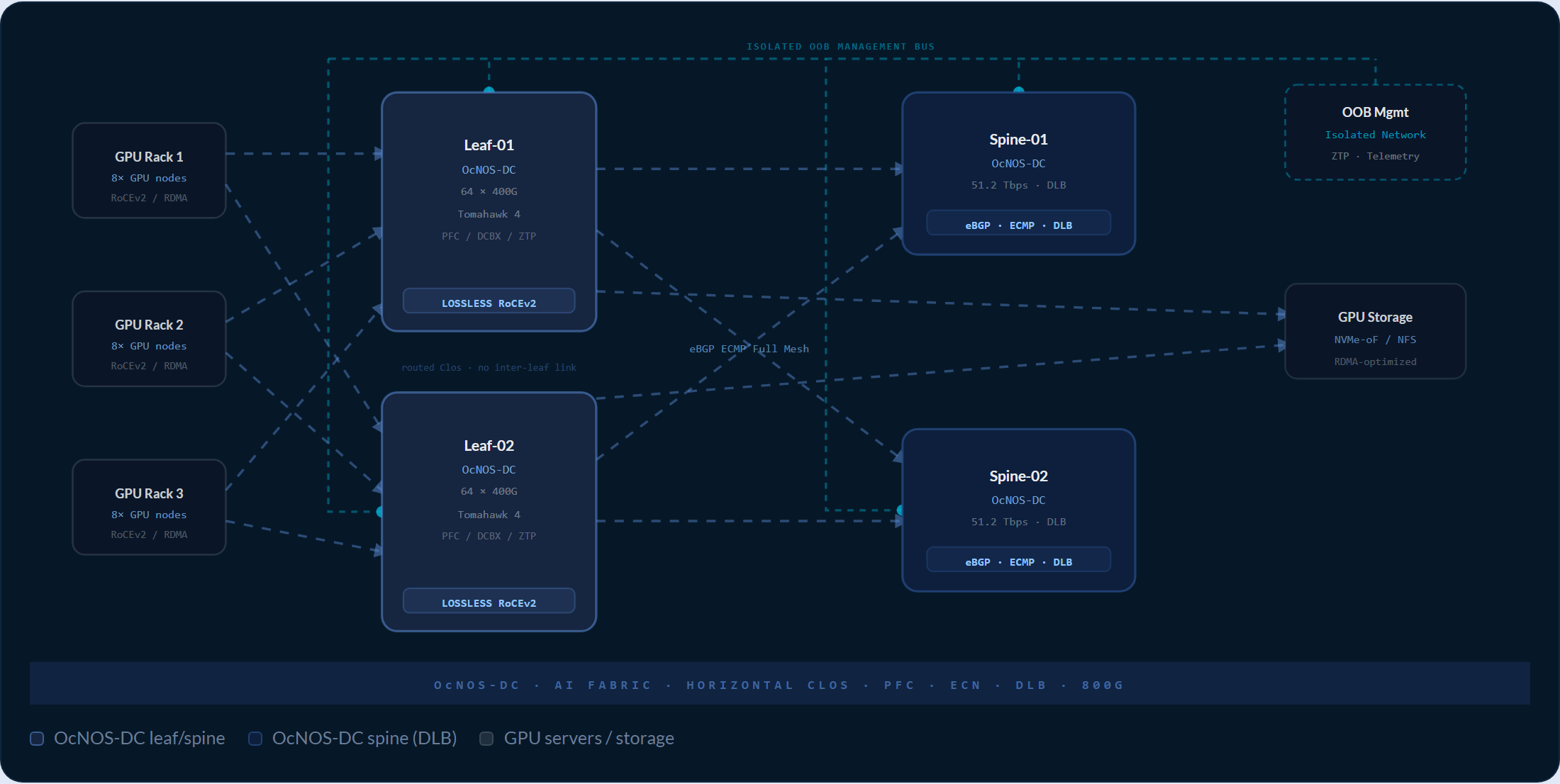
Hover nodes for capability and platform details · Full HCL: 40+ validated platforms at ipinfusion.com/hcl
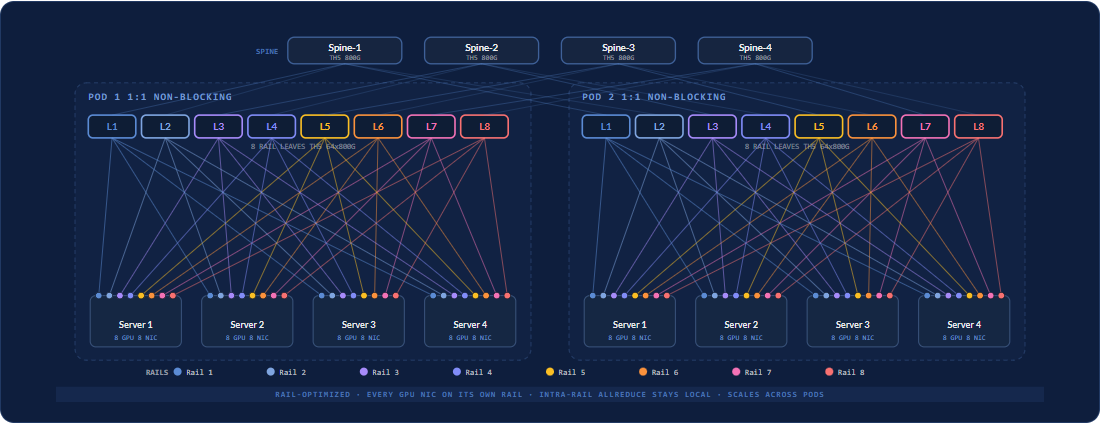
Every GPU NIC on its own rail, scaling across pods
In a rail-optimized fabric each GPU server homes one NIC to each of eight dedicated rail leaves, so the dominant same-rail AllReduce stays on one leaf and only cross-rail traffic reaches the spine. It scales pod by pod on the same 800G Tomahawk 5 switches. See the rail-optimized deep-dive and the full reference topologies.
Validated open switches
OcNOS-DC runs on Broadcom Tomahawk and Trident switches from Edgecore and UfiSpace, so every platform is validated, orderable, and second-sourceable.
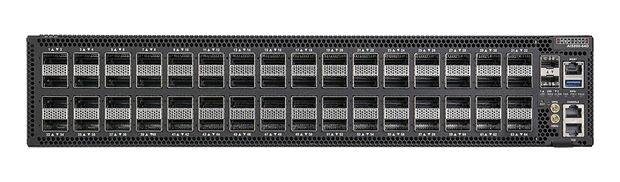
Edgecore AIS800-64D
64 x 800G · 51.2 Tbps
QSFP-DD800 · breakout to 2x400G / 4x200G / 8x100G
Datasheet →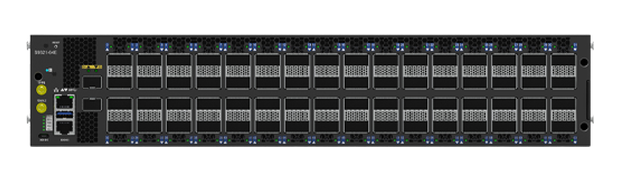
UfiSpace S9321-64E
64 x 800G · 51.2 Tbps
QSFP-DD800 · breakout to 2x400G / 4x200G / 8x100G
Datasheet →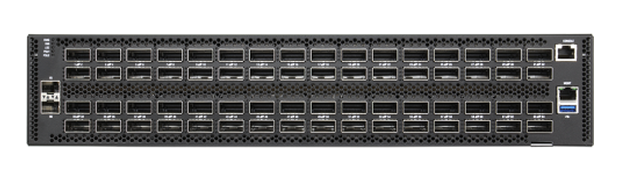
Edgecore AS9736-64D
64 x 400G · 25.6 Tbps
QSFP56-DD 400G · breakout to 4x100G / 4x25G · DAC / AOC
Datasheet →See all 40+ validated platforms in the HCL →
How the Broadcom Tomahawk and Trident families differ, and every open switch OcNOS runs on →
One vendor behind the software, the hardware, and support
One contract, one team to call
A single IP Infusion contract covers the OcNOS-DC software and the validated switch hardware together, so there is one TAC and one SLA instead of a separate NOS and hardware vendor. A 24/7 support portal is available on the Premium and Enterprise tiers.
See support detailsOne console for the fabric
IP Maestro is an element management system for OcNOS: topology, faults, configuration, and software images across every switch over NETCONF, sitting beneath your existing OSS. Manages large multi-site fleets from one console.
Explore IP MaestroStreaming telemetry and zero-touch
gNMI streaming telemetry feeds Prometheus and Grafana, DCBX pushes the correct lossless settings to each server automatically, and zero-touch provisioning brings switches up configured at boot.
Explore automationThe open, multi-vendor alternative to NVIDIA Spectrum-X
OcNOS-DC runs a lossless RoCEv2 AI fabric on standard Ethernet switches from more than one open-hardware vendor, under one support contract. It matches the fabric mechanisms an AI training job depends on, while keeping the NIC, GPU, and hardware choices open instead of locked to a single vendor.
| What decides the deal | Open AI fabric (OcNOS-DC on Edgecore / UfiSpace) | Closed single-vendor stack (NVIDIA Spectrum-X) |
|---|---|---|
| Hardware sourcing | Open merchant silicon from more than one vendor (Edgecore, UfiSpace) | Single-vendor switch, NIC, and GPU |
| NIC and GPU choice | Open; swap NICs and GPUs independently | Tied to the NVIDIA NIC and GPU roadmap |
| Lossless RoCEv2 (PFC, ECN, DCQCN) | ✓ details → | ✓ |
| Adaptive load balancing | ✓ sub-millisecond DLB flowlet rebinding details → | ✓ (proprietary) |
| PFC deadlock protection | ✓ deadlock watchdog with auto-drain details → | ✓ |
| Ultra Ethernet (UEC 1.0) | ✓ tracks the UEC 1.0 fabric profile details → | Aligned; also a UEC contributing member |
| Streaming telemetry and automation | ✓ gNMI, OpenConfig, ZTP, DCBX, Ansible | ✓ (vendor pipeline) |
| Single support contract (switch and software) | ✓ one TAC, one SLA | ✓ (single vendor) |
| GPU-silicon back-end integration | Standard Ethernet; no GPU-silicon co-design | Advantage NVIDIA: NIC, switch, and GPU co-designed |
| Fabric-controller layer | Managed through gNMI telemetry and your OSS or IP Maestro | Advantage NVIDIA: integrated fabric-controller layer |
| UEC certification | Aligned with the UEC 1.0 fabric profile (not a certification claim) | NVIDIA is a UEC steering member |
NVIDIA, Spectrum-X, Quantum, and ConnectX are trademarks of NVIDIA Corporation. IP Infusion is not affiliated with and does not endorse NVIDIA; the comparison reflects OcNOS-DC capabilities verifiable in the feature matrix.
Where OcNOS-DC sits
By 2026 almost every option clears the same technical bar: lossless RoCEv2, congestion control, adaptive routing, Ultra Ethernet alignment. So the decision comes down to the shape of the deal: an open operating system or a locked stack, open or locked hardware, standard Ethernet or closed InfiniBand. Here is where each one leaves you.
Each option targets a different priority. OcNOS-DC leads with open hardware, a complete solution, and no lock-in.
Size your GPU fabric in minutes
Enter your GPU count and NIC speed. The AI Fabric Design Suite maps it to a leaf-spine topology, switch and port counts, and a bill of materials you can take straight to a quote. No spreadsheet required.
Extend OcNOS across the data center
AI is one segment of the data center. The same OcNOS image extends into compute, storage, and remote sites: same NOS, same CLI, same support.
Frequently asked questions
AI Fabric Reference Design
Quick form. Your PDF opens immediately after submit.
✓ Opening your PDF in a new tab…
If it didn't open, use the link below.
OcNOS 800G Ethernet-Based Lossless AI Fabric
Quick form. Your PDF will download immediately after submit.
✓ Opening your PDF in a new tab…
If it didn't open, use the link below.
EVPN-VXLAN Data Center Fabric
Quick form. Your PDF will download immediately after submit.
✓ Opening your PDF in a new tab…
If it didn't open, use the link below.
Next-Generation DCI with IPoDWDM
Quick form. Your PDF will download immediately after submit.
✓ Opening your PDF in a new tab…
If it didn't open, use the link below.
OcNOS-DC Datasheet
Quick form. Your PDF will download immediately after submit.
✓ Opening your PDF in a new tab…
If it didn't open, use the link below.
AI fabric & DC deployments
Production AI clusters and data-center fabrics running OcNOS-DC on Broadcom Tomahawk 4/5.

NTT DATA partnered with IP Infusion to take open networking solutions to market, offering OcNOS-powered Cell Site Routers, Routed Optical…

Scott Data deployed OcNOS with open networking hardware from UfiSpace, Edgecore Networks, and Celestica, replacing legacy vendor stacks across its…

Madeo Consultant, a France-based data center systems integrator, replaced Cisco Nexus and Catalyst switches with IP Infusion OcNOS on Edgecore…

Prosoluce, a French ISP and managed services provider, upgraded its core to a 100G EVPN-VXLAN backbone running IP Infusion OcNOS…
Related from the blog
The AI Network Decision Framework: GPU Fabric for Speed, ROI, Strategic Freedom
Buyer-side framework for GPU fabric decisions with RoCEv2 and open hardware
Read the post →OcNOS 7.0 for Data Centers: AI Fabric, 800G Platforms, EVPN-VXLAN at Scale
800G AI fabric features and Tomahawk 5 platforms shipping in OcNOS 7.0
Read the post →OcNOS 7.0: What’s New for AI, Transport, and Cloud
Highlights RoCEv2 lossless transport with PFC for GPU clusters
Read the post →OcNOS 6.6 for Data Centers: AI Fabric PFC/ETS, EVPN Policy, 400G
PFC/ETS lossless DCB features that underpin OcNOS AI fabric deployments
Read the post →Design the whole AI fabric with OcNOS
From the business case to the port-count maths, pick up wherever you are in the build.
Would you like us to reach out?
Leave your details and a member of the IP Infusion team will be glad to help you design your AI fabric. We'll only be in touch if you'd like us to.