Service provider routers from the cell site to the core
IP Infusion delivers OcNOS-SP routers for each layer of a service provider network, from the cell site to the core and the peering edge, on qualified Edgecore and UfiSpace hardware with one support contract.
One router family for every layer of the network
Each layer of a service provider network places different demands on its router: timing at the cell site, queuing in aggregation, Carrier Ethernet in the metro, fast reroute in the core and route security at the peering edge. OcNOS-SP runs each role, in the edition that fits it.
Pick a layer
Cell site router
Connects the radio site to the transport network and provides it with timing and frequency.
- IEEE 1588v2 boundary clock with full and partial timing support, on 23 of 26 routers
- SyncE and ESMC for frequency, on 23 of 26 routers
- SR-MPLS with TI-LFA backup paths, on all 26 routers
Aggregation router
Gathers uplinks from OLTs, fixed wireless towers and cell sites, and keeps priority traffic ahead of bulk traffic.
- Up to three levels of queuing hierarchy, with shaping per queue and per port, on all 26 routers
- EVPN E-LINE and E-LAN over MPLS, on all 26 routers
- SR ECMP, BFD and VRRPv3 for redundant uplinks, on all 26 routers
Metro Ethernet router
Carries Carrier Ethernet services around metro rings in one of two designs.
- E-LAN over G.8032 ring protection, on all 26 routers
- Or EVPN E-LINE, E-LAN and E-TREE over SR-MPLS with TI-LFA, on all 26 routers
- Y.1731 Ethernet OAM, on all 26 routers
Core router
Switches labeled traffic between regions and moves it to a precomputed backup path when a link fails.
- SR-MPLS over IS-IS or OSPF, on all 26 routers
- TI-LFA, and Flex-Algo on IS-IS, on all 26 routers
- Initial SRv6 support on 10 Qumran 2 routers, with more in development
Peering edge router
Holds the full internet BGP table, rejects invalid routes and filters attack traffic at the edge.
- BGP RPKI invalid route rejection from OcNOS 7.0, on all 26 routers
- BGP FlowSpec and the blackhole community, on all 26 routers
- BGP route reflection and BGP-LS, on all 26 routers
Routed optical (IPoDWDM)
Puts a 400G coherent optic in the router port so the wavelength runs on the existing DWDM line system without a transponder shelf.
- 400G ZR and OpenZR+ on 7 OcNOS-SP routers
- 18 ZR+ capable 400G ports on the UfiSpace S9610-36D
- Optic tuning and monitoring through CMIS and OpenConfig
Illustrative. Check each router in the OcNOS Feature Matrix.
Operators running their networks on OcNOS-SP
“IP Infusion’s OcNOS software, paired with Edgecore hardware, is now part of our production environment supporting middle-mile and data center transport. In these targeted use cases, the platform’s flexibility, support for open standards, and cost structure align well with our goals to expand broadband access throughout the Heartland while maintaining operational agility and performance.”
Cameron Kilton, Chief Technology Officer, Nextlink Internet
Lintasarta
“IP Infusion’s OcNOS software provides the carrier-grade capacity that helps us scale for long-term requirements, while reducing overall costs.” Arya Damar, CEO of Lintasarta
Read the story →Africell Sierra Leone
“We made the decision to use a disaggregated routing solution because it covered all of our requirements and provided the flexibility we need at a lower point than traditional solutions.” Ali Abou Hamdan, Head of Transmission and IP at Africell Sierra Leone
Read the story →Routers by layer
Choose a router by the layer it serves, the ports it needs and the capacity it carries.
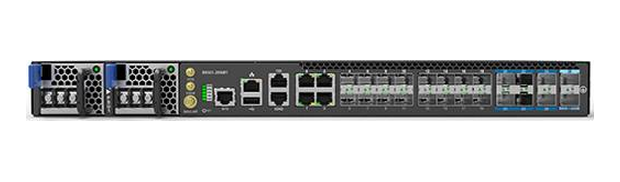
Cell site
UfiSpace S9501-28SMT
Qumran UX · 120 Gbps
8 × 10G, 16 × 1G, 4 × 1G RJ45
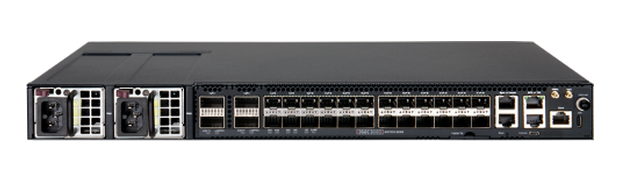
Aggregation
Edgecore AS7535-28XB
Qumran 2A · 800 Gbps
24 × 25G, 2 × 100G, 2 × 400G
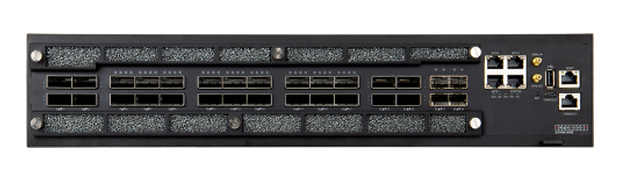
Metro and provider edge
Edgecore AS7946-30XB
Qumran 2C · 2.4 Tbps
4 × 25G, 22 × 100G, 4 × 400G
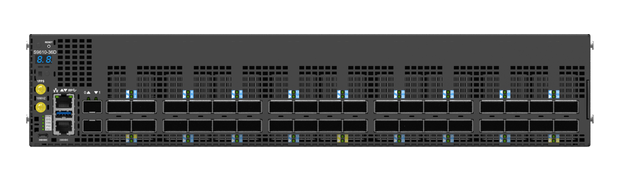
Core and peering
UfiSpace S9610-36D
Jericho 2C+ · 14.4 Tbps
36 × 400G, 18 ZR+ capable
See every qualified router on the OcNOS Hardware Compatibility List.
One OcNOS-SP family, in four editions
Each router runs the OcNOS-SP edition that fits its role and capacity. For an OcNOS System, one support contract covers the software and the hardware.
CSR
Cell site routing and fixed wireless or microwave backhaul: Layer 2 and Layer 3, IP/MPLS, ring and linear protection, OAM and timing.
IPBASE
Layer 2 switching, Layer 3 routing with OSPF, IS-IS and BGP, VXLAN-EVPN, IETF OAM and NETCONF.
MPLS
Adds MPLS, SR-MPLS, EVPN over MPLS, ring and linear protection, Carrier Ethernet, OAM and OpenConfig.
PLUS
Adds SRv6, CE 3.0, 1588v2 and SyncE, for high-density aggregation routers from 300 Gbps.
Editions per the OcNOS-SP datasheet. Support varies by router: check the OcNOS Feature Matrix.
Questions about service provider routers.
Datasheet and solution briefs.
The OcNOS-SP datasheet and three briefs to share with your team. Quick form, and the PDF downloads immediately.
OcNOS-SP Datasheet
The full OcNOS-SP overview: roles, protocols, timing, editions and the supported routers, in one PDF.
Get the datasheetService Provider WAN Transport
OcNOS-SP routers for every layer of the WAN, from the cell site to the core, with timing and 400G OpenZR+.
Get the briefSR-MPLS Upgrade with OcNOS
Move an MPLS network to SR-MPLS on OcNOS-SP routers, one router at a time, with TI-LFA from the first router you convert.
Get the briefIPoDWDM with 400G OpenZR+
Routed optical on OcNOS-SP: a coherent optic in the router port lights the wavelength on the existing DWDM line system.
Get the briefPlan your service provider network.
We map each layer of your network to qualified routers, the OcNOS-SP edition each one needs and a design that fits your services.
OcNOS-SP Datasheet
Quick form. Your PDF will download immediately after submit.
✓ Opening your PDF in a new tab.
If it did not open, use the link below.
SR-MPLS Upgrade with OcNOS
Quick form. Your PDF will download immediately after submit.
✓ Opening your PDF in a new tab.
If it did not open, use the link below.
IPoDWDM with 400G OpenZR+
Quick form. Your PDF will download immediately after submit.
✓ Opening your PDF in a new tab.
If it did not open, use the link below.
Service Provider WAN Transport
Quick form. Your PDF will download immediately after submit.
✓ Opening your PDF in a new tab.
If it did not open, use the link below.