PTP & SyncE: Class C Timing for 5G
5G NR and modern industrial transport demand sub-microsecond phase alignment across the network. OcNOS implements IEEE 1588v2 PTP with G.8273.2 Class C boundary clocks, ITU-T SyncE, and the hybrid mode that combines them, with boundary and transparent clocks distributed across qualified cell-site routers.
Timing Distribution: Grandmaster to Cell Site
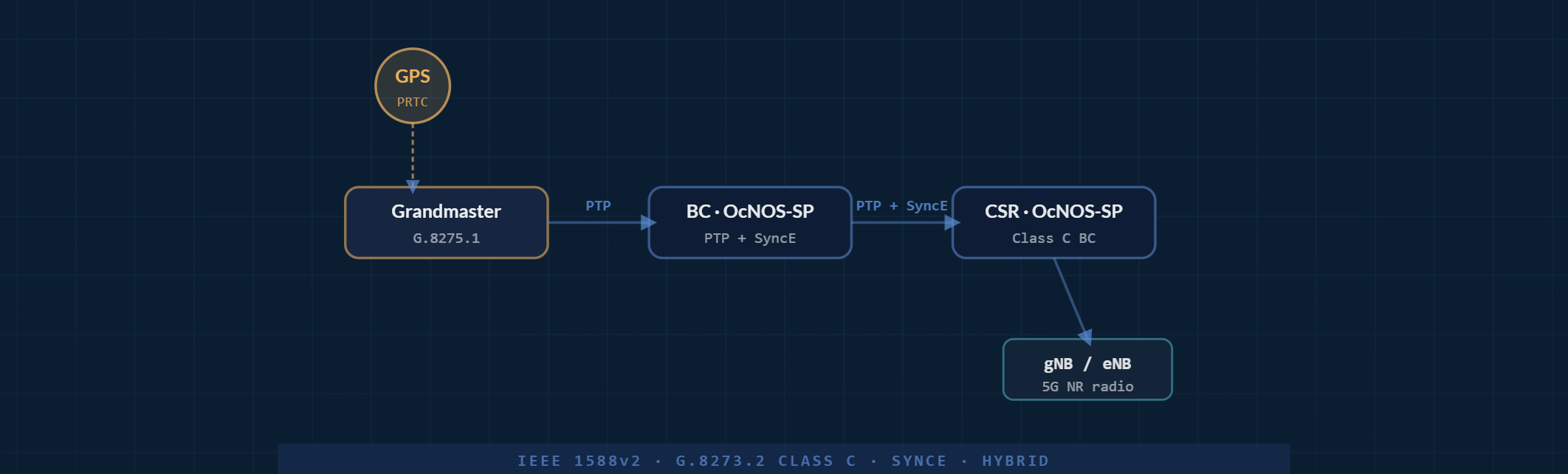
A GPS-disciplined grandmaster injects time at the aggregation site. Each hop is a PTP boundary clock (BC) running OcNOS, recovering frequency from SyncE and phase from PTP, and re-stamping events down to the cell-site router.
Why timing matters more than ever
5G TDD slot alignment, coordinated multipoint (CoMP), and emerging time-sensitive networking (TSN) profiles all require phase accuracy below 1.5 µs end-to-end, and most modern radio profiles tighten that to a few hundred nanoseconds. OcNOS combines IEEE 1588v2 PTP for phase with SyncE for frequency in a single hybrid clock per hop, keeping every interface in lock with the grandmaster.
5G timing and synchronization: the clock roles
A 5G network needs three things from transport: frequency, phase and time of day. TDD radios transmit on a common time base, so phase has to reach every cell site within 1.5 microseconds of a common reference. The ITU-T telecom profiles split that job into clock roles, and OcNOS-SP routers can take each of them.
| Clock role | What it does | OcNOS-SP support |
|---|---|---|
| T-GM, telecom grandmaster | Takes time from a GNSS antenna and starts the PTP chain | G.8275.1 and G.8275.2, with antenna delay compensationOcNOS-SP platforms: 11 |
| T-BC, telecom boundary clock | Recovers time on each hop and sends a fresh copy downstream | G.8275.1 profile with G.8273.2 timing characteristicsOcNOS-SP platforms: 23 |
| T-BC-P and T-BC-A | Partial timing support: carries time over IP where not every node runs PTP. T-BC-A also uses a local GNSS receiver, with PTP as the backup | G.8275.2 profile with G.8273.4 timing characteristicsOcNOS-SP platforms: 23 |
| T-TC, transparent clock | Measures how long each PTP message spends inside the router and corrects for it | End-to-end transparent clock with G.8275.1, G.8275.2 and the default profileOcNOS-SP platforms: 23 |
| SyncE and ESMC | Carries frequency on the Ethernet physical layer and signals the quality of the clock source | G.8262 and G.8264OcNOS-SP platforms: 23 |
| T-TSC, frequency only | Recovers frequency over a packet network for equipment that needs frequency but not phase | G.8265.1 telecom profile for frequencyOcNOS-SP platforms: 22 |
Timing is licensed in the OcNOS CSR and OcNOS-SP PLUS tiers. See platform-by-platform timing support in the OcNOS Feature Matrix
The OcNOS PTP & SyncE implementation
G.8275.1 / G.8275.2
Full-on-path (G.8275.1) and partial-timing-support (G.8275.2) profiles.
G.8261 + G.8262
SyncE frequency distribution with ESMC quality-level signalling and best-source selection.
G.8273.2 Class C
Boundary and transparent clock modes with hardware time-stamping; qualified platforms achieve G.8273.2 Class C per-hop specs, which bound time error to 30 ns at each clock.
What you get with OcNOS timing
- Included in CSR and PLUS. PTP and SyncE are included in the OcNOS CSR and OcNOS-SP PLUS SKUs; the IPBASE and MPLS SKUs do not include timing.
Frequently asked questions
How does OcNOS support 5G timing and synchronization?
What is the difference between PTP and SyncE?
Which PTP profiles does OcNOS support?
What timing accuracy can OcNOS achieve?
Which platforms support PTP and SyncE in OcNOS?
Go deeper. Take it with you.
The product datasheet plus short, technical downloads that go further than this page.
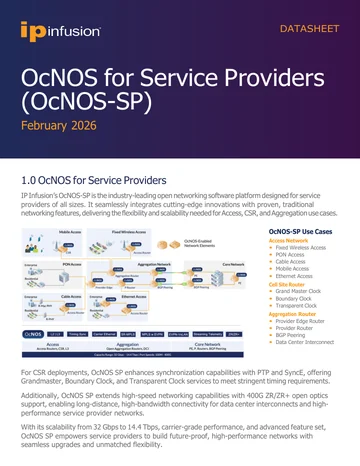
OcNOS-SP Datasheet
Full OcNOS-SP specification: the access, cell site and aggregation feature set, software SKUs, supported hardware platforms, and the solution ordering guide.
Get the datasheet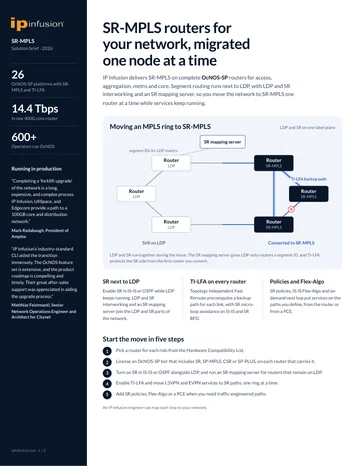
SR-MPLS Upgrade with OcNOS
Migrate SR-MPLS onto OcNOS on open hardware: Flex-Algo, TI-LFA, and a node-by-node cutover path.
Get the brief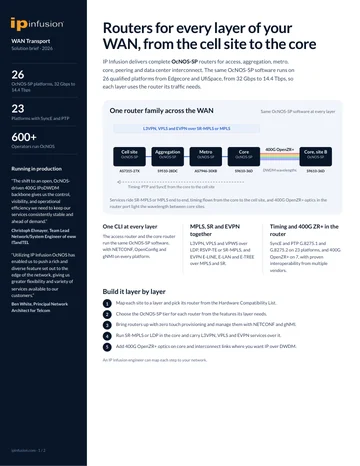
Cloud & Service Provider WAN Transport
Cloud and service-provider WAN transport on open hardware: SR-MPLS, EVPN, and scale-tested forwarding.
Get the briefOcNOS-SP Datasheet
Quick form. Your PDF opens in a new tab immediately after submit.
✓ Opening your PDF in a new tab…
If it didn't open, use the link below.
SR-MPLS Upgrade with OcNOS
Quick form. Your PDF opens in a new tab immediately after submit.
✓ Opening your PDF in a new tab…
If it didn't open, use the link below.
Cloud & Service Provider WAN Transport
Quick form. Your PDF opens in a new tab immediately after submit.
✓ Opening your PDF in a new tab…
If it didn't open, use the link below.