MEF · EVPN Ring · Aggregation · L3 Switch

The complete metro aggregation router, on open hardware.

The metro aggregation router carries MEF Carrier Ethernet, E-LINE, E-LAN, E-TREE, and E-Access, across an EVPN metro ring and hands service traffic up to the IP core. IP Infusion delivers it complete: validated open hardware from Edgecore or UfiSpace, OcNOS-SP pre-loaded, supported under one contract, with a self-protecting ring and a measured per-service SLA.

Proven in production

Operators running OcNOS-SP metro aggregation.

Regional operators moved metro aggregation and backbone routing to the complete open router on OcNOS-SP, interoperating with their installed networks through the transition. It runs in production at more than 600 operator networks across 60+ countries.

“IP Infusion's OcNOS software with Edgecore hardware were selected for providing a compelling set of features to accommodate our rapid growth. OcNOS provides an easy and common platform across different use cases, with an upgrade path from existing solutions.” Werner Rades, CEO of AnschlussWerk

Metro topology

One open router aggregates the metro ring.

You run both aggregation nodes in the ring on the same router, so the metro ring, the Carrier Ethernet services, and the transport all sit under one operational model. EVPN and SR-MPLS are covered in depth at EVPN and SR-MPLS; the ring hands service traffic up to the IP core provider edge.

OcNOS-SP metro Ethernet EVPN ring: access nodes and business CPE feed two aggregation provider-edge routers on the UfiSpace S9600-56DX in a G.8032-protected EVPN ring, delivering MEF E-LINE, E-LAN, and E-TREE over SR-MPLS, uplinked to the IP core on the S9610-36D
Metro Ethernet: access and business handoffs aggregate into an EVPN ring on the S9600-56DX with G.8032 protection, carrying MEF services over SR-MPLS to the IP core.
One box, four roles

The metro node plays four roles from one image.

You license and size one box for four jobs instead of stocking four. One OcNOS-SP image runs the aggregation router, the Layer 3 switch, the EVPN ring node, and the core uplink, each licensed and sized per role, so the node takes on new roles without a second box.

Aggregation

Aggregation router

Every access, OLT, CPE, and cell-site handoff lands on one router and rides upstream on high-density 100G and 400G interfaces to the ring and the core.

L3 switch

Layer 3 switch

Routes with BGP, OSPF, and IS-IS and switches Layer 2, with VRRP and MLAG multihoming for the access and business handoff.

Ring node

EVPN metro ring node

A live service attaches to two ring nodes at once, so a single node loss never drops it. EVPN all-active multihoming and a G.8032 ring instance keep one protected path around the ring.

Carrier Ethernet

MEF Carrier Ethernet, delivered over the EVPN ring.

The operator sells four kinds of Carrier Ethernet: private line, multipoint LAN, rooted broadcast, and wholesale handoff. This router delivers all four as MEF services over EVPN and SR-MPLS on the metro ring, so one box carries the whole service catalog.

MEF Carrier Ethernet service types on OcNOS-SP. Last verified: Jul 2026.
MEF service Connectivity EVPN delivery Typical use
E-LINE (EPL, EVPL) Point to point EVPN-MPLS or VxLAN E-LINE, single or all-active multihoming Dedicated business circuit; point-to-point backhaul.
E-LAN (EP-LAN, EVP-LAN) Multipoint to multipoint EVPN E-LAN, single or all-active multihoming Multisite Layer 2 for enterprise or wholesale.
E-TREE (rooted multipoint) Hub and spoke EVPN E-TREE, MPLS and VxLAN Broadcast, franchise, or hub-fed distribution.
E-Access (OVC handoff) Operator to operator Wholesale Ethernet access handoff via EVPN Wholesale Ethernet access to another operator.

MEF and MEF are marks of MEF Forum. OcNOS-SP delivers Carrier Ethernet aligned with the MEF service model.

Ring resilience

How the metro ring survives a break.

A fiber cut or a lost node should never drop a live customer service, and on this ring it does not. G.8032 reroutes the ring around the break, EVPN all-active multihoming holds the service up when a node fails, and TI-LFA moves SR-MPLS traffic onto a precomputed backup path, with BFD triggering the switch the instant the link goes down.

G.8032

Ethernet ring protection

The ring stays loop-free in steady state and reroutes itself the instant a link breaks. A G.8032 ring instance holds one ring port blocked until a break, then unblocks it to keep one protected path, and OcNOS-SP runs G.8032 over LAG and interworks a G.8032 major ring with MLAG.

EVPN

All-active multihoming

EVPN all-active multihoming attaches a service to two ring nodes at once, so the service stays up through a node loss. See the delivery detail on the EVPN technology page →

SR / TI-LFA

Sub-50ms fast reroute

SR-MPLS traffic moves to a backup path in under 50ms, before IS-IS has finished reconverging. TI-LFA precomputes a loop-free SR backup for every destination to make that switch immediate. See SR-MPLS →

Service SLA

Every service measures its own SLA.

Carrier Ethernet is sold against an SLA, and this router measures every service on the ring to prove it. Y.1731 reports delay and loss per service, so the operator hands each customer the exact number it committed to.

Delay

Frame delay per service

DMM and DMR measure two-way frame delay and delay variation on each E-LINE, E-LAN, and E-TREE, over EVPN-MPLS and VPLS, so the operator sees the delay each service delivers.

Loss

Frame loss per service

LMM/LMR and SLM/SLR measure frame loss per service, over a Layer 2 bridge and over VPLS, so packet loss is reported against the SLA.

Y.1731 also carries Ethernet Bandwidth Notification (EBN), so the ring signals available bandwidth to the service edge as conditions change. Delay, loss, and bandwidth notification run on the same Y.1731 service OAM the ring already carries.

The platform

Aggregation router and Layer 3 switch on one box.

One box does two jobs, so there is no second switch to stock, cable, and license. It terminates access and business handoffs as a Layer 3 switch, then carries MPLS, SR-MPLS, and MEF services upstream as an aggregation router, and grows into new roles on its own refresh cycle.

Validated metro aggregation router. Last verified: Jul 2026.
Role Validated router Silicon and capacity Why it fits the role
Metro aggregation / L3 switch
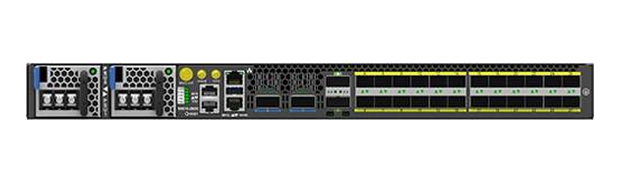
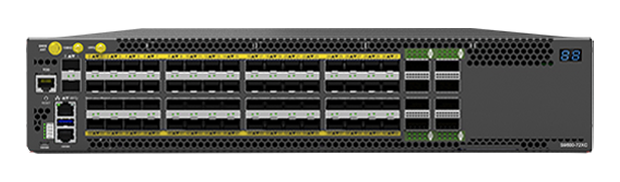
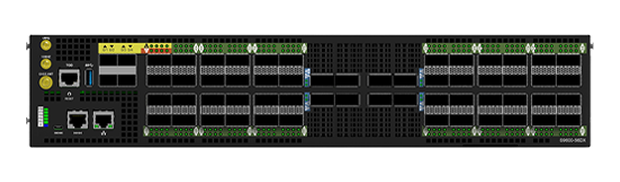
UfiSpace S9600-56DX open metro aggregation router, 4.8 TbpsUfiSpace S9600-56DX
Broadcom Qumran2c, 4.8 Tbps, 48×100G + 8×400G, deep buffer Deep buffer for microburst absorption, and a 400G coherent uplink for the metro, with proven interoperability from multiple vendors. Routed-optical uplink detail lives on IP over DWDM.
Core uplink target
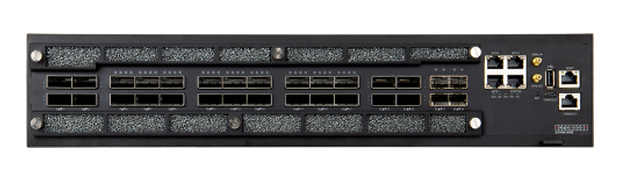
UfiSpace S9610-36D open core router, 14.4 TbpsUfiSpace S9610-36D
14.4 Tbps core The ring uplinks to the 14.4 Tbps core. The provider edge and core role live on the IP core spoke.

IP Infusion delivers the metro aggregation router on 43 validated platforms from Edgecore and UfiSpace, each lab-qualified with OcNOS-SP pre-loaded. See every validated platform in the hardware compatibility list, and match features to hardware in the feature matrix.

When the S9600-56DX fits

  • Metro ring aggregation with MEF services across two or more nodes.
  • 400G uplink to the core, or a routed-optical uplink, see IP over DWDM.
  • FTTx and OLT aggregation upstream of the access node, see broadband access.
  • Cell-site timing is a separate role, see mobile transport.
Configuration

An E-LINE service on a protected ring.

A metro E-LINE rides EVPN VPWS over the SR-MPLS underlay while a G.8032 ring protects the ring ports and a Y.1731 MEP reports the service SLA. The block below uses the real OcNOS-SP ERPS, EVPN VPWS, and Y.1731 command families with placeholder values, see the guides for the exact per-node syntax.

ocnos# metro-eline.cfg
! 1. G.8032 (ERPS) ring across the two ring ports
g8032 ring METRO-RING
 east-interface xe1
 west-interface xe2
!    ERP instance, control VLAN, and RPL role per the ERPS guide
! 2. EVPN VPWS (E-Line) on a mac vrf, carried over the SR-MPLS underlay
mac vrf E-LINE-100
 rd <router-id>:100
 route-target both <asn>:100
evpn mpls id <local-id> xconnect target-mpls-id <remote-id> host-reachability-protocol evpn-bgp E-LINE-100
! 3. Bind the access handoff (interface xe10, vlan 100) to E-LINE-100 per the EVPN VPWS guide
! 4. Y.1731 up-MEP on the service reports delay and loss
!    exact ethernet cfm mep form, plus delay-measurement (DMM) and
!    loss-measurement (SLM) profiles, per the OcNOS-SP Y.1731 guide

What each step does

  1. The g8032 ring with an east and west interface protects the two ring ports, so the ring keeps one loop-free protected path.
  2. The mac vrf plus evpn mpls id ... xconnect target-mpls-id ... creates the E-LINE (EVPN VPWS) instance and carries it over the SR-MPLS underlay around the ring.
  3. The access handoff binds to the E-LINE service on the access-facing port and VLAN.
  4. The Y.1731 ethernet cfm mep, with delay (DMM) and loss (SLM) measurement, reports the per-service SLA, so the operator measures the service it sold.

Representative OcNOS-SP configuration; angle-bracket values are placeholders. Use the OcNOS-SP ERPS, EVPN, and Y.1731 configuration guides for the exact commands and options for your release, documentation.ipinfusion.com.

Migration

Convert the ring one node at a time.

The metro ring keeps carrying services while you convert one node at a time onto the complete OcNOS-SP router. Standards-based EVPN, SR-MPLS, and MEF Carrier Ethernet let a new node interoperate with the installed network through the transition.

01 / Interop first

Interoperate with the installed metro

OcNOS-SP speaks standards-based EVPN, SR-MPLS, BGP, IS-IS, and MEF Carrier Ethernet, so a new node interoperates with installed Cisco, Juniper, and Nokia equipment, and replaces ZTE.

02 / Node by node

Convert one ring node at a time

Convert one ring node at a time onto the complete open router while the ring keeps carrying services. The cutover stays incremental, one node per maintenance window, with no forklift.

03 / Grow the role

Add services and capacity later

The same platform takes on new services and higher capacity as the metro grows, so a node earns more of the deployment over successive maintenance windows. IP Infusion supports the router at every step.

Cisco IOS-XR to OcNOS CLI translation assistance is available to speed configuration conversion. See the OcNOS-SP versus Cisco comparison for capability and licensing detail.

The decision

Open metro aggregation vs a proprietary metro chassis.

For the metro, the worry is whether an open router carries Carrier Ethernet as deeply as a purpose-built chassis. It does: MEF services, the EVPN ring, and per-service SLA measurement all run on it, and the operator still sources hardware from more than one vendor under one contract.

Metro aggregation router: OcNOS-SP on open hardware vs proprietary chassis. Last verified: Jul 2026.
Capability OcNOS-SP metro router (open) Proprietary chassis (Cisco / Juniper / Nokia)
MEF Carrier Ethernet (E-LINE, E-LAN, E-TREE, E-Access)
EVPN over MPLS and VxLAN details →
G.8032 ring protection and EVPN multihoming
Per-service Y.1731 delay and loss SLA
SR-MPLS with Flex-Algo and TI-LFA details →
Aggregation router and Layer 3 switch on one image
Runs on validated open merchant-silicon hardware Edgecore / UfiSpace, 43 platforms vendor chassis only
Hardware and software priced and refreshed on separate cycles bundled
One vendor owns hardware, software, and RMA one support contract single vendor
Source the box from more than one hardware vendor

Cisco, IOS-XR, NCS, Juniper, Junos, ACX, Nokia, and SR OS are trademarks of their respective owners. IP Infusion is not affiliated with and does not endorse these vendors; the comparison reflects OcNOS-SP capabilities verifiable in the feature matrix. To replace a proprietary metro, see the OcNOS-SP versus Cisco comparison.

Before you evaluate

Questions about the metro aggregation router.

It gathers traffic from access nodes, business CPE, OLT uplinks, and cell sites and hands it upstream to the metro ring and the IP core on high-density interfaces. IP Infusion delivers it as a complete router: the UfiSpace S9600-56DX with 48x100G and 8x400G, deep buffering for microbursts, and MEF Carrier Ethernet and EVPN service delivery, with OcNOS-SP pre-loaded and supported under one contract.
They are two roles on the same platform. The box terminates access and business handoffs as a Layer 3 switch, with BGP, OSPF, IS-IS, VRRP, and MLAG, then adds MPLS, SR-MPLS, and MEF service delivery as an aggregation router toward the core. One OcNOS-SP image runs both, so the node grows into new roles on its own refresh cycle.
All four: E-LINE for point-to-point EPL and EVPL, E-LAN for multipoint EP-LAN and EVP-LAN, E-TREE for rooted multipoint, and E-Access for wholesale operator handoff, so one router carries the Carrier Ethernet service set. Services ride EVPN over MPLS or VxLAN and SR-MPLS, with Y.1731 service OAM and per-service delay and loss measurement.
It keeps one ring port blocked in steady state to prevent a Layer 2 loop, then unblocks it on a break so the ring keeps one protected path, which means a fiber cut reroutes around the ring instead of dropping the service. OcNOS-SP runs G.8032 over LAG and interworks a G.8032 major ring with MLAG, and EVPN all-active multihoming and TI-LFA add node-level and SR-path protection on top.
Y.1731 measures each service. DMM and DMR measure two-way frame delay and delay variation per E-LINE, E-LAN, and E-TREE, and LMM/LMR and SLM/SLR measure frame loss, over EVPN-MPLS and VPLS, so the operator reports the SLA it sold. Y.1731 also carries Ethernet Bandwidth Notification.
Yes. OcNOS-SP supports a phased, node-by-node migration. It speaks standards-based EVPN, SR-MPLS, BGP, IS-IS, and MEF Carrier Ethernet, so it interoperates with installed Cisco, Juniper, and Nokia equipment and replaces ZTE while you convert the ring one node at a time. Cisco IOS-XR to OcNOS CLI translation assistance is available.
No. It sits at the aggregation and transport layer, upstream of the access node, aggregating business and access uplinks with deep-buffer merchant silicon and per-service QoS. Subscriber termination belongs to the broadband access layer; see the broadband access router for that role.
Evaluate OcNOS-SP

Put the metro router on your own hardware.

Download the OcNOS VM and build an EVPN ring on your bench, or contact us to scope the metro aggregation router for your network.