
El router de agregación metropolitana completo, en hardware abierto.
The metro aggregation router carries MEF Carrier Ethernet, E-LINE, E-LAN, E-TREE, and E-Access, across an EVPN metro ring and hands service traffic up to the IP core. IP Infusion delivers it complete: validated open hardware from Edgecore or UfiSpace, OcNOS-SP pre-loaded, supported under one contract, with a self-protecting ring and a measured per-service SLA.
Operadores que ejecutan agregación metropolitana OcNOS-SP.
Operadores regionales trasladaron la agregación metropolitana y el enrutamiento de backbone al router abierto completo sobre OcNOS-SP, interoperando con sus redes instaladas durante la transición. Se ejecuta en producción en más de 600 redes de operador en más de 60 países.
"IP Infusion's OcNOS software with Edgecore hardware were selected for providing a compelling set of features to accommodate our rapid growth. OcNOS provides an easy and common platform across different use cases, with an upgrade path from existing solutions." Werner Rades, director ejecutivo de AnschlussWerk
Un router abierto agrega el anillo metropolitano.
Usted ejecuta ambos nodos de agregación del anillo en el mismo router, por lo que el anillo metropolitano, los servicios Carrier Ethernet y el transporte se sitúan todos bajo un modelo operativo. EVPN y SR-MPLS se cubren en profundidad en EVPN and SR-MPLS; the ring hands service traffic up to the Borde de proveedor de core IP.

Abra la vista vectorial para pasar el cursor sobre cada nodo y ver los detalles de plataforma y servicio.
El nodo metropolitano juega cuatro roles desde una imagen.
Usted licencia y dimensiona una caja para cuatro trabajos en lugar de almacenar cuatro. Una imagen OcNOS-SP ejecuta el router de agregación, el switch de capa 3, el nodo de anillo EVPN y el enlace ascendente de core, cada uno licenciado y dimensionado por rol, por lo que el nodo asume nuevos roles sin una segunda caja.
Aggregation router
Cada handoff de acceso, OLT, CPE y cell-site aterriza en un router y viaja hacia arriba sobre alta densidad 100G and 400G interfaces to the ring and the core.
Layer 3 switch
Routes with BGP, OSPF, and IS-IS and switches Layer 2, with VRRP and MLAG multihoming for the access and business handoff.
Nodo de anillo metropolitano EVPN
Un servicio activo se conecta a dos nodos del anillo a la vez, por lo que la pérdida de un solo nodo nunca lo cae. Multihoming all-active EVPN and a G.8032 ring instance keep one protected path around the ring.
Core uplink
Entrega el tráfico de servicio al borde de proveedor sobre un 400G-capable interface, so metro and core run one transport model.
MEF Carrier Ethernet, delivered over the EVPN ring.
The operator sells four kinds of Carrier Ethernet: private line, multipoint LAN, rooted broadcast, and wholesale handoff. This router delivers all four as MEF services over EVPN and SR-MPLS on the metro ring, so one box carries the whole service catalog.
| MEF service | Connectivity | EVPN delivery | Typical use |
|---|---|---|---|
| E-LINE (EPL, EVPL) | Point to point | E-LINE EVPN-MPLS o VxLAN, multihoming single o all-active | Circuito de negocio dedicado; backhaul punto a punto. |
| E-LAN (EP-LAN, EVP-LAN) | Multipunto a multipunto | EVPN E-LAN, multihoming single o all-active | Capa 2 multisitio para empresa o mayorista. |
| E-TREE (rooted multipoint) | Hub and spoke | EVPN E-TREE, MPLS and VxLAN | Distribución por difusión, franquicia o alimentada por hub. |
| E-Access (OVC handoff) | De operador a operador | Handoff de acceso Ethernet mayorista vía EVPN | Acceso Ethernet mayorista a otro operador. |
MEF and Carrier Ethernet are marks of MEF Forum. OcNOS-SP delivers Carrier Ethernet aligned with the MEF service model.
Cómo sobrevive el anillo metropolitano a un corte.
Un corte de fibra o la pérdida de un nodo nunca deben caer un servicio de cliente activo, y en este anillo no lo hacen. G.8032 reenruta el anillo alrededor del corte, el multihoming all-active de EVPN mantiene el servicio cuando falla un nodo, y TI-LFA mueve el tráfico SR-MPLS a una ruta de respaldo precalculada, con BFD activando el cambio en el instante en que el enlace cae.
Protección de anillo Ethernet
El anillo permanece libre de bucles en estado estable y se reenruta en el instante en que se rompe un enlace. Un G.8032 ring instance holds one ring port blocked until a break, then unblocks it to keep one protected path, and OcNOS-SP runs G.8032 over LAG and interworks a G.8032 major ring with MLAG.
Multihoming all-active
Multihoming all-active EVPN attaches a service to two ring nodes at once, so the service stays up through a node loss. See the delivery detail on the EVPN technology page →
Reenrutamiento rápido de menos de 50 ms
El tráfico SR-MPLS se mueve a una ruta de respaldo en menos de 50 ms, antes de que IS-IS haya terminado de reconverger. TI-LFA precomputes a loop-free SR backup for every destination to make that switch immediate. See SR-MPLS →
Cada servicio mide su propio SLA.
Carrier Ethernet se vende contra un SLA, y este router mide cada servicio del anillo para demostrarlo. Y.1731 informa el retardo y la pérdida por servicio, por lo que el operador entrega a cada cliente la cifra exacta que comprometió.
Retardo de trama por servicio
DMM and DMR measure two-way frame delay and delay variation on each E-LINE, E-LAN, and E-TREE, over EVPN-MPLS and VPLS, so the operator sees the delay each service delivers.
Pérdida de trama por servicio
LMM/LMR and SLM/SLR measure frame loss per service, over a Layer 2 bridge and over VPLS, so packet loss is reported against the SLA.
Y.1731 también lleva Ethernet Bandwidth Notification (EBN), so the ring signals available bandwidth to the service edge as conditions change. Delay, loss, and bandwidth notification run on the same Y.1731 service OAM the ring already carries.
Router de agregación y switch de capa 3 en una caja.
Una caja hace dos trabajos, por lo que no hay un segundo switch que almacenar, cablear y licenciar. Termina los handoffs de acceso y de negocio como un switch de capa 3, luego transporta servicios MPLS, SR-MPLS y MEF hacia arriba como un router de agregación, y crece hacia nuevos roles en su propio ciclo de renovación.
| Función | Validated router | Silicio y capacidad | Por qué encaja en el rol |
|---|---|---|---|
| Agregación metropolitana / switch L3 | 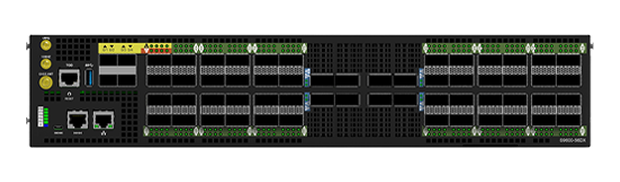 UfiSpace S9600-56DX UfiSpace S9600-56DX |
Broadcom Qumran 2C (BCM88820), 4.8 Tbps, 48×100G + 8×400G, deep buffer | Deep buffer para la absorción de microbursts, y un enlace ascendente coherente de 400G para la red metropolitana, con interoperabilidad probada de múltiples proveedores. El detalle del enlace ascendente de óptica enrutada está en IP over DWDM. |
| Agregación metropolitana / switch L3 | 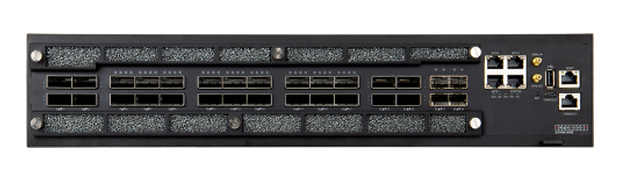 Edgecore AS7946-30XB (AGR400) Edgecore AS7946-30XB (AGR400) |
Broadcom Qumran 2C (BCM88820), 2.4 Tbps, 22×100G + 4×400G, deep buffer | El router de agregación metro de Edgecore sobre el mismo silicio Qumran 2C, buffer profundo con enlace ascendente 400G, para un anillo metro más pequeño. |
| Objetivo del enlace ascendente del core | 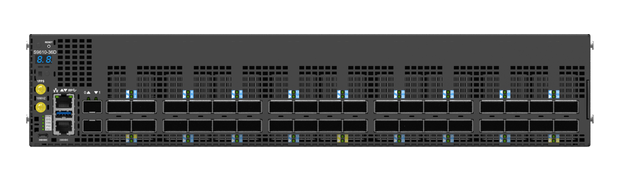 UfiSpace S9610-36D UfiSpace S9610-36D |
Broadcom Jericho2C+ (BCM88850), 14.4 Tbps core | El anillo enlaza hacia arriba al core de 14.4 Tbps. El rol de borde de proveedor y core vive en el IP core spoke. |
| Objetivo del enlace ascendente del core | 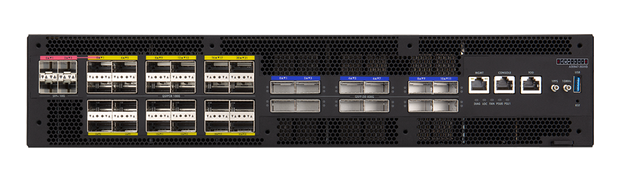 Edgecore AS9947-36XKB (AGR560) Edgecore AS9947-36XKB (AGR560) |
Broadcom Jericho2C+ (BCM88850), 7.2 Tbps core, deep buffer | The Edgecore deep-buffer core uplink on the same Jericho2C+ silicon. The provider edge and core role live on the IP core spoke. |
IP Infusion entrega el router de agregación metropolitana sobre 40+ plataformas cualificadas from Edgecore and UfiSpace, each lab-qualified with OcNOS-SP pre-loaded. See every validated platform in the lista de compatibilidad de hardware, y haga coincidir las funciones con el hardware en la matriz de funciones.
Cuándo encaja el S9600-56DX
- Agregación de anillo metropolitano with MEF services across two or more nodes.
- 400G uplink to the core, or a routed-optical uplink, see IP over DWDM.
- Agregación FTTx y OLT upstream of the access node, see broadband access.
- Temporización del cell-site is a separate role, see mobile transport.
Un servicio E-LINE en un anillo protegido.
A metro E-LINE rides EVPN VPWS over the SR-MPLS underlay while a G.8032 ring protects the ring ports and a Y.1731 MEP reports the service SLA. The block below uses the real OcNOS-SP ERPS, EVPN VPWS, and Y.1731 command families with placeholder values, see the guides for the exact per-node syntax.
! 1. G.8032 (ERPS) ring across the two ring ports
g8032 ring METRO-RING
 east-interface xe1
 west-interface xe2
!    ERP instance, control VLAN, and RPL role per the ERPS guide
! 2. EVPN VPWS (E-Line) on a mac vrf, carried over the SR-MPLS underlay
mac vrf E-LINE-100
 rd <router-id>:100
 route-target both <asn>:100
evpn mpls id <local-id> xconnect target-mpls-id <remote-id> host-reachability-protocol evpn-bgp E-LINE-100
! 3. Bind the access handoff (interface xe10, vlan 100) to E-LINE-100 per the EVPN VPWS guide
! 4. Y.1731 up-MEP on the service reports delay and loss
!    exact ethernet cfm mep form, plus delay-measurement (DMM) and
!    loss-measurement (SLM) profiles, per the OcNOS-SP Y.1731 guide
Qué hace cada paso
- The
g8032 ringwith an east and west interface protects the two ring ports, so the ring keeps one loop-free protected path. - The
mac vrfplusevpn mpls id ... xconnect target-mpls-id ...creates the E-LINE (EVPN VPWS) instance and carries it over the SR-MPLS underlay around the ring. - The access handoff binds to the E-LINE service on the access-facing port and VLAN.
- The Y.1731
ethernet cfm mep, with delay (DMM) and loss (SLM) measurement, reports the per-service SLA, so the operator measures the service it sold.
Representative OcNOS-SP configuration; angle-bracket values are placeholders. Use the OcNOS-SP ERPS, EVPN, and Y.1731 configuration guides for the exact commands and options for your release, documentation.ipinfusion.com.
Convierta el anillo un nodo cada vez.
El anillo metropolitano sigue transportando servicios mientras usted convierte un nodo cada vez al router OcNOS-SP completo. EVPN, SR-MPLS y MEF Carrier Ethernet basados en estándares permiten que un nuevo nodo interopere con la red instalada durante la transición.
Interoperar con la red metropolitana instalada
OcNOS-SP habla EVPN, SR-MPLS, BGP, IS-IS, and MEF Carrier Ethernet, so a new node interoperates with installed Cisco, Juniper, and Nokia equipment, and replaces ZTE.
Convertir un nodo del anillo cada vez
Convierta un nodo del anillo cada vez al router abierto completo mientras el anillo sigue transportando servicios. La migración se mantiene incremental, un nodo por ventana de mantenimiento, sin sustitución total.
Añadir servicios y capacidad más adelante
La misma plataforma asume nuevos servicios y mayor capacidad a medida que la red metropolitana crece, por lo que un nodo se gana más del despliegue en sucesivas ventanas de mantenimiento. IP Infusion da soporte al router en cada paso.
Hay asistencia disponible para la traducción de CLI de Cisco IOS-XR a OcNOS para acelerar la conversión de configuración. Consulte la OcNOS-SP frente a Cisco comparison for capability and licensing detail.
Agregación metropolitana abierta frente a un chasis metropolitano propietario.
Un router abierto soporta Carrier Ethernet con la misma profundidad que un chasis diseñado a medida: los servicios MEF, el anillo EVPN y la medición de SLA por servicio se ejecutan todos en él, y el operador sigue adquiriendo hardware de más de un proveedor bajo un solo contrato.
| Capacidad | Router metropolitano OcNOS-SP (abierto) | Chasis propietario (Cisco / Juniper / Nokia) |
|---|---|---|
| MEF Carrier Ethernet (E-LINE, E-LAN, E-TREE, E-Access) | ✓ | ✓ |
| EVPN sobre MPLS y VxLAN | ✓ details → | ✓ |
| Protección de anillo G.8032 y multihoming EVPN | ✓ | ✓ |
| SLA de retardo y pérdida Y.1731 por servicio | ✓ | ✓ |
| SR-MPLS con Flex-Algo y TI-LFA | ✓ details → | ✓ |
| Router de agregación y switch de capa 3 en una imagen | ✓ | ✓ |
| Se ejecuta en hardware de silicio merchant abierto validado | ✓ Edgecore / UfiSpace, 40+ plataformas | ✓ vendor chassis only |
| Hardware y software con precio y renovación en ciclos separados | ✓ | ✓ bundled |
| Un proveedor es dueño del hardware, el software y la RMA | ✓ un único contrato de soporte | ✓ single vendor |
| Abastezca la caja de más de un proveedor de hardware | ✓ | ✓ |
Cisco, IOS-XR, NCS, Juniper, Junos, ACX, Nokia y SR OS son marcas comerciales de sus respectivos propietarios. IP Infusion no está afiliada a estos proveedores ni los respalda; la comparación refleja las capacidades de OcNOS-SP verificables en la matriz de funciones. To replace a proprietary metro, see the OcNOS-SP frente a Cisco comparison.
Datasheet y brief de SR-MPLS.
El datasheet de OcNOS-SP y el brief de actualización a SR-MPLS para compartir con su equipo. Formulario rápido, y el PDF se descarga de inmediato.
Datasheet de OcNOS-SP
La visión general completa de OcNOS-SP: roles, protocolos, temporización y el hardware validado, en un PDF.
Obtener el datasheetActualización SR-MPLS con OcNOS
Una ruta de migración desde SR-MPLS de Cisco IOS-XR y Juniper Junos hacia OcNOS en hardware abierto.
Obtener el briefPreguntas sobre el router de agregación metropolitana.
Ponga el router metropolitano en su propio hardware.
Descargue la VM de OcNOS y construya un anillo EVPN en su banco de pruebas, o contáctenos para dimensionar el router de agregación metropolitana para su red.
Datasheet de OcNOS-SP
Formulario breve. su PDF se descargará de inmediato tras el envío.
✓ Opening your PDF in a new tab.
Si no se abrió, use el enlace de abajo.
Actualización SR-MPLS con OcNOS
Formulario breve. su PDF se descargará de inmediato tras el envío.
✓ Opening your PDF in a new tab.
Si no se abrió, use el enlace de abajo.
Relacionado del blog
EVPN E-LAN single-homed y multi-homed con IS-IS SR y TI-LFA
Multihoming EVPN E-LAN y reenrutamiento rápido TI-LFA, el transporte detrás del E-LAN metropolitano y los servicios de anillo
Lea la publicación →Por qué los proveedores de servicios despliegan redes abiertas: 5 impulsores
Caso de negocio del operador para trasladar la agregación metropolitana y el enrutamiento de backbone a routers abiertos desagregados
Lea la publicación →