
El fabric de centro de datos leaf-spine completo, en switches abiertos.
IP Infusion ofrece un fabric completo Leaf-spine EVPN-VXLAN para centros de datos: switches de 400G y 800G con OcNOS-DC, precargado y con soporte bajo un único contrato. Usted añade capacidad añadiendo switches, un servidor mantiene el mismo gateway en cualquier leaf y cada tenant permanece aislado, con gateway anycast distribuido, multihoming EVPN, un underlay BGP y aislamiento VRF multi-tenant sobre hardware abierto.
Un switch validado, software y contrato de soporte.
IP Infusion cualifica el switch y OcNOS-DC juntos y les da soporte bajo un contrato, por lo que el fabric que usted diseña es el fabric que se envía. Cada afirmación a continuación se corresponde con una plataforma validada en la lista de hardware y una función soportada en la matrix.
18 plataformas de centro de datos validadas
Cada switch leaf, spine y border es calificado en laboratorio por plataforma con OcNOS-DC precargado, desde leaves de acceso de 100G hasta spines Tomahawk 5 de 800G.
Verificable en la feature matrix
EVPN-VXLAN, la puerta de enlace anycast, el multihoming, el underlay BGP unnumbered y las VNI multi-tenant están cada uno asignados a las plataformas que los admiten.
Switch, software y RMA juntos
Un equipo es dueño del el software, el switch y el RMA, y usted sigue renovando el hardware y OcNOS-DC en ciclos independientes.
Cómo se construye el fabric, y qué le aporta cada nivel.
Los servidores se conectan a los leaves, los leaves se conectan a cada spine, y un nivel border alcanza la WAN y el segundo sitio. La división del trabajo entre estos niveles es lo que le permite añadir capacidad a un nivel sin tocar los otros, y permite que un servidor mantenga la misma puerta de enlace donde sea que aterrice.
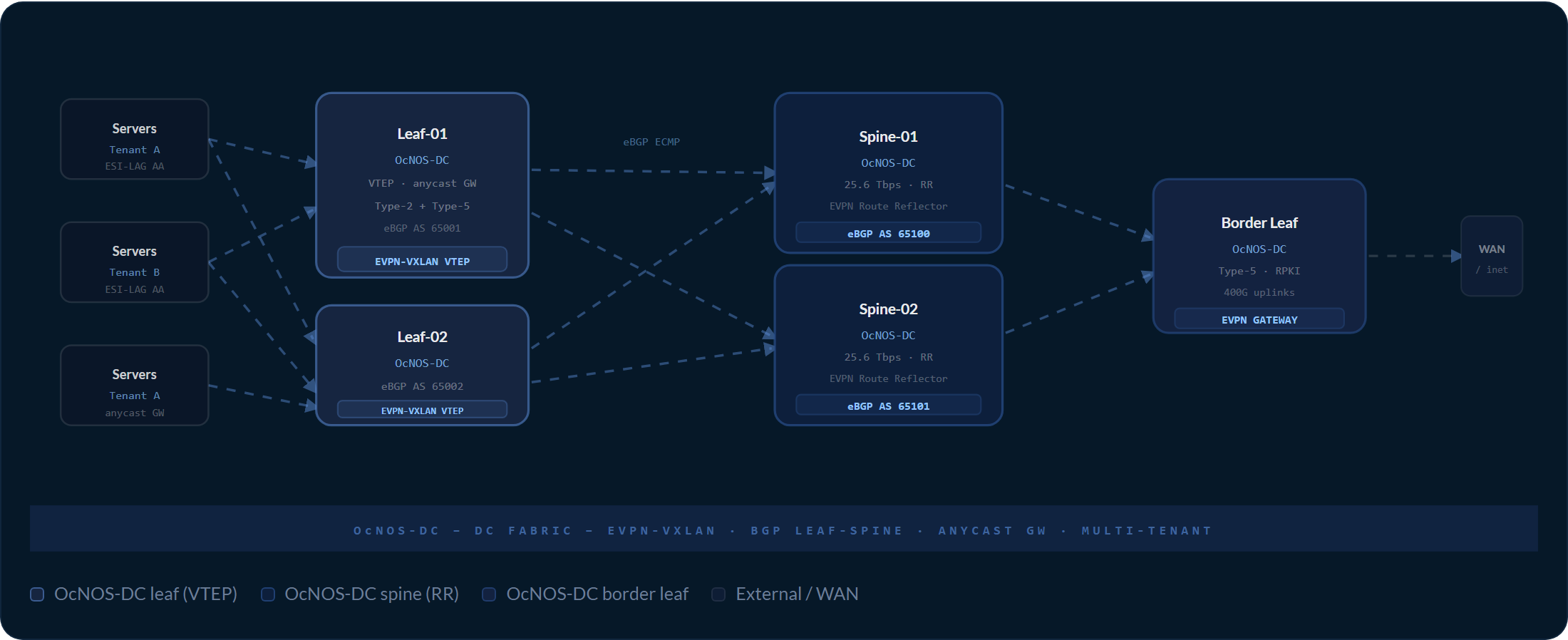
Pase el cursor sobre cada nodo para ver los detalles de rol y plataforma.
La misma imagen OcNOS-DC ejecuta cada nivel, por lo que usted dimensiona y licencia por rol y opera una sola línea base de software en todo el fabric.
Leaf: la rampa de entrada de cada rack
El leaf termina VXLAN y aloja el gateway anycast distribuido, de modo que un servidor ve la misma IP y MAC de gateway en cualquier leaf. Si mueve o añade una carga de trabajo, conserva su ruta predeterminada sin cambiar direcciones.
Usted añade capacidad de servidor añadiendo leaves, en un switch Trident 4 de 400G.
Spine: ancho de banda para todo el fabric
El spine lleva la Underlay BGP unnumbered, refleja las rutas EVPN y reparte el tráfico con ECMP de overlay. No aloja extremos de túnel, así que añadir un spine añade ancho de banda a todo el fabric.
Usted escala más ancho añadiendo spines, sin recablear los leaves.
Border leaf: la salida controlada del fabric
El border leaf ejecuta el Puerta de enlace de capa 3 EVPN y anuncia hacia fuera los prefijos IP de cada tenant, VRF por VRF. Es su único punto de entrega controlado hacia la WAN y hacia el segundo sitio.
También es donde dos fabrics se unen para la interconexión coherente.
Underlay: cableado plug-and-peer
Cada enlace leaf-spine ejecuta BGP-unnumbered con codificación extended next-hop, de modo que un enlace establece la sesión sin una IP por interfaz que asignar ni controlar. Cablear un enlace nuevo es plug-and-peer.
Eso es lo que hace que el fabric sea rápido de cablear y rápido de hacer crecer.
Cómo construye el switch el fabric.
El fabric crece añadiendo switches, no rearquitectando, y EVPN-VXLAN es lo que hace que eso funcione. VXLAN encapsula en túnel el tráfico de tenant entre leaves sobre el underlay IP, y EVPN anuncia dónde vive cada MAC, host y prefijo, de modo que el switch reenvía a partir de un plano de control aprendido en lugar de inundar para encontrar un host.
EVPN anuncia MAC, IP y prefijos
El leaf ejecuta el EVPN de capa 2 para VXLAN como plano de control y la ruta de prefijo para EVPN IRB, de modo que EVPN transporta rutas de host MAC e IP y prefijos IP a través del fabric y cada leaf reenvía a partir de lo aprendido.
Puerta de enlace anycast distribuida
Cada leaf presenta la misma IP y MAC de gateway para una subred, usando varias direcciones IP en la interfaz IRB para el gateway anycast, de modo que un servidor está siempre a un salto de su gateway, sea cual sea el leaf tras el que se encuentre.
Multihoming EVPN, activo-activo
Multihoming EVPN de capa 2 para VXLAN conecta un servidor a dos o más leaves en modo activo-activo sobre un Ethernet Segment. Ambos enlaces reenvían tráfico y no hay peer-link MLAG entre los leaves.
Underlay BGP unnumbered
Cada enlace leaf-spine ejecuta VXLAN EVPN con BGP unnumbered con codificación extended next-hop. Un enlace establece la sesión sin dirección IP por interfaz, lo que mantiene el underlay sencillo de cablear y ampliar.
Aislamiento VRF sobre VNI
Cada tenant vive en su propia VRF sobre sus propias VNI, y la fuga de rutas entre VRF sobre EVPN-VXLAN deja pasar solo los prefijos que usted permite, de modo que el aislamiento es la opción predeterminada y cualquier compartición entre tenants es explícita.
ECMP de overlay y reflexión de rutas
Multipath de igual coste de overlay reparte el tráfico entre todos los spines, y la reflexión de rutas EVPN en el fabric pasa rutas entre leaves sin malla completa, de modo que el fabric crece en anchura añadiendo spines.
Consulte el detalle de la función en la EVPN-VXLAN y multihoming EVPN páginas de tecnología →
De switch básico a leaf de producción en minutos.
Un nuevo switch arranca, obtiene su configuración y se une al fabric sin una sesión de consola. A partir de ahí opera el fabric como código, con telemetría en streaming y configuración basada en modelos en cada plataforma.
ZTP en el arranque
Un switch obtiene su imagen y configuración mediante Zero Touch Provisioning, por lo que pasa de la caja a leaf de producción sin una sesión de consola.
Streaming gNMI
gNMI transmite telemetría a su colector, en dial-in y dial-out, de modo que el estado de leaves y spines es un flujo en vivo en lugar de un sondeo.
NETCONF, OpenConfig, Ansible
Los modelos NETCONF y OpenConfig con Ansible le permiten aplicar y verificar el estado de EVPN y VXLAN como código, de forma consistente en todo el fabric.
sFlow, BFD, graceful restart
sFlow muestrea el tráfico para dar visibilidad, BFD detecta un fallo rápidamente y el graceful restart de BGP mantiene el fabric reenviando mientras un vecino reconverge.
Los mismos switches también ejecutan el conjunto RoCEv2 sin pérdidas para tráfico de GPU, con PFC, ECN y DCQCN. Para un fabric de entrenamiento de GPU, consulte el solución AI Fabric →
Interconecte dos fabrics sobre DCI coherente.
Cuando un operador ejecuta dos centros de datos, los tenants de uno necesitan alcanzar a los tenants del otro, y el fabric se extiende por ambos sitios como una sola red. El border leaf de cada fabric une los dos dominios VXLAN de capa 3, cada fabric anuncia al otro los prefijos IP de sus tenants mediante EVPN, y un enlace coherente 400G OpenZR+ transporta el tráfico entre los sitios, con la misma técnica de óptica enrutada ya probada en routers de proveedores de servicios.
El border leaf une los dominios L3
El gateway EVPN de capa 3 en cada border leaf realiza la unión VXLAN de capa 3, de modo que el dominio VXLAN de un fabric se entrega al otro en capa 3 en lugar de extender un único dominio plano a través de la WAN.
Prefijos Type-5, por tenant
Cada fabric anuncia sus prefijos IP de tenant al otro como Rutas de prefijo IP EVPN, reflejadas por los route servers, y la fuga de rutas entre VRF mantiene aislada la VRF de cada tenant en ambos sitios.
400G ZR+ coherente, sin transponder
Un switch con capacidad ZR+ aloja un 400G OpenZR+ , una óptica coherente, directamente en un puerto del panel frontal e ilumina la longitud de onda, sin un chasis de transpondedores aparte. El mismo DCI coherente de 400G funciona en switches de centro de datos como el Edgecore AS9726-32DB y en los routers de proveedor de servicios ya desplegados para la interconexión, y el fabric Tomahawk 5 de 800G escala la capacidad de puertos detrás de él.
Vista de extremo a extremo
Cambie la vista entre el fabric de un sitio, la unión DCI coherente entre sitios, y el fabric remoto.
Unión DCI coherente. Los dos border leaves unen los fabrics en la capa 3 y encienden un enlace coherente 400G OpenZR+ entre los sitios. Cada fabric anuncia sus prefijos IP de tenant al otro como rutas EVPN Type-5, y el aislamiento VRF por tenant se preserva en ambos sitios.
Fabric del sitio A. Un fabric leaf-spine EVPN-VXLAN: los leaves son los extremos de túnel VXLAN donde se conectan los servidores, el spine transporta el underlay BGP unnumbered y refleja las rutas EVPN, y el border leaf ejecuta el gateway EVPN de capa 3 hacia la interconexión. Unión DCI coherente. Los dos border leaves unen los fabrics en la capa 3 y encienden un enlace coherente 400G OpenZR+ entre los sitios. Cada fabric anuncia sus prefijos IP de tenant al otro como rutas EVPN Type-5, y el aislamiento VRF por tenant se preserva en ambos sitios. Fabric del sitio B. El fabric remoto es un espejo del sitio A: sus propios leaves, spine y border leaf ejecutan las mismas capacidades EVPN-VXLAN, de modo que los tenants del sitio B llegan a los tenants del sitio A a través de la interconexión unida.Qué switch validado para qué rol.
IP Infusion entrega el fabric sobre 18 plataformas de centro de datos validadas de Edgecore y UfiSpace, cada una calificada en laboratorio por plataforma con OcNOS-DC precargado. Los leaves se dimensionan por número de puertos y el gateway anycast; los spines por la anchura del fabric; el leaf de interconexión por la óptica coherente.
| Función | Switch validado | Silicio y capacidad | Por qué encaja en el rol |
|---|---|---|---|
| Leaf (400G) | Edgecore AS9726-32DB / UfiSpace S9300-32D | Broadcom Trident 4, 12.8 Tbps, 400G | El nivel VTEP: puertos orientados al servidor, la puerta de enlace anycast distribuida y el multihoming EVPN. |
| Spine (400G) | Edgecore AS9736-64D | Broadcom Tomahawk 4, 25.6 Tbps, 400G | ECMP de underlay y reflexión de rutas EVPN, sin VTEP, dimensionado para el ancho del fabric. |
| Spine / super-spine (800G) | Edgecore AIS800-64D / UfiSpace S9321-64E | Broadcom Tomahawk 5, 51.2 Tbps, 800G | Escalado horizontal de 800G para los fabrics más grandes. El AIS800-64D utiliza óptica QSFP-DD800. |
| Leaf de interconexión (400G coherente) | Edgecore AS9726-32DB | Broadcom Trident 4, 12,8 Tbps, 32×400G, 400G ZR+ coherente | Aloja un pluggable coherente 400G OpenZR+ en un puerto QSFP-DD y enciende la longitud de onda de interconexión directamente, sin transponder externo. |
| Leaf / ToR de 100G | Edgecore AS7726-32X / UfiSpace S9110-32X | Broadcom Trident 3, 3.2 Tbps, 100G | Leaves de nivel de acceso para racks de servidores de 25G y 100G. |
18 plataformas de centro de datos validadas. Consulte todas las plataformas validadas, incluido el resto del portfolio, en la lista de compatibilidad de hardware, y haga coincidir las funciones con el hardware en la matriz de funciones.
Compare todo el portafolio de silicio Broadcom en el que se ejecuta OcNOS, StrataXGS y StrataDNX →
Cómo dimensionar el fabric
- Nivel leaf. Ponga los leaves en Trident 4 de 400G para el VTEP, la puerta de enlace anycast y el multihoming EVPN, o en un leaf Trident 3 de 100G para racks de servidores de 25G y 100G.
- Nivel spine. Ponga los spines en Tomahawk 4 de 400G, o en Tomahawk 5 de 800G cuando el fabric necesite escalar más ancho, y añada spines en lugar de tocar los leaves.
- Leaf de interconexión. Use el AS9726-32DB con pluggables coherentes 400G OpenZR+ en sus puertos QSFP-DD cuando el fabric se extienda a un segundo sitio, para que el leaf de interconexión encienda la longitud de onda directamente.
- Un solo contrato. IP Infusion valida y da soporte a cada rol como un solo sistema, y el switch y OcNOS-DC se renuevan en ciclos independientes.
Configurar un VTEP de leaf.
Cada leaf termina túneles VXLAN, aloja el gateway anycast distribuido y ejecuta la familia de direcciones EVPN en BGP. A continuación se muestra una configuración representativa de un leaf OcNOS-DC: VXLAN con enrutamiento y bridging integrados, un tenant con su VNI de capa 3 y su dominio de bridge, el gateway anycast distribuido con una MAC compartida, la asignación de VNI a tenant y EVPN bajo BGP.
! Leaf VTEP: VXLAN overlay, distributed anycast gateway, EVPN in BGP
configure terminal
nvo vxlan enable
nvo vxlan irb
evpn irb-forwarding anycast-gateway-mac 0000.0000.1111
ip vrf tenant1
 l3vni 5010
mac vrf tenant1_l2
 rd 10.0.0.1:10
 route-target both 100:10
interface irb10
 ip vrf forwarding tenant1
 ip address 10.10.10.1/24 anycast
 evpn irb-if-forwarding anycast-gateway-mac
nvo vxlan id 10 ingress-replication inner-vid-disabled
 vxlan host-reachability-protocol evpn-bgp tenant1_l2
 evpn irb10
nvo vxlan vtep-ip-global 10.0.0.1
router bgp 65001
 neighbor 10.0.1.1 remote-as 65000
 address-family l2vpn evpn
  neighbor 10.0.1.1 activate
Qué hace cada línea
nvo vxlan enableynvo vxlan irbactivan VXLAN y el enrutamiento y bridging integrados, de modo que el leaf conmuta dentro de una subred y enruta entre subredes a través del fabric.evpn irb-forwarding anycast-gateway-mac 0000.0000.1111establece una MAC de gateway compartida para todo el fabric, de modo que cada leaf responde como el mismo gateway predeterminado.ip vrf tenant1yl3vni 5010dan juntos al tenant su propia tabla de enrutamiento y el VNI de capa 3 que transporta el tráfico enrutado entre subredes a través del fabric.mac vrf tenant1_l2define el dominio de bridge del tenant, y susrdyroute-target bothle asignan un route distinguisher y targets de importación y exportación, de modo que EVPN mantiene separadas las rutas MAC e IP de cada tenant.interface irb10es el gateway del tenant:ip vrf forwarding tenant1lo vincula a la tabla del tenant,ip addressestablece la IP del gateway, yevpn irb-if-forwarding anycast-gateway-macaplica la MAC anycast compartida a esta interfaz.nvo vxlan id 10(bloque) asigna el VNI 10 al tenant, usa replicación de entrada para el tráfico broadcast y multicast, y establecehost-reachability-protocol evpn-bgppara que BGP EVPN aprenda la alcanzabilidad de los hosts.nvo vxlan vtep-ip-global 10.0.0.1establece la dirección del extremo del túnel, una loopback, que identifica a este leaf en el fabric.router bgp 65001yneighbor 10.0.1.1 remote-as 65000establecen juntos la sesión con el spine, y eladdress-family l2vpn evpn(bloque) activa EVPN para que el leaf anuncie y aprenda rutas MAC, IP y de prefijo.
Estos son comandos VXLAN y EVPN de OcNOS-DC tomados de la guía de configuración de OcNOS-DC, mostrados con VNI, nombres de VRF y direcciones de ejemplo en lugar de copiados de un equipo. Confirme los ID, route targets y direcciones exactos para su fabric en la guía de configuración VXLAN y EVPN de OcNOS-DC en documentation.ipinfusion.com.
Switch de fabric abierto frente a un switch de centro de datos propietario.
Frente a Arista o Cisco, la pregunta sobre el fabric es si un switch abierto ejecuta leaf-spine EVPN-VXLAN de forma tan completa. OcNOS-DC lo hace, sobre silicio merchant que el operador puede comprar a más de un proveedor, todo bajo un único contrato de soporte.
| Capacidad del fabric | Switch abierto (OcNOS-DC) | Propietario (Arista EOS / Cisco NX-OS / Juniper Junos) |
|---|---|---|
| Fabric leaf-spine EVPN-VXLAN | ✓ detalles → | ✓ |
| Puerta de enlace anycast distribuida | ✓ | ✓ |
| Multihoming EVPN (ESI-LAG, sin dependencia de MLAG) | ✓ | ✓ |
| Underlay BGP unnumbered | ✓ detalles → | ✓ |
| Aislamiento VRF y VNI multi-tenant | ✓ | ✓ |
| ZTP, gNMI, NETCONF y OpenConfig | ✓ | ✓ |
| 800G en Tomahawk 5 | ✓ | ✓ |
| Aprovisionamiento de hardware | Silicio merchant abierto de múltiples proveedores | Switch de un solo proveedor |
| Entrega y soporte | Switch completo, un contrato de soporte, renovación de switch y software por separado | Integrado por el proveedor |
Arista, EOS, Cisco, NX-OS, Nexus, Juniper y Junos son marcas comerciales de sus respectivos propietarios. IP Infusion no está afiliada a estos proveedores ni los respalda; la comparación refleja las capacidades de OcNOS-DC verificables en la matriz de funciones.
Solution briefs y datasheet.
El brief del fabric EVPN-VXLAN, el brief de DCI de óptica enrutada y el datasheet de OcNOS-DC para compartir con su equipo. Formulario rápido, y el PDF se descarga de inmediato.
Fabric DC EVPN-VXLAN
Cómo encaja el fabric leaf-spine: EVPN-VXLAN, la puerta de enlace anycast, el multihoming y las VNI multi-tenant en switches abiertos.
Obtener el briefDCI de óptica enrutada con 400G OpenZR+
La técnica de interconexión de óptica enrutada: una óptica coherente 400G OpenZR+ en el border leaf enciende la longitud de onda entre sitios, sin transponder separado.
Obtener el briefDatasheet de OcNOS-DC
La visión general de OcNOS-DC: el conjunto de funciones del fabric, el hardware de centro de datos validado y las operaciones, en un PDF.
Obtener el datasheetPreguntas sobre el fabric de centro de datos.
Consulte el fabric de centro de datos abierto.
Vea cómo IP Infusion entrega el fabric leaf-spine EVPN-VXLAN como un solo sistema, o contáctenos para mapear sus leaves, spines e interconexión a las plataformas validadas adecuadas.
DCI de óptica enrutada con 400G OpenZR+
Formulario breve. su PDF se descargará de inmediato tras el envío.
✓ Abriendo su PDF en una pestaña nueva.
Si no se abrió, use el enlace de abajo.
Fabric DC EVPN-VXLAN
Formulario breve. su PDF se descargará de inmediato tras el envío.
✓ Abriendo su PDF en una pestaña nueva.
Si no se abrió, use el enlace de abajo.
Datasheet de OcNOS-DC
Formulario breve. su PDF se descargará de inmediato tras el envío.
✓ Abriendo su PDF en una pestaña nueva.
Si no se abrió, use el enlace de abajo.
Relacionado del blog
ECMP de overlay en un fabric leaf-spine EVPN-VXLAN, parte 1
Cómo el ECMP de overlay EVPN-VXLAN balancea la carga en un fabric de centro de datos leaf-spine Clos
Lea la publicación →ECMP de overlay en un fabric leaf-spine EVPN-VXLAN, parte 2
La segunda parte del recorrido de ECMP de overlay EVPN-VXLAN para el fabric de centro de datos
Lea la publicación →