EVPN-VXLAN fabrics for 400G and 800G data centers
IP Infusion delivers the complete data center fabric: OcNOS-DC preloaded on qualified switches from 100G to 800G, under one support contract. Leaves run EVPN-VXLAN with a distributed anycast gateway and EVPN multihoming, and spines carry the IP underlay. Add switches to grow.
How the fabric works
A data center fabric connects every server in the building. In a leaf-spine design every leaf reaches every other leaf through one spine, EVPN-VXLAN lets many tenants share the fabric in isolation, and dual-homed servers stay reachable when a leaf goes down.
Each tenant gets its own VRF and VNIs. Only prefixes you permit cross between them.
A server links to two leaves on one Ethernet segment. If one leaf goes down, traffic keeps flowing through the other, with no peer-link. MLAG is supported too.
EVPN multihoming →A distributed anycast gateway lets a workload move between racks without re-addressing.
EVPN-VXLAN →Add leaves for servers and spines for bandwidth. The rest of the fabric stays as it is.
BGP underlay →Running in production
Data center operators that moved to OcNOS on open switches.
Madeo Consultant, France
Replaced its incumbent switches with OcNOS on Edgecore and UfiSpace.
“We are now delivering software as a service more efficiently, thanks to the increased performance and future-proofing achieved with IP Infusion’s solution.”
François Defrocourt, Solutions Engineer
Scott Data, Omaha
Runs OcNOS on UfiSpace, Edgecore and Celestica. Lead times went from years to weeks.
“OcNOS and an open networking strategy hits all the right notes in terms of cost, support, and features.”
Ken Moreano, CEO
Technical summary
What OcNOS-DC runs in the fabric. Follow a link for the deep dive.
| Area | OcNOS-DC | Deep dive |
|---|---|---|
| Overlay | EVPN-VXLAN for Layer 2 and Layer 3: IRB with a distributed anycast gateway, and EVPN prefix routes (Type 5) for tenant subnets. | EVPN → |
| Underlay | BGP unnumbered with extended next hop, ECMP for VXLAN traffic, and BFD for fast failure detection. | BGP → |
| Multihoming | EVPN multihoming for dual-homed servers, with no peer-link. MLAG is supported too. | Multihoming → |
| Tenancy | Per-tenant VRFs and VNIs, inter-VRF route leaking, route-target filtering, and EVPN MAC limits. | |
| Border and DCI | EVPN Layer 3 gateway and VXLAN Layer 3 stitching at the border leaf, with 400G OpenZR+ optics on supported switches. | Coherent DCI → |
| Security | Storm control, ARP ACLs, dynamic ARP inspection and ACLs on IRB interfaces. | |
| Visibility | gNMI streaming telemetry using OpenConfig models, SNMP VXLAN statistics, and ERSPAN on VXLAN access ports. | Telemetry → |
| Automation | ZTP over IPv4 and IPv6, Ansible, and NETCONF with YANG models. | Automation → |
| Lossless traffic | PFC and ECN for RoCEv2 traffic across the VXLAN fabric. | AI fabric → |
Support varies by switch model. Check each platform in the OcNOS Feature Matrix.
Switches by role
18 qualified data center platforms from Edgecore, UfiSpace and Celestica.
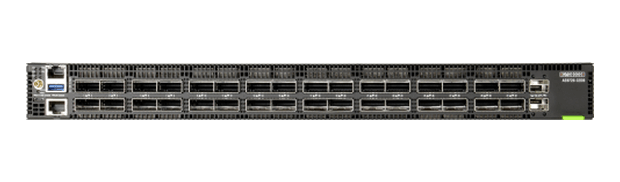
Leaf and interconnect leaf
Edgecore AS9726-32DB / UfiSpace S9300-32D
Broadcom Trident 4 · 12.8 Tbps · 400G
The AS9726-32DB also seats a 400G OpenZR+ optic for the interconnect.
Datasheet →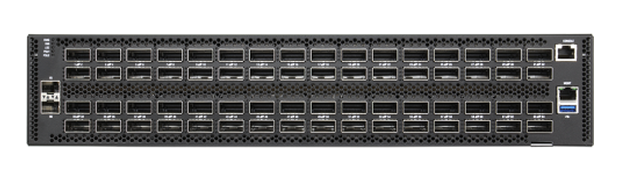
Spine (400G)
Edgecore AS9736-64D
Broadcom Tomahawk 4 · 25.6 Tbps · 64 x 400G
Underlay ECMP and EVPN route reflection, sized for fabric width.
Datasheet →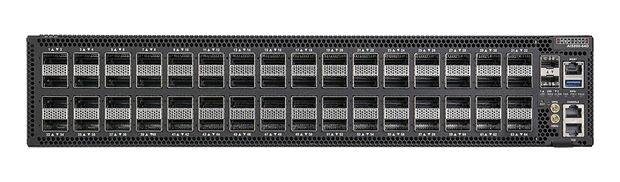
Spine and super-spine (800G)
Edgecore AIS800-64D / UfiSpace S9321-64E
Broadcom Tomahawk 5 · 51.2 Tbps · 64 x 800G
800G spine ports for wider fabrics.
Datasheet →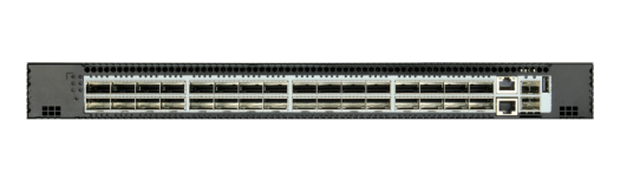
100G leaf / ToR
Edgecore AS7726-32X / UfiSpace S9110-32X
Broadcom Trident 3 · 3.2 Tbps · 100G
Access leaves for 25G and 100G server racks.
Datasheet →Optics have proven multi-vendor interoperability. Ask us for the transceiver list. See every qualified platform.
One system, one contract
Bought as OcNOS Systems: switch, OcNOS-DC and support from one vendor.
Qualified build
OcNOS-DC preloaded, qualified per switch model and ASIC stepping.
One support path
One PO, one support contract, one RMA path. P1 response from 8 hours (Standard) to 30 minutes (Enterprise).
Zero-touch Day 0
A new switch pulls its configuration and joins the fabric. No console session.
Day 2 operations
gNMI, NETCONF, OpenConfig and Ansible. Refresh switch and software on their own cycles.
The same switches run lossless RoCEv2 for GPU traffic. See the AI Fabric solution →
Two sites, one routed interconnect
Border leaves join two fabrics at Layer 3 over 400G OpenZR+.
Layer 3 stitch
Each border leaf stitches its VXLAN domain to the other site. No flat Layer 2 stretch.
Per-tenant routes
EVPN Type-5 routes carry each tenant's prefixes. Isolation holds across both sites.
No transponder
A 400G OpenZR+ optic in the switch port lights the wavelength.
Take the design to your team
Short PDFs. A quick form, then the download starts.
EVPN-VXLAN data center fabric
Anycast gateway, multihoming and multi-tenant VNIs on open switches.
Get the briefRouted optical DCI with 400G OpenZR+
How the border leaf lights the wavelength between sites.
Get the briefOcNOS-DC datasheet
Feature set, qualified hardware and operations.
Get the datasheetFrequently asked questions
Map your fabric with our engineers
Tell us your racks, tenants and sites. We match them to qualified switches.
Routed Optical DCI with 400G OpenZR+
Quick form. Your PDF will download immediately after submit.
✓ Opening your PDF in a new tab.
If it did not open, use the link below.
EVPN-VXLAN Data Center Fabric
Quick form. Your PDF will download immediately after submit.
✓ Opening your PDF in a new tab.
If it did not open, use the link below.
OcNOS-DC Datasheet
Quick form. Your PDF will download immediately after submit.
✓ Opening your PDF in a new tab.
If it did not open, use the link below.