
Border Gateway Protocol
The interdomain routing protocol of the internet, and the control plane of modern DC fabrics. OcNOS implements BGP-4 (RFC 4271) for SP transit, IXP peering, and leaf-spine DC underlay.
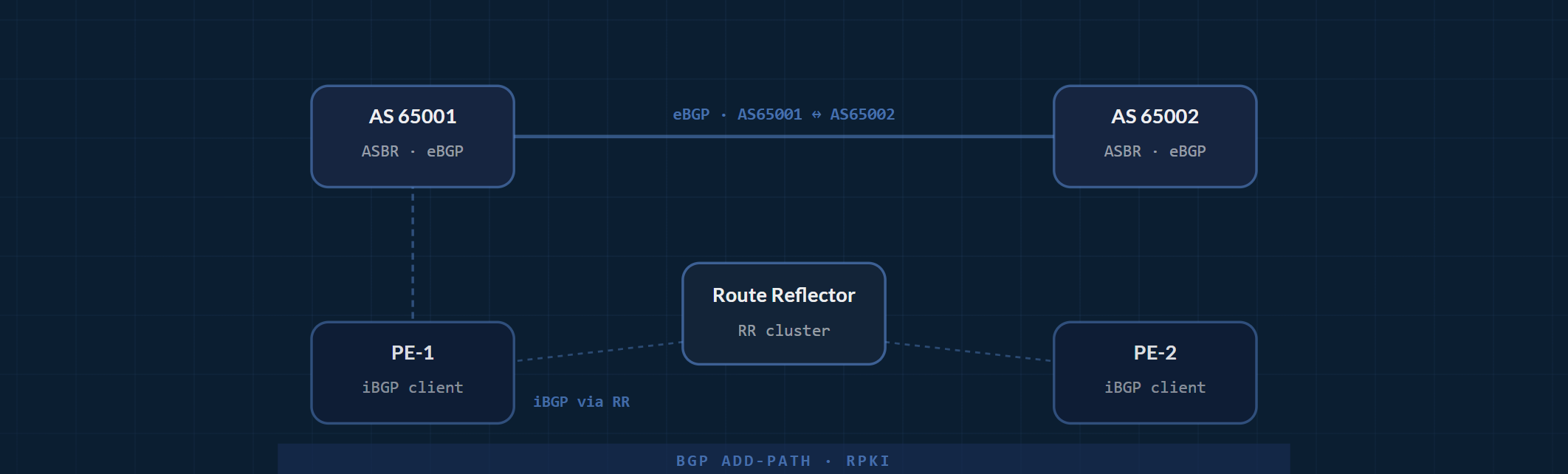
BGP Peering Topology
Two autonomous systems exchanging routes via eBGP, with the local AS running iBGP through a Route Reflector to scale full-mesh peering.
BGP in Service Provider and DC Contexts
BGP-4 (RFC 4271) is a path-vector protocol that exchanges reachability information between autonomous systems. Its policy model, including route maps, community tagging, and AS-path filtering, gives operators precise control over traffic engineering across AS boundaries. The BGP multi-protocol extensions (RFC 4760) allow the same session to carry multiple address families: IPv4, IPv6, VPN, EVPN, SR-TE, and more.
In the data center, BGP has replaced OSPF and IS-IS as the de facto underlay in large-scale leaf-spine designs. RFC 7938 (Use of BGP for Routing in Large-Scale Data Centers) documents this shift: eBGP as the only routing protocol, a private ASN for each leaf with one ASN shared by the spines, and BGP multipath for ECMP load distribution. OcNOS supports this design with BGP unnumbered (RFC 5549), ADD-PATH (RFC 7911) and eBGP and iBGP multipath.
BGP-LU (RFC 3107) distributes MPLS labels with BGP prefixes, enabling inter-AS MPLS LSP stitching without LDP. This is the foundation for BGP-signaled L3VPN Option C deployments across AS boundaries without exchanging full VPN routing tables at the border.
BGP FlowSpec
BGP FlowSpec (RFC 5575, RFC 8955) distributes traffic flow specifications as BGP routes. Each FlowSpec route matches fields such as prefix, protocol, port or DSCP and carries a REDIRECT or RATE-LIMIT action. This enables distributed DDoS mitigation at the network edge: a controller pushes a FlowSpec prefix to all PE routers simultaneously, black-holing or rate-limiting attack traffic without manual per-device configuration.
OcNOS Implementation
BGP-4 Base
4-byte ASN (RFC 6793). MD5 TCP authentication (RFC 2385). Graceful Restart (RFC 4724). BGP NOTIFICATION reason codes.
Route Reflector
RR cluster support. Multiple RR clients per cluster. ORIGINATOR_ID and CLUSTER_LIST loop prevention. Confederation support (RFC 5065). On-demand RR for scaled deployments.
ADD-PATH / ECMP
RFC 7911 ADD-PATH, with eBGP and iBGP multipath load sharing.
BGP-LU
RFC 3107 labeled unicast. Per-prefix label allocation. Inter-AS MPLS LSP stitching without LDP. Compatible with SR-MPLS co-existence.
FlowSpec
RFC 8955 BGP FlowSpec on OcNOS-SP, from OcNOS 6.3.0.
EVPN Address Family
L2VPN EVPN AFI/SAFI (25/70). Type-2, Type-3, Type-4, Type-5 routes. RT import/export policy. eBGP EVPN for DC leaf-spine.
BFD Fast Drain
BFD for BGP (RFC 5882). Sub-second peer failure detection. Per-session BFD discriminator. Integrated with ECMP next-hop withdrawal on BFD down.
Policy & Filtering
Route maps, prefix-lists, community-lists. Large community (RFC 8092). Extended community for VPN RT. AS-path regex filtering. NEXT_HOP rewrite and local preference manipulation.
OcNOS-Qualified Hardware
For reference only. The platforms below are a representative subset of BGP-qualified hardware. The complete, current list of qualified platforms, with ASIC, port density, and version coverage, is maintained in the OcNOS Hardware Compatibility List.
Related Technologies & Solutions
Compare BGP support across all OcNOS-qualified platforms
Open Feature Matrix →Frequently asked questions
What is BGP used for?
Why is BGP used in data center fabrics instead of OSPF or IS-IS?
What is BGP FlowSpec?
What is BGP-LU?
Which hardware runs OcNOS BGP?
Go deeper. Take it with you.
The product datasheet plus short, technical downloads that go further than this page.
OcNOS-SP Datasheet
Full OcNOS-SP specification: the access, cell site and aggregation feature set, software SKUs, supported hardware platforms, and the solution ordering guide.
Get the datasheetSR-MPLS Upgrade with OcNOS
Migrate SR-MPLS onto OcNOS on open hardware: Flex-Algo, TI-LFA, and a node-by-node cutover path.
Get the briefCloud & Service Provider WAN Transport
Cloud and service-provider WAN transport on open hardware: SR-MPLS, EVPN, and scale-tested forwarding.
Get the briefOcNOS-SP Datasheet
Quick form. Your PDF opens in a new tab immediately after submit.
✓ Opening your PDF in a new tab…
If it didn't open, use the link below.
SR-MPLS Upgrade with OcNOS
Quick form. Your PDF opens in a new tab immediately after submit.
✓ Opening your PDF in a new tab…
If it didn't open, use the link below.
Cloud & Service Provider WAN Transport
Quick form. Your PDF opens in a new tab immediately after submit.
✓ Opening your PDF in a new tab…
If it didn't open, use the link below.