
Segment Routing over IPv6
SR applied to the IPv6 data plane: segment lists encoded as a sequence of IPv6 addresses in an SRH extension header, enabling source routing without MPLS labels or additional encapsulation overhead.
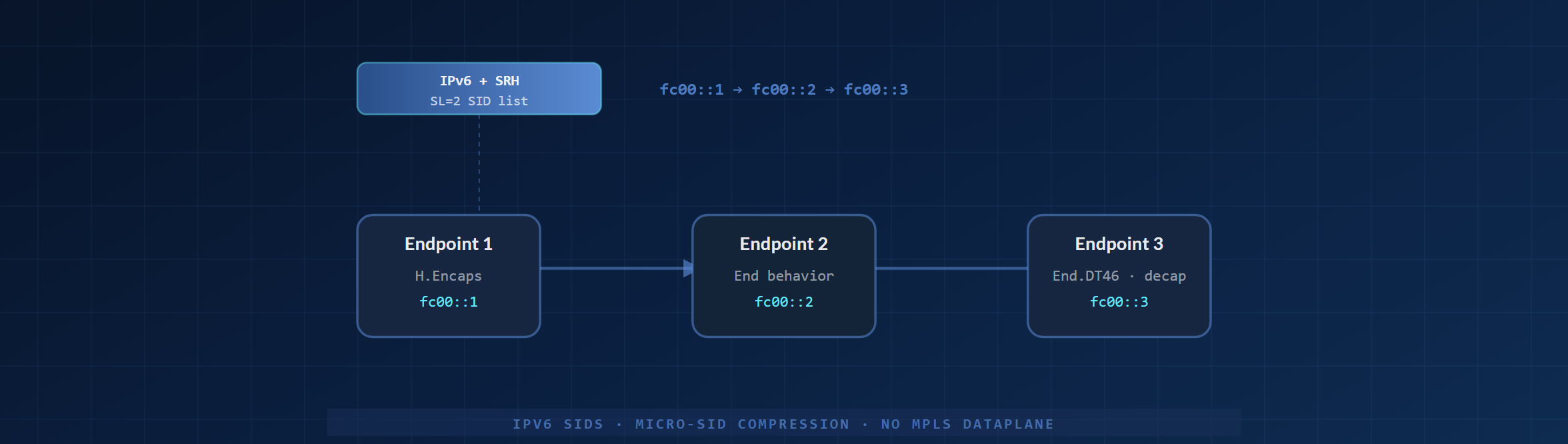
SRv6 SID List Forwarding
A packet traverses three SR endpoints. The SID list is encoded directly in the IPv6 destination address: each hop pops the active uSID and forwards on the next.
What is Segment Routing?
Segment Routing (RFC 8402) is a source-routing architecture. The head-end encodes the path a packet takes as an ordered list of instructions called segments, and the network forwards on that list without holding per-flow state at every hop. It runs on two data planes: SR-MPLS carries the segment list as an MPLS label stack, and SRv6 carries it as a list of IPv6 addresses. This page covers SRv6, and the SR-MPLS data plane is documented on its own page.
What SRv6 Is
SRv6 (RFC 8986) encodes a source-initiated path as an ordered list of IPv6 addresses called SIDs, each representing a topological instruction (segment) at a specific node. The Segment Routing Header (SRH, RFC 8754) carries the SID list in the IPv6 extension header stack. At each SR node, the active SID is processed, the SL (Segments Left) pointer is decremented, and the IPv6 DA is updated to the next SID.
SRv6 SIDs are routable IPv6 addresses structured with a Locator (topologically significant prefix, typically /48 or /64) and a Function (behavior identifier). This means SR forwarding state is embedded in the IPv6 routing table: no separate label space, no LFIB, no MPLS-specific HW resources. Transit nodes need no SRH awareness unless they are SR endpoints.
SRv6 uSID (draft-ietf-spring-srv6-srh-compression) compresses the SID encoding significantly: multiple micro-SIDs are packed into a single 128-bit IPv6 address, reducing per-hop processing and header overhead to levels competitive with SR-MPLS in typical SP deployments.
SRv6 Network Programming
RFC 8986 defines a set of SRv6 endpoint behaviors: End (SR endpoint), End.X (endpoint with cross-connect), End.T (endpoint with table lookup), End.DT4/DT6/DT46 (endpoint with decap and L3 table lookup). These behaviors implement the full VPN forwarding function within the SID semantics, enabling L3VPN and L2VPN services over a pure IPv6 core.
OcNOS-SP Implementation
IS-IS SRv6 Extensions
IS-IS with SRv6 extensions (draft-ietf-lsr-isis-srv6-extensions). Locator advertisement, SID sub-TLV per prefix. Flexible Algorithms for topology-aware SID assignment.
uSID Compression
uSID implementation per draft-ietf-spring-srv6-srh-compression. /32 block, /48 locator. Multiple uSIDs packed per 128-bit address. Compatible with existing IPv6 forwarding HW: no SRH processing at transit.
H.Encaps Behavior
Head-end encapsulation inserting a new IPv6 outer header with SRH. H.Encaps.Red for reduced SRH (single SID). Supports policy-based steering by match criteria.
SRv6-TE Policies
SRv6 traffic engineering policies with explicit SID lists. PCE-computed paths via PCEP. BGP SR-TE for cross-domain policy distribution.
L3VPN over SRv6
End.DT46 behavior for decap and VRF lookup. BGP L3VPN with SRv6 transport per RFC 9252 (BGP Overlay Services on SRv6). Per-VRF SID allocation from Locator block.
SR-MPLS Co-existence
SRv6 and SR-MPLS active simultaneously on the same node. Per-VPN transport plane selection. Interworking function for cross-domain stitching at domain boundaries.
OcNOS-Validated Hardware
For reference only. The platforms below are a representative subset of SRv6-validated hardware. The complete, current list of qualified platforms, with ASIC, port density, and version coverage, is maintained in the OcNOS Hardware Compatibility List.
Related Technologies & Solutions
Compare SRv6 support across all OcNOS-validated platforms
Open Feature Matrix →Frequently asked questions
What is SRv6?
What is the difference between SRv6 and SR-MPLS?
What is a uSID in SRv6?
Does SRv6 need MPLS?
What is the SRH in SRv6?
Should I choose SRv6 or SR-MPLS?
Does SRv6 support L3VPN?
What hardware supports SRv6 in OcNOS?
Go deeper. Take it with you.
The product datasheet plus short, technical downloads that go further than this page.
OcNOS-SP Datasheet
Full OcNOS-SP specification: the access, cell site and aggregation feature set, software SKUs, supported hardware platforms, and the solution ordering guide.
Get the datasheetSR-MPLS Upgrade with OcNOS
Migrate SR-MPLS onto OcNOS on open hardware: Flex-Algo, TI-LFA, and a proven Cisco-alternative cutover path.
Get the briefCloud & Service Provider WAN Transport
Cloud and service-provider WAN transport on open hardware: SR-MPLS, EVPN, and scale-tested forwarding.
Get the briefOcNOS-SP Datasheet
Quick form. Your PDF opens in a new tab immediately after submit.
✓ Opening your PDF in a new tab…
If it didn't open, use the link below.
SR-MPLS Upgrade with OcNOS
Quick form. Your PDF opens in a new tab immediately after submit.
✓ Opening your PDF in a new tab…
If it didn't open, use the link below.
Cloud & Service Provider WAN Transport
Quick form. Your PDF opens in a new tab immediately after submit.
✓ Opening your PDF in a new tab…
If it didn't open, use the link below.