MPLS Traffic Engineering: RSVP-TE, FRR, Bandwidth Constraints
MPLS Traffic Engineering (MPLS-TE) forwards traffic along bandwidth-reserved, explicitly routed label-switched paths instead of the IGP shortest path. RSVP-TE signals each LSP, CSPF computes a path that meets the constraints, and Fast Reroute pre-programs a backup bypass tunnel at every point of local repair. OcNOS implements the full RSVP-TE stack (CSPF, FRR link/node protection, DS-TE class-types, and auto-bandwidth) alongside SR-MPLS, on the same chassis.
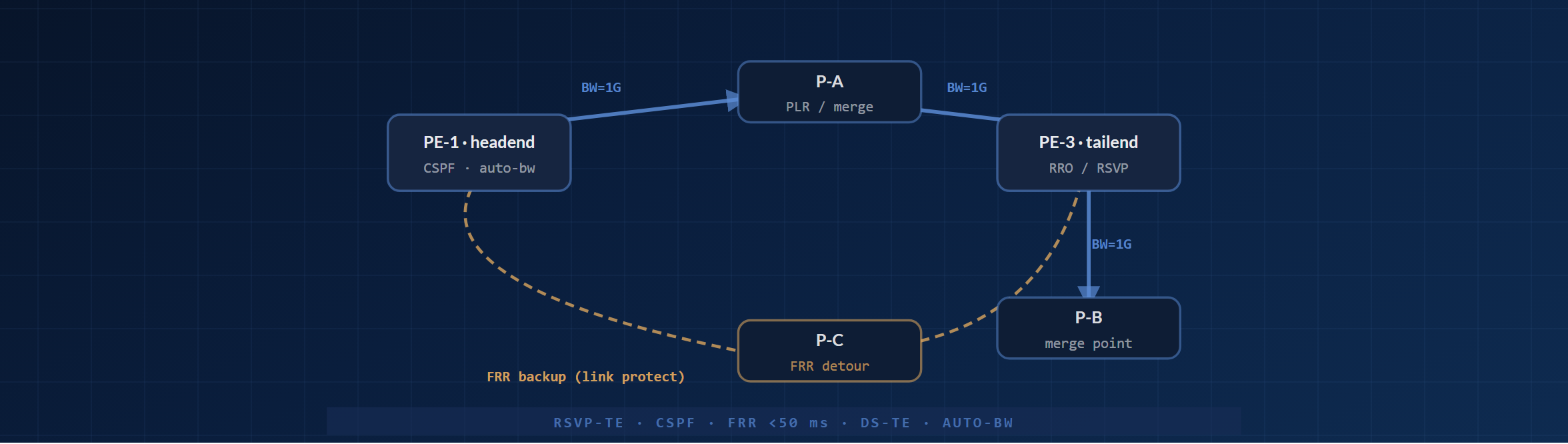
RSVP-TE LSP with FRR Backup
A four-router ring carrying a primary RSVP-TE LSP from PE-1 to PE-3. The primary path (solid) is the CSPF-computed shortest path that meets the 1G bandwidth constraint; the FRR backup (dashed) protects the primary against a P-A link or node failure.
Where MPLS-TE still wins
Segment Routing handles most modern transport with less state in the network, but RSVP-TE still does one thing better: strict bandwidth admission control across the network, because it reserves bandwidth per LSP at every hop. For carriers with strict SLA contracts, capacity-managed wholesale services, or per-class-type DiffServ guarantees, OcNOS delivers a complete RSVP-TE stack that runs alongside (or instead of) SR-MPLS on the same hardware.
The OcNOS MPLS-TE implementation
Path / Resv signalling
Full RSVP-TE signalling with explicit-route (ERO), record-route (RRO), graceful restart, hello-based detection, and refresh reduction.
Constraint-based path
CSPF using IGP-TE extensions (OSPF-TE / IS-IS-TE): bandwidth, affinity, hop-count, SRLG-disjoint, and admin-group constraints.
Link / node protection
Facility-mode FRR with bypass tunnels at every PLR. Sub-50 ms repair on link, node, or SRLG failure with bandwidth-aware backup selection.
Class-types & bandwidth pools
Diffserv-aware TE (RFC 4124) with per-class-type bandwidth pools, in the OcNOS-SP CSR, MPLS and PLUS SKUs.
DS-TEAdaptive reservation
Auto-bandwidth resizing based on observed utilization with configurable adjust-interval and overflow / underflow thresholds.
Per-domain expansion
Inter-AS TE LSPs with per-domain ERO expansion and PCE-based stitching for multi-AS service provider deployments.
What you get with OcNOS MPLS-TE
- Coexists with SR-MPLS. Run RSVP-TE for legacy services and SR-MPLS for new ones on the same router: same IGP, same forwarding plane.
- Carrier-grade scale. Tested with thousands of LSPs per node, including auto-bandwidth resize churn and large FRR backup meshes.
- Operational tooling. CLI and gNMI streaming for LSP state, RSVP neighbour status, and bandwidth-pool utilization per class-type.
- PCE-ready. PCEP support for stateful PCE deployments, including PCInitiate for controller-driven LSP placement.
Designing a TE-managed transport core?
Request a Technical Demo →Frequently asked questions
What is MPLS Traffic Engineering?
What is RSVP-TE Fast Reroute (FRR)?
When should I use MPLS-TE instead of Segment Routing?
Can OcNOS run MPLS-TE and SR-MPLS together?
What is DS-TE in OcNOS?
Go deeper. Take it with you.
The product datasheet plus short, technical downloads that go further than this page.
OcNOS-SP Datasheet
Full OcNOS-SP specification: the access, cell site and aggregation feature set, software SKUs, supported hardware platforms, and the solution ordering guide.
Get the datasheetSR-MPLS Upgrade with OcNOS
Migrate SR-MPLS onto OcNOS on open hardware: Flex-Algo, TI-LFA, and a proven Cisco-alternative cutover path.
Get the briefCloud & Service Provider WAN Transport
Cloud and service-provider WAN transport on open hardware: SR-MPLS, EVPN, and scale-tested forwarding.
Get the briefOcNOS-SP Datasheet
Quick form. Your PDF opens in a new tab immediately after submit.
✓ Opening your PDF in a new tab…
If it didn't open, use the link below.
SR-MPLS Upgrade with OcNOS
Quick form. Your PDF opens in a new tab immediately after submit.
✓ Opening your PDF in a new tab…
If it didn't open, use the link below.
Cloud & Service Provider WAN Transport
Quick form. Your PDF opens in a new tab immediately after submit.
✓ Opening your PDF in a new tab…
If it didn't open, use the link below.