RoCE vs InfiniBand for AI clusters
RoCEv2 runs RDMA over open, multi-vendor Ethernet; InfiniBand is a single-vendor lossless fabric. RoCEv2 stays lossless with PFC and ECN and controls congestion with DCQCN, while InfiniBand is lossless by design through credit-based flow control. For most AI workloads, Ethernet with RoCEv2 now matches InfiniBand while keeping hardware choice. This page compares them axis by axis.
The same GPUs, two ways to stay lossless
Left: RoCEv2 over Ethernet keeps queues shallow with hop-by-hop PFC pause, ECN marking on the switch, and DCQCN rate control back at the sending NIC. Right: InfiniBand uses credit-based flow control, sending only when the receiver has advertised buffer credits. Both avoid drops; one on open, multi-vendor Ethernet, the other on a single-vendor fabric.
RoCE and InfiniBand, axis by axis
RoCE is RDMA over Converged Ethernet; the version that matters for AI is RoCEv2, which encapsulates RDMA in UDP/IP on destination port 4791 so the traffic is routable across a Layer 3 Ethernet fabric. InfiniBand is a purpose-built interconnect from the InfiniBand Trade Association, lossless by architecture through credit-based flow control. The practical question for an AI cluster is which transport meets the workload while keeping cost, supply chain, and operations sane.
| Axis | RoCERoCEv2 over Ethernet, open | InfiniBandsingle-vendor fabric |
|---|---|---|
| Transport & standard | RDMA over UDP/IP (RoCEv2, IBTA), routable at Layer 3 on destination UDP port 4791. Rides on standard IEEE Ethernet. | Purpose-built InfiniBand link and transport layers (IBTA), with dedicated switches and host channel adapters. |
| How it stays lossless | PFC for hop-by-hop flow control plus ECN with DCQCN for end-to-end congestion control, keeping switch queues shallow so RDMA avoids drops. | Credit-based flow control: a sender transmits only against advertised receiver buffer credits, so the fabric is lossless by design. |
| Ecosystem | Open, multi-vendor at every layer: switch ASIC, switch, NIC, NOS, and optics from independent suppliers. | Effectively single-vendor for NIC and switch silicon; the fabric, adapters, and management come as one stack. |
| Switch silicon choice | Broadcom Tomahawk 5 (51.2 Tbps, 64x800G) and Tomahawk 4 (25.6 Tbps, 64x400G) across Edgecore and UfiSpace platforms, among others. | Silicon from the InfiniBand vendor only; no independent ASIC or switch supply. |
| Congestion control | DCQCN end-to-end: the switch marks ECN and the sending NIC lowers its rate. Dynamic load balancing (DLB) spreads flows and rebalances on local congestion. | Credit-based flow control with adaptive routing built into the specification. |
| Scale | On Tomahawk 5, a 2-tier fabric reaches 4,096 GPUs at 800G per GPU, 1:1 non-blocking; adding a super-spine tier extends designs up to 16,384 GPUs. | Scales through fat-tree topologies managed by a centralized subnet manager within one vendor's fabric. |
| Operations & tooling | Standard Ethernet operations: BGP, EVPN, gNMI/OpenConfig telemetry, and the same automation (Ansible, NETCONF) used across the data center. | Specialized InfiniBand tooling and a subnet manager, separate from the rest of the data center's operational model. |
| Vendor lock-in | None inherent: mix and match hardware and software, and second-source the supply chain. | High: NIC, switch, cabling, and management typically come from a single vendor. |
InfiniBand is a trademark of the InfiniBand Trade Association. NVIDIA and Mellanox are trademarks of their respective owners. This comparison is provided for informational purposes and does not imply affiliation or endorsement.
Where each one wins
The right answer is workload-specific. Pick InfiniBand where an absolute latency floor is the requirement; pick RoCE where the operating model, cost, or reach across sites carries the decision.
The latency floor is the spec
Tightly coupled HPC simulation where the absolute NIC-to-NIC latency floor matters more than total cost of ownership, and captive single-tenant clusters where a single-vendor stack is acceptable.
Operations and supply chain matter
Multi-tenant GPU-as-a-Service and AI back-ends that share one operational model, one tooling stack, and a multi-vendor supply chain with the rest of the data center.
Cost per GPU is the gate
OcNOS-DC runs on open hardware from multiple vendors, so the switch hardware can be sourced competitively.
The fabric spans data centers
Ethernet extends naturally across halls and regions with 400G ZR/ZR+ coherent optics, without a separate long-haul gateway layer.
How OcNOS-DC delivers the RoCEv2 path
OcNOS-DC provides the lossless Ethernet substrate that RoCEv2 requires. The switch supplies the loss-avoidance and congestion primitives; RoCEv2 is the transport that runs on the NIC.
PFC and ECN
Priority Flow Control, including PFC-with-QoS over Layer 3 with DCBX/LLDP, plus ECN, and Dynamic ECN on Tomahawk 5, so RDMA flows keep shallow queues without drops.
DCQCN marking
The switch marks ECN so the end-to-end NIC-plus-switch DCQCN loop can rate-limit senders. ETS and WRED shape and manage the queues that carry RDMA.
DLB and RTAG7
Dynamic Load Balancing (including Reactive Path Rebalance and Random Flow on Tomahawk 5) with RTAG7 hashing spreads collectives and rebalances on local congestion.
PFC deadlock protection
PFC Deadlock Detection and Recovery plus buffer tuning keep the lossless fabric stable under the pause propagation that PFC can create.
gNMI / OpenConfig
Streaming gNMI and OpenConfig telemetry give visibility for closed-loop tuning during cluster bring-up and steady-state operation.
Ultra Ethernet Consortium member
IP Infusion is a member of the Ultra Ethernet Consortium (UEC). UEC 1.0 defines a multipath Ethernet transport that spreads one flow across many paths, running on UEC-capable NICs.
Silicon choice is open: OcNOS-DC runs on the Edgecore AIS800-64D and UfiSpace S9321-64E / S9321-64EO (the -64EO adds 400G ZR+) on Broadcom Tomahawk 5, and the Edgecore AS9736-64D on Tomahawk 4, all on-chip and shared-buffer platforms. One IP Infusion contract covers the software and the qualified hardware on OcNOS Systems, with one TAC and one SLA.
Why many operators move to Ethernet for AI back-ends
The shift is operational and economic more than it is about raw latency. Three things add up fast on a large build: one network model shared with the rest of the data center, a multi-vendor supply chain, and lower cost per port at 400G and 800G.
The scale is proven in the field. Meta has described training its largest models over a RoCE Ethernet fabric on a 24,576-GPU cluster, a size once assumed to require InfiniBand. Dynamic load balancing on Tomahawk 4 and Tomahawk 5 rebinds flows on real-time congestion, so a well-run fabric can target utilization above 90 percent where static hashing would strand it.
InfiniBand's remaining edge, a lower absolute latency floor, still matters for a set of tightly coupled HPC workloads. For most distributed-training and inference collectives at scale, a correctly tuned RoCEv2 fabric sits below the threshold that changes job completion time, which is why the operational and economic case now decides most new AI back-end builds.
- One network model shared with the rest of the data center, so skills and tooling carry over.
- A multi-vendor supply chain that lets you second-source silicon, switches, NICs, and optics.
- Lower cost per port at 400G and 800G, freeing capital for more GPUs, a larger storage tier, or a second site.
Both are valid, and most new AI back-ends land on Ethernet
InfiniBand keeps a lower absolute latency floor that a set of tightly coupled HPC workloads will keep paying for. For most AI back-end builds, the operational and economic case decides in favor of RoCEv2 over open Ethernet.
Both are valid
InfiniBand keeps a lower absolute latency floor that a set of tightly coupled HPC workloads will keep paying for.
RoCEv2 has closed the gap for AI
With PFC, ECN, DCQCN, and dynamic load balancing configured correctly, Ethernet matches InfiniBand on most distributed-training collectives while keeping hardware choice.
The decision is usually operational
One network model, a multi-vendor supply chain, and lower cost per port at 400G and 800G decide most new AI back-end builds.
OcNOS-DC is the open path
RoCEv2 primitives today on qualified open hardware from Edgecore and UfiSpace, with one contract, one TAC, and one SLA on OcNOS Systems.
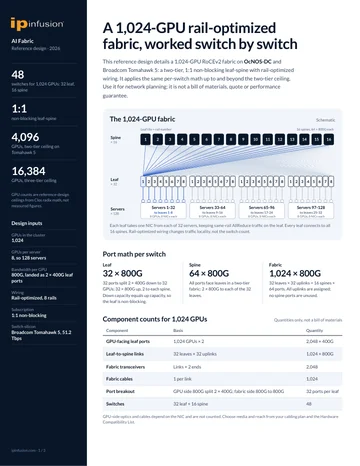
Get the AI Fabric Reference Design
The full PDF: lossless RoCEv2 topology, switch and transceiver counts, qualified platforms, and a DCQCN starting profile on OcNOS-DC.
Get the AI Fabric Reference Design
Quick form: your PDF will download immediately after submit.
✓ Opening your PDF in a new tab…
If it didn't open, use the link below.
RoCE vs InfiniBand FAQ
What is the difference between RoCE and InfiniBand?
Is Ethernet as fast as InfiniBand for AI?
What is RoCEv2?
Does RoCE need a lossless fabric?
Can I run RoCE on open switches?
What about Ultra Ethernet?
Go deeper. Take it with you.
The product datasheet plus short, technical downloads that go further than this page.
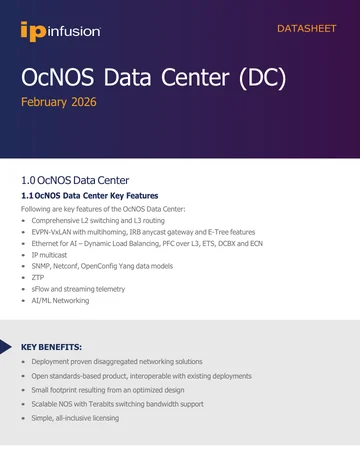
OcNOS-DC Datasheet
Full OcNOS-DC specification: the EVPN-VXLAN and Ethernet for AI feature set, software SKUs, supported hardware platforms, and the solution ordering guide.
Get the datasheet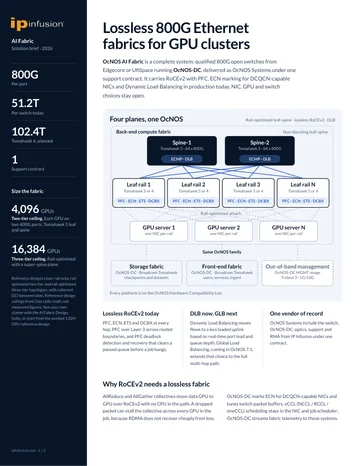
OcNOS 800G Lossless AI Fabric
Lossless RoCEv2 fabric on Tomahawk 5 spines: SKU tiers, qualified platforms, and deployment architecture.
Get the brief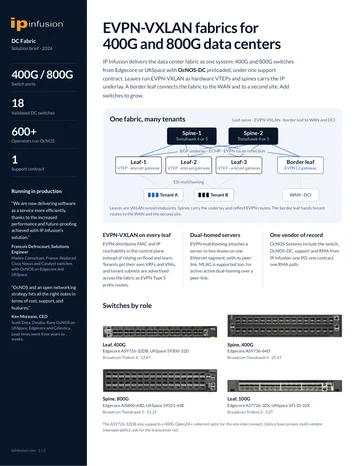
EVPN-VXLAN Data Center Fabric
Leaf-spine data center fabric on EVPN-VXLAN: a VRF and VNIs per tenant, EVPN multihoming, BGP unnumbered and route-target filtering.
Get the briefOcNOS-DC Datasheet
Quick form. Your PDF opens in a new tab immediately after submit.
✓ Opening your PDF in a new tab…
If it didn't open, use the link below.
OcNOS 800G Lossless AI Fabric
Quick form. Your PDF opens in a new tab immediately after submit.
✓ Opening your PDF in a new tab…
If it didn't open, use the link below.
EVPN-VXLAN Data Center Fabric
Quick form. Your PDF opens in a new tab immediately after submit.
✓ Opening your PDF in a new tab…
If it didn't open, use the link below.
Sizing a RoCEv2 fabric against InfiniBand? Let's run the workload-specific maths
Tell us the workload and the GPU scale, and an IP Infusion engineer will run the numbers with you, or start with a first-pass leaf-spine layout in the AI Fabric Design Suite.
Design the whole AI fabric with OcNOS
From the business case to the port-count maths, pick up wherever you are in the build.