Broadcom Tomahawk 6: 1.6T Ethernet for AI fabrics.
Tomahawk 6 is Broadcom's StrataXGS Ethernet switch chip for AI and data center fabrics.
OcNOS on Tomahawk 6
Coming soon. OcNOS-DC support for Tomahawk 6 is planned for the upcoming OcNOS 7.2 release.
Tomahawk 4 and Tomahawk 5 AI fabrics run on OcNOS-DC in production today.
Planning a 1.6T deployment? Contact us about platform availability and migration planning.
What changes from Tomahawk 5?
At 200GbE, Tomahawk 5 offers 256 ports and Tomahawk 6 offers 512, so a Tomahawk 6 switch can connect twice as many 200G endpoints. That can reduce the number of switches a given fabric design needs. Actual switch count, cabling, power and cost depend on the topology, oversubscription, port mix and cluster architecture.
| Chip level | Tomahawk 5 | Tomahawk 6 |
|---|---|---|
| Switching capacity | 51.2 Tbps | 102.4 Tbps |
| Maximum port speed | 64 x 800GbE | 64 x 1.6TbE |
| Radix at 200GbE | 256 ports | 512 ports |
| Process | 5 nm | 3 nm |
| Topologies | Clos and non-Clos, including torus, Dragonfly, Dragonfly+ and Megafly | Arbitrary topologies, including scale-up, Clos, rail-optimized, rail-only and torus |
| OcNOS-DC | Available today | Planned, OcNOS 7.2 |
Technical silicon detail: devices, SerDes, congestion handling and Ultra Ethernet.
What 1.6T means for an AI cluster.
If your endpoints are 200G
Higher radix can raise the number of endpoints attached to each switch. How to size a switch by radix is on the AI networking switches page.
If your endpoints are 400G or 800G
You do not have to replace every endpoint to move to a 1.6T-capable switch. The speed a switch port can run is separate from the speed each endpoint uses.
If you are designing a new large cluster
Higher bandwidth and radix can change how many leaf and spine switches, optics, cables and ports the design needs. Links that move to 1.6T need optics and cabling rated for it; Broadcom cites the 200G SerDes for the longest reach over passive copper.
If you run an OcNOS fabric today
The software you run today, and what is planned for Tomahawk 6, are under What OcNOS adds.
Send us your cluster size and endpoint speed for a fabric design review.
Silicon, congestion handling and Ultra Ethernet.
The Tomahawk 6 family includes two conventional switch devices and a co-packaged optics variant.
| Device | Family name | SerDes | Main distinction | Status |
|---|---|---|---|---|
| BCM78910 | Tomahawk 6 | 128 Peregrine cores, 1024 lanes of 100G PAM4 | Twice the lane count of the BCM78914, at half the lane rate | Broadcom-stated: production volume for the Tomahawk 6 family switch series, announced March 12, 2026 |
| BCM78914 | Tomahawk 6 | 64 Condor cores, 512 lanes of 200G PAM4 | Broadcom cites the 200G SerDes for the longest reach over passive copper interconnect | Broadcom-stated: production volume for the Tomahawk 6 family switch series, announced March 12, 2026 |
| BCM78919 | Tomahawk 6-Davisson | 64 Condor 3 nm cores, 200G | Co-packaged optics with 16 x 6.4 Tbps optical engines and a 267 MB unified packet buffer | Broadcom-stated: sampling; the product page reads limited release |
Cognitive Routing 2.0
Broadcom-stated: Cognitive Routing 2.0 on Tomahawk 6 combines advanced telemetry, dynamic congestion control, rapid failure detection and packet trimming, with hardware-based link failover in the silicon. How the lossless path works is on the RoCEv2 page.
Ultra Ethernet
Broadcom-stated: Tomahawk 6 is Ultra Ethernet Consortium compliant. IP Infusion is a member of the Ultra Ethernet Consortium. What the transport changes is on the Ultra Ethernet page.
OcNOS roadmap
Planned: packet trimming, latency-based ECN, link-level retry and credit-based flow scheduling, set out on the AI fabric architecture page.
Where Tomahawk 6 sits in an AI data center.
Tomahawk 6 can sit in both domains. The boundary between the two is on the GPU fabric page.
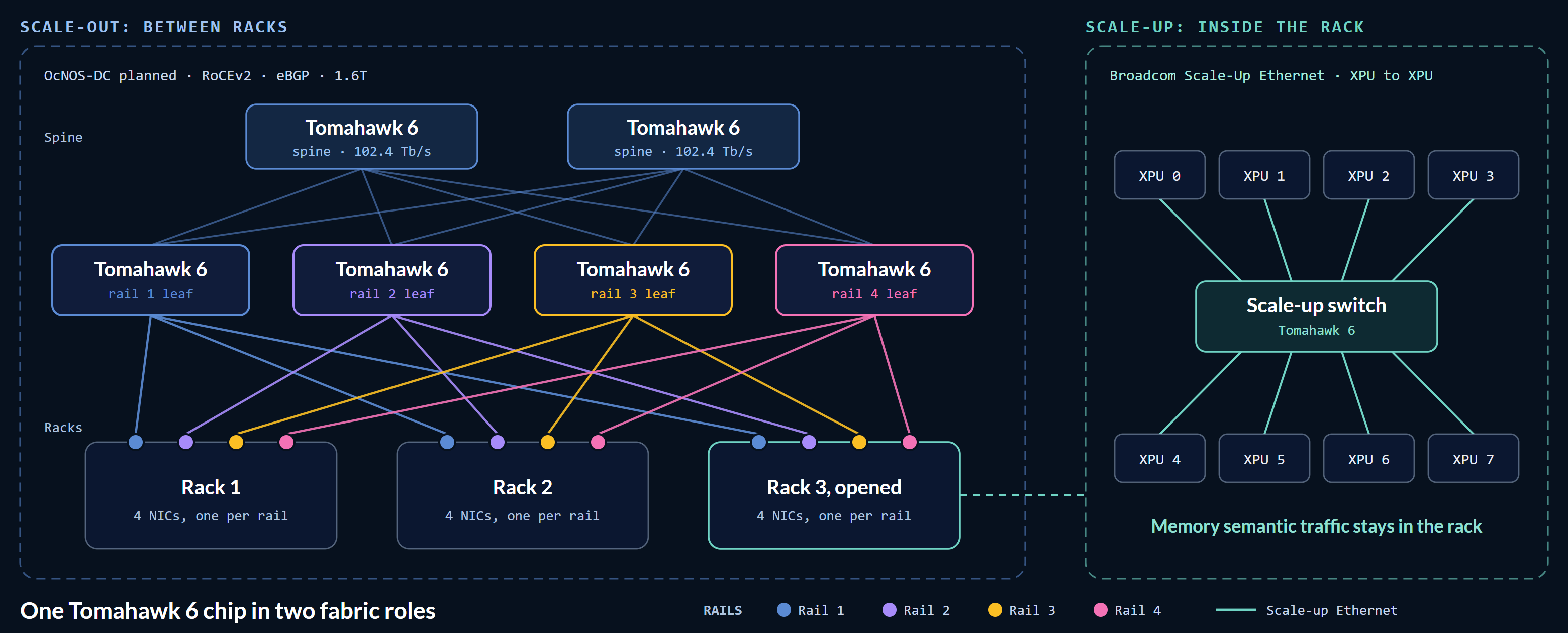
What OcNOS adds on top of the switch silicon.
OcNOS runs on top of the switch silicon. It runs AI fabrics in production today on Tomahawk 5 at 800G and Tomahawk 4 at 400G, on platforms listed in the hardware compatibility list.
OcNOS software
OcNOS-DC, the data center edition
- Forwarding
- eBGP unnumbered underlay with multipath load sharing
- Congestion control
- PFC and ECN for lossless RoCEv2
- Load balancing
- Dynamic load balancing across fabric links
- Telemetry
- gNMI streaming telemetry with OpenConfig models
- Failure recovery
- BFD, and PFC deadlock detection and recovery
- Automation
- Zero-touch provisioning, NETCONF with YANG, Ansible, and one CLI on every HCL-listed data center platform
Broadcom Tomahawk 6 silicon
StrataXGS Ethernet switch chip
- Capacity and ports
- 102.4 Tbps; 64 x 1.6TbE or 512 x 200GbE
- In the silicon
- Cognitive Routing 2.0 and Ultra Ethernet Consortium compliance, per Broadcom
Planned for Tomahawk 6 in OcNOS 7.2
- OcNOS-DC that will span Tomahawk 4, Tomahawk 5 and Tomahawk 6
- One CLI and one automation toolchain
- One routed underlay design that will span 400G, 800G and 1.6T
Supported Tomahawk 6 platforms will be announced with the release. Feature detail by release is in the OcNOS feature matrix; contact our sales team for Tomahawk 6 plans.
Built by many. Delivered by one.
Broadcom supplies the switching silicon and hardware partners build the platforms. IP Infusion delivers the complete system: OcNOS software on open hardware it qualifies per model, optics with proven interoperability, and support and RMA from one vendor.
Named at the Tomahawk 6 launch
Broadcom named IP Infusion in its Tomahawk 6 launch announcement of June 2025. IP Infusion maintains expertise with the Broadcom StrataXGS product line.
One portfolio covers the data center and the service provider network
OcNOS-DC runs the AI back end, storage, front end and out-of-band management networks in the data center, and OcNOS-SP runs the service provider transport beside them. One vendor and one support relationship cover both.
More than one place to buy the hardware
HCL-listed Tomahawk 5 platforms come from two hardware makers, so an 800G fabric can be built on a dual-source bill of materials.
Tomahawk 6 questions
What is Broadcom Tomahawk 6?
Can I run OcNOS on Tomahawk 6?
How does Tomahawk 6 compare with Tomahawk 5?
What changes when an AI fabric moves from 800G to 1.6T?
What is the difference between scale-out and scale-up on Tomahawk 6?
Is Tomahawk 6 Ultra Ethernet compliant?
What can I buy from IP Infusion for an AI fabric today?
Do 800G and 400G endpoints still attach to a 1.6T switch?
Planning a 1.6T fabric?
Send us the size of the cluster and the endpoint speeds, and we will review the design and the platform options with you.
AI fabric downloads
The product datasheet plus short, technical downloads that go further than this page.
AI Fabric Reference Design
A worked 1,024-GPU rail-optimized fabric on OcNOS-DC and Tomahawk 5: 32 leaves, 16 spines, 1:1 non-blocking, and where a super-spine tier begins.
Get the designOcNOS 800G Lossless AI Fabric
Lossless RoCEv2 fabric on Tomahawk 5 spines: SKU tiers, qualified platforms, and deployment architecture.
Get the briefOcNOS-DC Datasheet
Full OcNOS-DC specification: the EVPN-VXLAN and Ethernet for AI feature set, software SKUs, supported hardware platforms, and the solution ordering guide.
Get the datasheetAI Fabric Reference Design
Quick form. Your PDF opens in a new tab immediately after submit.
✓ Opening your PDF in a new tab…
If it didn't open, use the link below.
OcNOS 800G Lossless AI Fabric
Quick form. Your PDF opens in a new tab immediately after submit.
✓ Opening your PDF in a new tab…
If it didn't open, use the link below.
OcNOS-DC Datasheet
Quick form. Your PDF opens in a new tab immediately after submit.
✓ Opening your PDF in a new tab…
If it didn't open, use the link below.
Broadcom, StrataXGS, StrataDNX, Tomahawk, Jericho, Qumran and the BCM part numbers referenced on this page are trademarks of Broadcom Inc. and its affiliates. Ultra Ethernet and Ultra Ethernet Consortium are marks of the Ultra Ethernet Consortium. All are used here for identification only. IP Infusion is an independent company and is not affiliated with, endorsed by or sponsored by these companies. Chip figures on this page are those published by Broadcom, attributed where they appear and subject to change.