Ist Ethernet bereit für AI? Der Beleg ist bereits lieferbar
The four sections below each answer it with something already in production, not a roadmap: shipping 800G silicon, a hyperscale Ethernet cluster, the closed utilization gap, and a moving standard. Every figure is sourced to a hardware spec or a named third party.
The hardware is here
Open 800G AI switches are not a preview. They are on the hardware compatibility list and shipping. OcNOS-DC runs on Broadcom Tomahawk 5 and Tomahawk 4 platforms from Edgecore and UfiSpace, the same merchant silicon the rest of the industry builds AI fabrics on, so you keep switch, NIC, and GPU choices open. These are on-chip, shared-buffer switches built for lossless RDMA at 800G.
800G spine and leaf
Edgecore AIS800-64D and UfiSpace S9321-64E / S9321-64EO, the latter with 400G ZR+ coherent ports. On-chip shared buffering for lossless RoCEv2. Both platforms are HCL-listed.
400G leaf
Edgecore AS9736-64D for 400G leaf roles and smaller fabrics, on the same lossless RoCEv2 primitives as the 800G tier, breaking out to 100G and 25G.
Supported as a system
Mit OcNOS Systems deckt ein Vertrag mit IP Infusion OcNOS-DC und die qualifizierte Switch-Hardware gemeinsam ab, sodass es einen TAC und ein SLA für die gesamte Fabric gibt.
The scale is proven
The most common objection to Ethernet for AI is scale, and the industry has already answered it in production. You do not have to take a switch vendor's word for it, because the hyperscalers publish their designs.
Meta betreibt einen AI-Trainingscluster mit 24.576 GPUs auf einer Ethernet-basierten Fabric. Das belegt für die Branche, dass Standard-Ethernet AI-Training im Hyperscale-Maßstab heute produktiv trägt. Es ist der Bezugspunkt, der die Frage der Reife beantwortet: Die Fabric ist nicht die Grenze.
Auf OcNOS-DC gelten für Ihren Aufbau dieselben physikalischen Gesetze. Ein zweistufiges Tomahawk-5-Design erreicht 4.096 GPUs bei 800G pro GPU und einem Subscription-Verhältnis von 1:1. Darüber hinaus erweitert eine Super-Spine-Ebene dies auf 16.000 oder mehr. Siehe die AI-Fabric-Topologien for the port math behind each tier.
The utilization gap is closed
The old knock on Ethernet was load balancing: standard ECMP pins each large flow to one uplink, so during a collective some links jam while parallel paths sit idle and the sync waits on the slowest link. That gap is now closed on the same switches, and the proof is a hardware feature, not a promise.
How the gap closes. Static ECMP pins each large flow to one uplink; dynamic load balancing rebinds flows on real-time congestion so a well-run AI fabric targets utilization in the 90 percent range on Tomahawk 4 and Tomahawk 5, on the same switches, with no extra uplinks. OcNOS-DC ships DLB on those platforms.
DLB deep-dive →The standard is moving
Ethernet für AI ist kein proprietärer Umweg eines einzelnen Anbieters. Das Ultra Ethernet Consortium hat die UEC-1.0-Spezifikation veröffentlicht, um den Ethernet-Transport an die Größenordnung von AI und HPC anzupassen, getragen von den Unternehmen, die Silicon, NICs und Clouds bauen. IP Infusion ist Mitglied des Ultra Ethernet Consortium.
UEC 1.0 definiert einen Multipath-Transport, der einen Flow über viele Pfade verteilt, statt ihn an einen einzelnen ECMP-Hash zu binden; dieses Endpunktverhalten läuft auf UEC-fähigen NICs. OcNOS-DC betreibt heute produktiv verlustfreies RoCEv2 mit PFC, ECN-Markierung und DLB auf Broadcom-Tomahawk-4- und Tomahawk-5-Switches. DCQCN läuft auf den NICs und reagiert auf diese ECN-Markierungen. Siehe den Ultra-Ethernet-Deep-Dive for how packet spray and multi-path RDMA change the transport.
What OcNOS-DC ships today
Underneath the proof points is a fabric you can turn up now. OcNOS-DC provides the lossless Ethernet fabric that RoCEv2 requires, so your training collectives move GPU-to-GPU over RDMA without loss. DCQCN is the end-to-end loop between the NICs and the switches; the switch role in that loop is early ECN marking. Every primitive below is verified and shipping, not a roadmap item.
PFC
Priority flow control, including over L3, with DCBX and LLDP.
ECN and Dynamic ECN
Early congestion marking, the switch side of the DCQCN loop.
ETS
Enhanced transmission selection to keep RDMA flows ahead.
WRED
Weighted random early detection for queue management.
DLB
Dynamic load balancing with Reactive Path Rebalance and Random Flow.
PFC-Deadlock-Erkennung und -Wiederherstellung
Detects paused-queue cycles and auto-drains before jobs hang.
Buffer tuning
Abstimmung des Switch-Paketpuffers auf dem gemeinsam genutzten On-Chip-Puffer.
RTAG7 hashing
Fine-grained hashing for even spread across the fabric.
gNMI / OpenConfig telemetry
Streaming telemetry over OpenConfig YANG for closed-loop tuning.
What is coming next
The items below are roadmap and upcoming-silicon, labeled as such. They are not shipping capabilities today, and none of the figures are IP Infusion performance numbers.
Global Load Balancing (GLB)
Extends DLB fabric-wide: spines publish path-quality telemetry back to ingress leaves so routing scores the full multi-hop path.
Latency-based ECN
Congestion marking driven by measured latency, adding to the existing ECN and Dynamic ECN behavior.
LLR, CBFS, packet trimming
Link-Level-Retry, kreditbasierte Flusskontrolle und Packet Trimming für Verlustbehebung und Überlastbehandlung an Link und Switch.
Broadcom Tomahawk 6
BCM78910 / BCM78914, 102.4 Tbps, 3nm. Announced by Broadcom. OcNOS support planned.
Follow the evidence further
Each proof point above has a deeper technical page. Compare the transports head to head, size a fabric for your GPU count, or read how the lossless behavior is built.
FAQ zu AI-Fabric-Nachweisen
Ist Ethernet bereit für AI-Fabrics im Produktivbetrieb?
Kann Ethernet bei AI-Workloads mit InfiniBand mithalten?
Welche Größenordnung ist auf Ethernet für AI-Training belegt?
Was unterstützt OcNOS-DC heute für AI-Fabrics?
Wo steht OcNOS-DC bei Ultra Ethernet (UEC)?
Kann ich jetzt eine offene Ethernet-AI-Fabric einsetzen?
Die gesamte AI-Fabric mit OcNOS entwerfen
Vom Business Case bis zur Portanzahl-Berechnung: Steigen Sie dort ein, wo Sie beim Aufbau gerade stehen.
Tiefer einsteigen. Zum Mitnehmen.
Zwei kurze, technische Downloads, die weiter gehen als diese Seite: das vollständige OcNOS-DC-Datenblatt und die verlustfreie 800G-AI-Fabric-Architektur.
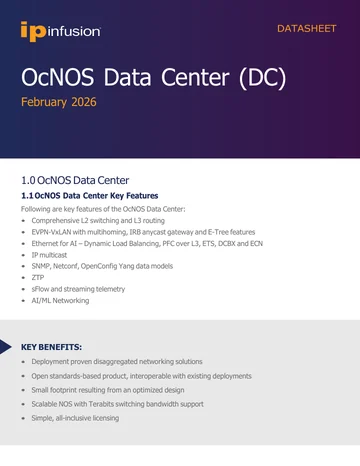
OcNOS-DC-Datenblatt
Vollständige OcNOS-DC-Spezifikation: Funktionsumfang für EVPN-VXLAN und Ethernet for AI, Software-SKUs, unterstützte Hardware-Plattformen und der Solution Ordering Guide.
Datenblatt abrufen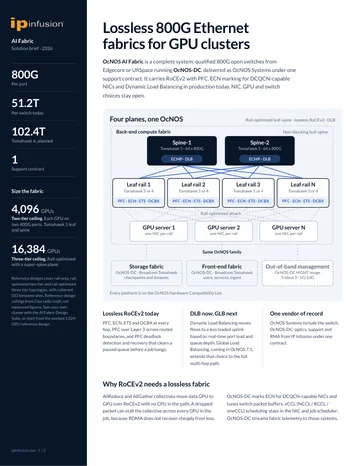
OcNOS: verlustfreie 800G-AI-Fabric
Verlustfreie RoCEv2-Fabric auf Tomahawk-5-Spines: SKU-Stufen, qualifizierte Plattformen und Deployment-Architektur.
Brief anfordernOcNOS-DC-Datenblatt
Kurzes Formular. Ihr PDF öffnet sich unmittelbar nach dem Absenden in einem neuen Tab.
✓ Ihr PDF wird in einem neuen Tab geöffnet…
Falls es sich nicht geöffnet hat, nutzen Sie den untenstehenden Link.
OcNOS: verlustfreie 800G-AI-Fabric
Kurzes Formular. Ihr PDF öffnet sich unmittelbar nach dem Absenden in einem neuen Tab.
✓ Ihr PDF wird in einem neuen Tab geöffnet…
Falls es sich nicht geöffnet hat, nutzen Sie den untenstehenden Link.