AI Fabric 拓扑:Rail-Optimized 与调度式设计

The shape of your fabric decides the shape of your training job. This page lays out the reference topologies OcNOS-DC ships against, from a rail-optimized single pod, through a scheduled 3-stage Clos, to coherent multi-DC DCI, sized in concrete port-counts on Broadcom Tomahawk 4 and Tomahawk 5 hardware.

Which AI fabric topology should you use? Pick the smallest non-blocking design that keeps every GPU's link saturated during collectives. Up to about 1,000 GPUs, use a rail-optimized leaf-spine pod (8 rails per GPU server, one rail per leaf). From roughly 1,000 to 16,000+ GPUs, move to a 3-stage Clos (leaf, spine, super-spine). To span data centers, extend with 400G ZR/ZR+ coherent DCI. All three run on OcNOS-DC over a RoCEv2 lossless (PFC + ECN) L3 fabric.

按 GPU 数量选择,而非按流行术语

AI fabric 拓扑只有一个使命:保持 every GPU 的出向链路在集合操作期间达到饱和,同时不产生尾延迟离群值。合适的拓扑是能够针对您的 GPU 数量实现这一目标的最小规模拓扑,并具备扩展至下一更大规模的回退路径。以下为 OcNOS-DC 当前支持的三种参考设计,并附有具体的端口计算。

正在为自己的集群做容量规划? The AI Fabric Design Suite 可提供快速的初步测算:它可测算出一个 无阻塞两级架构 假设条件下的 leaf-spine pod 每个 GPU 一块 fabric NIC,并在进入三层规模时予以提示。下面的参考设计采用 same 非阻塞的leaf/spine计算,并将其扩展为大规模的3级Clos,从而使交换机数量与工具相吻合。 Rail-optimized here is the wiring discipline of an 8-NIC GPU server (one rail per leaf, so intra-rail AllReduce stays on the leaf) layered on that non-blocking fabric: it changes traffic locality, not the switch count. Use the tool for a ballpark; use these designs for the build.

256GPUs

入门级无阻塞 pod

在小型 spine 层之上部署一行轨道对齐 leaf。两层折叠式 Clos,1:1 无阻塞。

8 个 leaf · 4 个 spine · TH4 · 400G
1,024GPUs

轨道优化的两层 pod

采用轨道对齐 leaf 加 1:1 无阻塞 spine。轨道内 AllReduce 保持在 leaf 上完成;跨轨道流量经由 spine。标准的单 pod 可扩展单元。

32 个 leaf · 16 个 spine · TH5 · 800G
4,096GPUs

3 级 Clos

Leaf, spine, super-spine. Each 1,024-GPU pod is 1:1 non-blocking; a super-spine plane scales across pods. DLB at every tier; GLB end-to-end on the OcNOS 7.1 train.

128 leaves · 64 spines · 32 super-spines · TH5 · 800G
16,384GPUs

规模化 3 级 Clos

带有超级骨干平面的多 Pod 三级 Clos。专为万亿参数训练级别设计。

512 leaves · 256 spines · 128 super-spines · TH5 · 800G
参考设计 1

轨道优化单 Pod

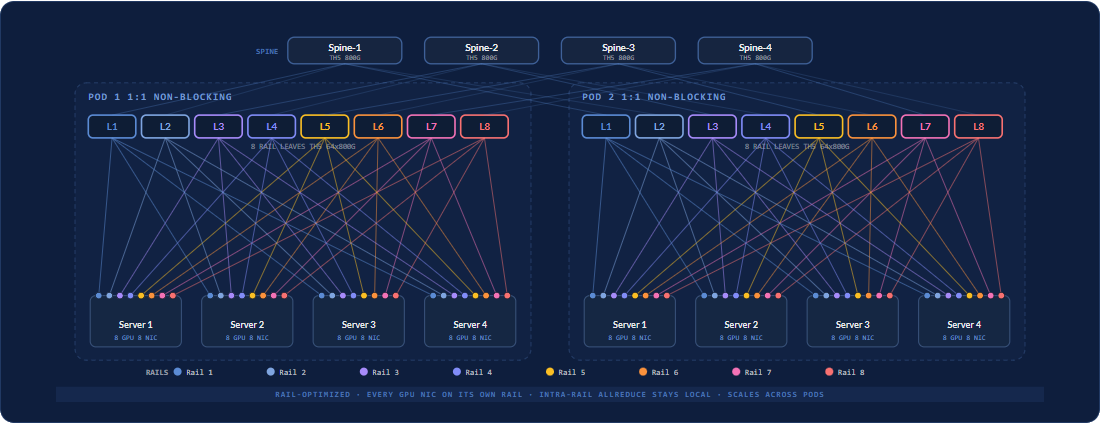
每台 GPU 服务器配备 8 个 NIC,每个对应一条 "rail",即专用 xCCL (NCCL / RCCL / oneCCL) 集体通信通道。每条 rail 拥有独立的专用叶交换机、因此每台服务器的 8 个 NIC 都落到不同的叶交换机上。跨 rail-N 的 AllReduce 保持在 leaf-N 内部。主导集体通信模式不会对 spine 产生东西向压力。

轨道优化的 AI fabric:8 条轨道、轨道对齐 leaf、1:1 无阻塞 spine(示意图) 轨道优化的 AI 网络结构。底部的八台 GPU 服务器各配备八块网卡,分别对齐八台 rail-leaf。每台服务器的 Rail-N 连接至 leaf-N。leaf 之上的 spine 层承载跨轨道流量。占主导地位的 AllReduce 流量保持在单一轨道内,从不经过 spine。 Spine-1TH5 · 800G Spine-2TH5 · 800G Spine-3TH5 · 800G Spine-4TH5 · 800G Rail-1leaf Rail-2leaf Rail-3leaf Rail-4leaf Rail-5leaf Rail-6leaf Rail-7leaf Rail-8leaf GPU Server 1 8 × NIC · 8 条 rail GPU Server 2 8 × NIC · 8 条 rail GPU Server 3 8 × NIC · 8 条 rail GPU Server 4 8 × NIC · 8 条 rail RAIL-OPTIMIZED · 8 RAILS · INTRA-RAIL ALLREDUCE STAYS LOCAL

OcNOS 组件: BGP-unnumbered L3 underlay, RoCEv2 lossless (PFC + ECN) on every leaf, DLB at the spine tier. Built on HCL-listed hardware: the 800G scalable unit uses TH5 64×800G leaves and spines (Edgecore AIS800-64D or UfiSpace S9321-64E); the entry 256-GPU pod uses Edgecore AS9736-64D (TH4, 64×400G).

调度式对比 Rail-Aligned:规模化时的变化

Rail-optimized stops scaling somewhere between 1k and 2k GPUs: you run out of leaf radix, or the spine tier becomes too oversubscribed. Above that, most modern AI fabrics move to a 3-stage Clos: leaf, spine, super-spine. The hard part on a Clos is spreading flows evenly so no link becomes a hot spot. Approaches run from per-flow ECMP, through adaptive (dynamic) load balancing, to per-packet spray, the model Ultra Ethernet uses with reordering handled at the NIC. A separate family, cell-based scheduled fabrics such as Broadcom DDC, segments traffic into cells and schedules it inside the fabric. OcNOS keeps the GPU plane balanced with DLB today and adds fabric-wide GLB on the 7.1 train, and is UEC-ready as UEC NICs arrive.

参考设计 2

3-Stage Clos Scheduled Fabric: 4,096-16,384 GPUs

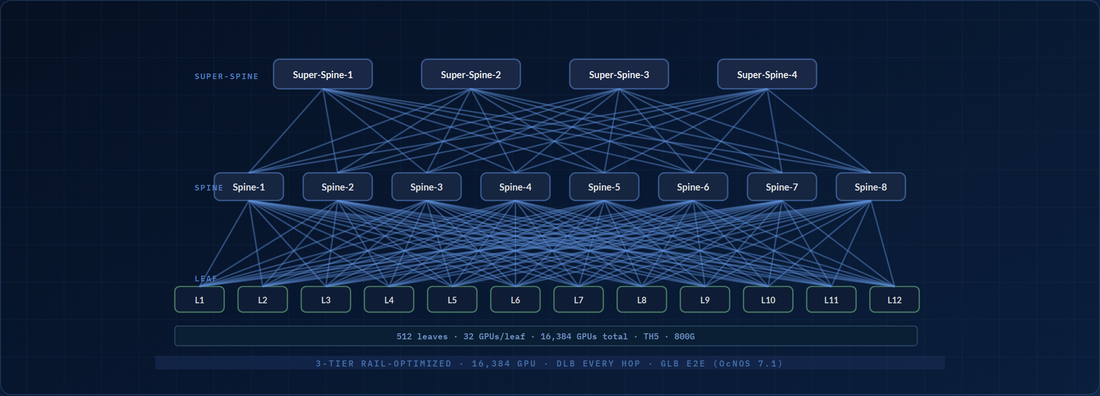
Three tiers: leaf, spine, super-spine. Any two GPUs are at most four switch hops apart; same-leaf and same-pod peers are closer. Non-blocking within a pod, with the super-spine plane setting the cross-pod ratio. DLB at every hop, GLB across the full path on the OcNOS 7.1 train, UEC packet-spray on UEC-capable NICs. The diagram is schematic: it draws a reduced tier count; the 4,096-GPU build is 128 leaves / 64 spines / 32 super-spines on TH5 800G.

三级 Clos AI fabric 调度型拓扑 三级 Clos 拓扑。顶层为四台 super-spine 交换机。中层为八台 spine 交换机。底层为 12 台 leaf 交换机,向 GPU pod 馈送流量。leaf 到 spine、spine 到 super-spine 之间为全互联链路。底部条带标注:4096 GPU 调度网络、各层级 DLB、端到端 GLB(基于 OcNOS 7.1)。 Super-Spine-1 Super-Spine-2 Super-Spine-3 Super-Spine-4 Spine-1 Spine-2 Spine-3 Spine-4 Spine-5 Spine-6 Spine-7 Spine-8 L1 L2 L3 L4 L5 L6 L7 L8 L9 L10 L11 L12 SUPER-SPINE SPINE LEAF GPU PODS 128 个 leaf · 每 leaf 32 个 GPU · 共 4,096 个 GPU · TH5 · 800G 3-STAGE CLOS · 4,096 GPU · DLB EVERY HOP · GLB E2E(OcNOS 7.1)· UEC-READY

OcNOS 组件: eBGP-unnumbered L3 underlay、RoCEv2 无损传输 (PFC + ECN)、每一层的 DLB、OcNOS 7.1 系列上的端到端 GLB,以及向你的可观测性栈传输的 gNMI 流式遥测;在需要多租户隔离的场景中提供 EVPN-VXLAN 多租户 overlay。全程基于 HCL 列出的 TH5 64×800G 机箱构建。

Subscription is a dial, not a fixed rule. These counts make each 1,024-GPU pod 1:1 non-blocking and use a cost-optimized ~2:1 super-spine for cross-pod traffic, the rail-optimized approach hyperscale Ethernet fabrics rely on (published large-scale designs oversubscribe the top tier far more, because collective traffic stays pod-local). Want maximal any-to-any headroom instead? A fully non-blocking 1:1 build is 128 / 128 / 64 at 4,096 GPUs and 512 / 512 / 256 at 16,384; only the spine and super-spine counts change. Model either in the AI Fabric Design Suite.

面向分布式训练的多 DC 与 DCI

当单次训练任务跨越多个数据机房时(这在万亿参数模型中日益普遍),网络结构需要延伸至 WAN。OcNOS-DC 在 spine 上直接支持 400G ZR / ZR+ 相干光模块,实现免转发器的 DCI,并通过 EVPN 隧道扩展跨站点承载 VXLAN 租户。

参考设计 3

多数据中心 AI 网络:相干 DCI

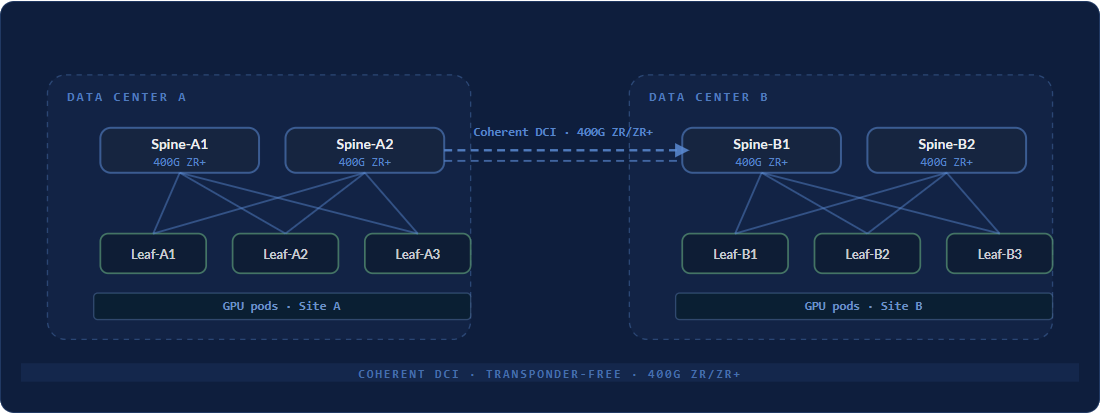
两个 AI 数据中心通过 spine 上的 400G ZR/ZR+ 互联。EVPN inter-DC 承载 L2/L3 租户扩展;各站点底层的三级 Clos 保持不变。

采用 400G ZR/ZR+ DCI 的多 DC AI fabric 两个 AI 数据中心,各自采用 leaf-spine fabric。两个 spine 通过跨 WAN 的 400G ZR/ZR+ 相干光模块互联。EVPN 数据中心间隧道将租户从一个站点延伸至另一个站点。底部条带:无需转发器的相干 DCI。 DATA CENTER A DATA CENTER B Spine-A1400G ZR+ Spine-A2400G ZR+ Spine-B1400G ZR+ Spine-B2400G ZR+ EVPN inter-DC · 400G ZR/ZR+ Leaf-A1 Leaf-A2 Leaf-A3 Leaf-B1 Leaf-B2 Leaf-B3 GPU pod · 站点 A GPU pod · 站点 B 相干 DCI · 免转发器 · EVPN 跨数据中心 · 400G ZR/ZR+

OcNOS 组件: 400G ZR/ZR+ pluggable coherent optics on a DWDM-capable spine or border-leaf port, EVPN inter-DC for tenant L2/L3 extension, gNMI telemetry across sites. No external transponders required. Reach: 400ZR to roughly 120 km amplified; OpenZR+ reaches farther on oFEC.

设计经验法则

  • 使拓扑与 GPU 数量相匹配。 最小规模 pod(不超过单台 leaf 的 NIC 基数):仅用 rail-only 即可。单 pod 规模:采用 rail 优化的 leaf-spine。多 pod 规模:三级 Clos 是唯一能在不牺牲超额订阅的前提下实现扩展的设计。
  • AI 平面始终保持 1:1 订阅比。 存储与 CPU 机架可承受更高的超额订阅比。GPU 平面则不应如此。
  • 轨道数应依据 xCCL 规划,而非布线便利。 对于 8-NIC GPU 服务器,8 轨是当前的事实标准。请勿将多条轨合并到更少的 leaf 上。
  • 按功耗和密度选择芯片,而非按品牌标识。 TH4(25.6T)和 TH5(51.2T)是主力芯片;二者之间的取舍在于机架功耗和 breakout 线缆成本。
  • 在设计阶段就为 GLB / UEC 做好规划。 从第一天起就将遥测平面构建到位,即便是在 7.0 fabric 上,这样 OcNOS 7.1 GLB 升级便纯粹是一次软件操作。详见 GLB and Ultra Ethernet.
  • 对照 HCL 进行验证。 此处的每个参考方案均构建于所列硬件之上,详见 OcNOS 硬件兼容性列表;从那里开始即可获得一流支持。
常见问题

AI fabric topology FAQ

What is a rail-optimized topology, and how is it different from rail-only?
Rail-optimized wiring connects each of a GPU server's 8 NICs to its own dedicated rail leaf, so the dominant same-rail AllReduce traffic stays on one leaf and never traverses the spine. Rail-only is the small-cluster case: a single rack-row of rail-aligned leaves with no spine tier, where cross-rail traffic relies on the GPU scale-up domain. Rail-optimized adds a non-blocking spine so cross-rail flows have a network path.
How many GPUs can a 3-stage Clos scale to?
On radix-64 switches (Tomahawk 5 at 800G) a 2-tier leaf-spine tops out at 2,048 GPUs. A 3-stage Clos with a super-spine tier extends that to 16,000+ GPUs in the reference designs above, and up to about 65,000 GPUs at the theoretical fat-tree limit. Because most collective traffic stays rail-local, the super-spine plane is sized to the cross-pod ratio you actually need.
Should I use Tomahawk 4 or Tomahawk 5?
Both run OcNOS-DC. Tomahawk 4 (25.6 Tbps, 64×400G) is the cost-optimized choice for entry pods and 400G GPU NICs. Tomahawk 5 (51.2 Tbps, 64×800G) is the workhorse for 800G GPU servers and larger fabrics. Tomahawk 4 has no native 800G, so match the switch to your NIC speed.
Do I need InfiniBand, or is Ethernet enough?
Ethernet is now a first-class AI-fabric transport. RoCEv2 with PFC and ECN delivers lossless RDMA today. Ultra Ethernet(UEC) removes the network-wide PFC dependency using endpoint packet-spray, selective retransmission, and link-level retry as UEC NICs ship. OcNOS-DC runs the RoCEv2 fabric today and is UEC-ready.
Where does scale-up end and scale-out begin?
Inside a GPU server and its NVLink domain (for example GB200 NVL72), GPUs communicate over the scale-up fabric at terabit speeds. The rail, leaf-spine, and Clos network is the scale-out fabric between servers and pods. Most same-rail collective traffic is absorbed by scale-up first, so the network carries the cross-rail and cross-pod remainder, which is why 1:1 non-blocking matters most on the GPU plane.

正在设计您的 AI fabric?我们与您一起完成端口数量的测算。

预约架构评审 →
AI 网络

Design the whole AI fabric with OcNOS

From the business case to the port-count maths, pick up wherever you are in the build.