
EVPN over MPLS and Segment Routing
EVPN over MPLS uses the BGP EVPN control plane to deliver E-Line, E-LAN, E-Tree, and Layer 3 VPN services on the MPLS or Segment Routing transport a service provider already runs. Endpoints are learned in BGP instead of by flooding, multi-homing is all-active, and protection comes from TI-LFA or RSVP-TE in the underlay. It is the service-provider counterpart of EVPN-VXLAN, with the same control plane and a label data plane.
EVPN services on an SR-MPLS transport
Three provider edge routers and a Segment Routing core. PE1 and PE2 share one Ethernet Segment for an all-active multi-homed customer site; PE3 serves a single-homed site. E-Line, E-LAN, and L3VPN services all ride the same label stack, protected hop by hop with TI-LFA.
What EVPN over MPLS is
EVPN (RFC 7432) was designed for MPLS first. Its BGP control plane advertises MAC and IP reachability between provider edge routers, and the traffic itself is forwarded with a label stack: a transport label to reach the remote PE and a service label that identifies the EVPN instance. The transport can be anything the core already runs, LDP, RSVP-TE, or Segment Routing, so EVPN slots into an existing MPLS network without changing the underlay.
The result is one service model for everything a service provider sells over Ethernet. Point-to-point circuits, multipoint LANs, rooted-multipoint access trees, and routed VPNs are all EVPN instances with different route-target and forwarding policy, signalled by the same BGP session. This page covers what is specific to the MPLS and Segment Routing data plane. The route types themselves, Type-1 through Type-5, are the same in every data plane and are explained on the EVPN-VXLAN page.
EVPN-MPLS and EVPN-VXLAN, side by side
Same control plane, different wire. The table is what changes when the encapsulation does.
| Aspect | EVPN over MPLS or SR | EVPN over VXLAN |
|---|---|---|
| Where it runs | Service provider core, metro, and aggregation | Data centre leaf-spine fabrics |
| Data plane | MPLS label stack: transport label plus service label | UDP encapsulation with a 24-bit VNI over plain IP |
| Transport | IGP with LDP, RSVP-TE, SR-MPLS, or SRv6 | Any IP underlay, usually eBGP unnumbered |
| Traffic engineering | Native: RSVP-TE tunnels or SR policies steer per service | Limited to ECMP over the fabric |
| Fast protection | TI-LFA or RSVP Fast Reroute in the underlay | Underlay IGP or BGP reconvergence |
| Carrier Ethernet OAM | CFM and Y.1731 performance monitoring per service | Service monitoring over VXLAN where supported |
| Services | E-Line, E-LAN, E-Tree, L3VPN with IRB, Inter-AS | L2 overlay, IRB, Type-5 routing, DCI |
| OcNOS package | OcNOS-SP | OcNOS-DC and OcNOS-SP |
The transport underneath
EVPN does not care how the label-switched path is built, which is why it migrates cleanly. OcNOS-SP carries EVPN services over every transport in the Feature Matrix:
- LDP and RSVP-TE. The classic MPLS transports, with ECMP across parallel LSPs for both (RSVP ECMP since OcNOS 5.0, LDP ECMP since 6.1.0) and graceful restart with EVPN services attached.
- SR-MPLS. EVPN over the IGP-computed Segment Routing LSP or over an SR policy (since 4.2), with TI-LFA local protection (since 5.1) and BGP-LU for inter-domain reach (since 5.1).
- SRv6. Initial SRv6 support on selected routers in OcNOS-SP PLUS covers EVPN E-Line and E-LAN single-homed over an IPv6 segment list (RFC 9252), with more in development. How SRv6 works.
Service mapping picks the tunnel per EVPN instance through a local tunnel policy, so a premium E-Line can ride an SR policy with a latency objective while best-effort E-LAN follows the IGP path.
What OcNOS-SP delivers
The complete list, with platform and licence coverage, is in the Feature Matrix.
E-Line and E-LAN
EVPN VPWS point-to-point (RFC 8214) and multipoint E-LAN (RFC 7432), single and multi-homed attachment, MAC statistics per instance.
Since OcNOS 4.0E-Tree
Rooted-multipoint per RFC 8317, single-homed from 4.1, multi-homed from 6.5.1, scenario 2 leaf handling from 7.0.0.
Since OcNOS 4.1EVPN over Segment Routing
Services carried over the SR LSP or an SR policy, selected per instance by local tunnel policy. TI-LFA and BGP-LU from 5.1.
Since OcNOS 4.2Transport protection
One-to-one and facility backup with RSVP-TE, TI-LFA with SR-MPLS, and RSVP or LDP graceful restart with EVPN services attached.
Since OcNOS 4.0Multi-homing modes
All-active multi-homing from 4.0 and single-active (active-standby) from 6.4.1 for MPLS and SR. Mass withdrawal and aliasing across the segment.
Since OcNOS 4.0IRB and L3VPN
Integrated Routing and Bridging (RFC 9135), EVPN L3VPN with or without IRB, host-route advertisement, anycast gateway with multiple IPs, ECMP for symmetric IRB from 7.0.0.
Since OcNOS 6.0.0Inter-AS
Option A and Option C for EVPN services that cross an autonomous system boundary, with control word support from 6.0.1.
Since OcNOS 5.1Carrier Ethernet OAM
CFM (IEEE 802.1ag) and Y.1731 delay and loss measurement over EVPN MPLS E-Line and E-LAN, single and multi-homed. TWAMP over EVPN L3VPN over SR-MPLS.
Since OcNOS 6.4.1EVPN over SRv6
Initial SRv6 support on selected routers in OcNOS-SP PLUS: EVPN E-Line and E-LAN single-homed over SRv6 (RFC 9252), with more in development.
Selected routersPolicy and scale controls
EVPN address-family route-maps, per-instance MAC limits, MAC hold timer, link-loss forwarding, and L2CP handling on EVPN access.
Since OcNOS 7.0.0Migrating from VPLS and VPWS
Most service providers arrive at EVPN from an LDP-signalled VPLS or VPWS estate. EVPN removes the two things that limited VPLS at scale: data-plane MAC learning, which floods until every PE has seen every address, and the full mesh of pseudowires, which grows with the square of the PE count. In EVPN the MAC table is a BGP table and the mesh is a set of BGP routes.
The migration does not need a flag day. OcNOS-SP runs LDP and BGP-signalled VPLS, hierarchical VPLS, and EVPN on the same router, so services move instance by instance. The multi-homing that VPLS could only offer as active-standby MLAG becomes all-active in EVPN, and the same BGP session that already carries L3VPN carries the new L2 services.
Where EVPN over MPLS fits
- Metro Ethernet: E-Line and E-LAN business services with CFM and Y.1731 SLA measurement per circuit.
- Core and aggregation: one BGP EVPN control plane across core, metro, and the data centre edge, with SR-MPLS transport and TI-LFA.
- Wholesale and access aggregation: E-Tree keeps leaf sites isolated from each other while every leaf reaches the root.
Qualified hardware
Reference, not a specification. EVPN over MPLS is an OcNOS-SP capability and runs on the Broadcom Qumran and Jericho based routers qualified for the SP package. The current qualified list, with ASIC, port density, and release coverage per platform, is the OcNOS Hardware Compatibility List.
Related technologies and solutions
Planning an EVPN migration on your MPLS or Segment Routing core?
Contact usFrequently asked questions
What is EVPN over MPLS?
What is the difference between EVPN-MPLS and EVPN-VXLAN?
Can EVPN run over Segment Routing?
What is EVPN E-Line, E-LAN, and E-Tree?
How does EVPN replace VPLS?
What is EVPN multi-homing with an Ethernet Segment Identifier?
How is EVPN over MPLS protected against link and node failure?
Does EVPN over MPLS support Layer 3 services?
Go deeper. Take it with you.
The product datasheet plus short, technical downloads that go further than this page.
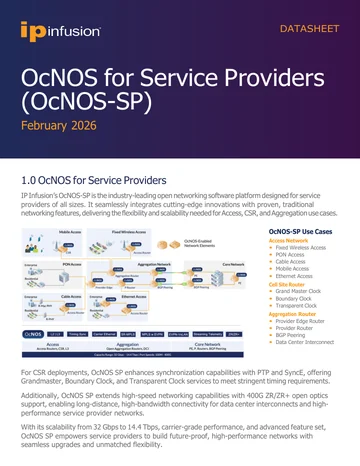
OcNOS-SP Datasheet
Full OcNOS-SP specification: the access, cell site and aggregation feature set, software SKUs, supported hardware platforms, and the solution ordering guide.
Get the datasheet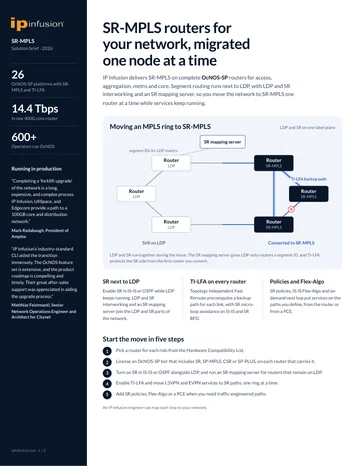
SR-MPLS Upgrade with OcNOS
Migrate SR-MPLS onto OcNOS on open hardware: Flex-Algo, TI-LFA, and a node-by-node cutover path.
Get the brief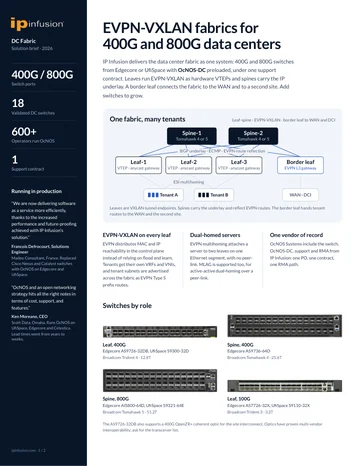
EVPN-VXLAN Data Center Fabric
Leaf-spine data center fabric on EVPN-VXLAN: a VRF and VNIs per tenant, EVPN multihoming, BGP unnumbered and route-target filtering.
Get the briefOcNOS-SP Datasheet
Quick form. Your PDF opens in a new tab immediately after submit.
✓ Opening your PDF in a new tab…
If it didn't open, use the link below.
SR-MPLS Upgrade with OcNOS
Quick form. Your PDF opens in a new tab immediately after submit.
✓ Opening your PDF in a new tab…
If it didn't open, use the link below.
EVPN-VXLAN Data Center Fabric
Quick form. Your PDF opens in a new tab immediately after submit.
✓ Opening your PDF in a new tab…
If it didn't open, use the link below.