EVPN E-Line on OcNOS provides point-to-point Ethernet connectivity over an IS-IS SR-MPLS core, replacing manually built EoMPLS pseudowires. It brings native EVPN multi-homing and TI-LFA sub-50ms protection, so a single BGP EVPN control plane delivers resilient virtual private wire service across the network. See EVPN on OcNOS.
EVPN E-LINE (Ethernet Private Line) delivers point-to-point Layer 2 connectivity between exactly two customer sites over an MPLS/SR backbone. It is the EVPN evolution of traditional EoMPLS and VPWS. By using the BGP EVPN control plane to signal the point-to-point cross-connect, EVPN E-LINE replaces manually provisioned pseudowires and adds native multi-homing. E-LINE is a port or VLAN based service, so unlike E-LAN it does not learn customer MAC addresses in the control plane.
This guide is part of the IP Infusion EVPN services series over ISIS-SR:
- EVPN-ELINE (this article): point-to-point E-Line service
- EVPN-ELAN: multipoint E-LAN service
- EVPN-ETREE: rooted multipoint E-Tree service
- EVPN-L3VPN: Layer 3 VPN over ISIS-SR
EVPN E-LINE: Single-Homed Topology
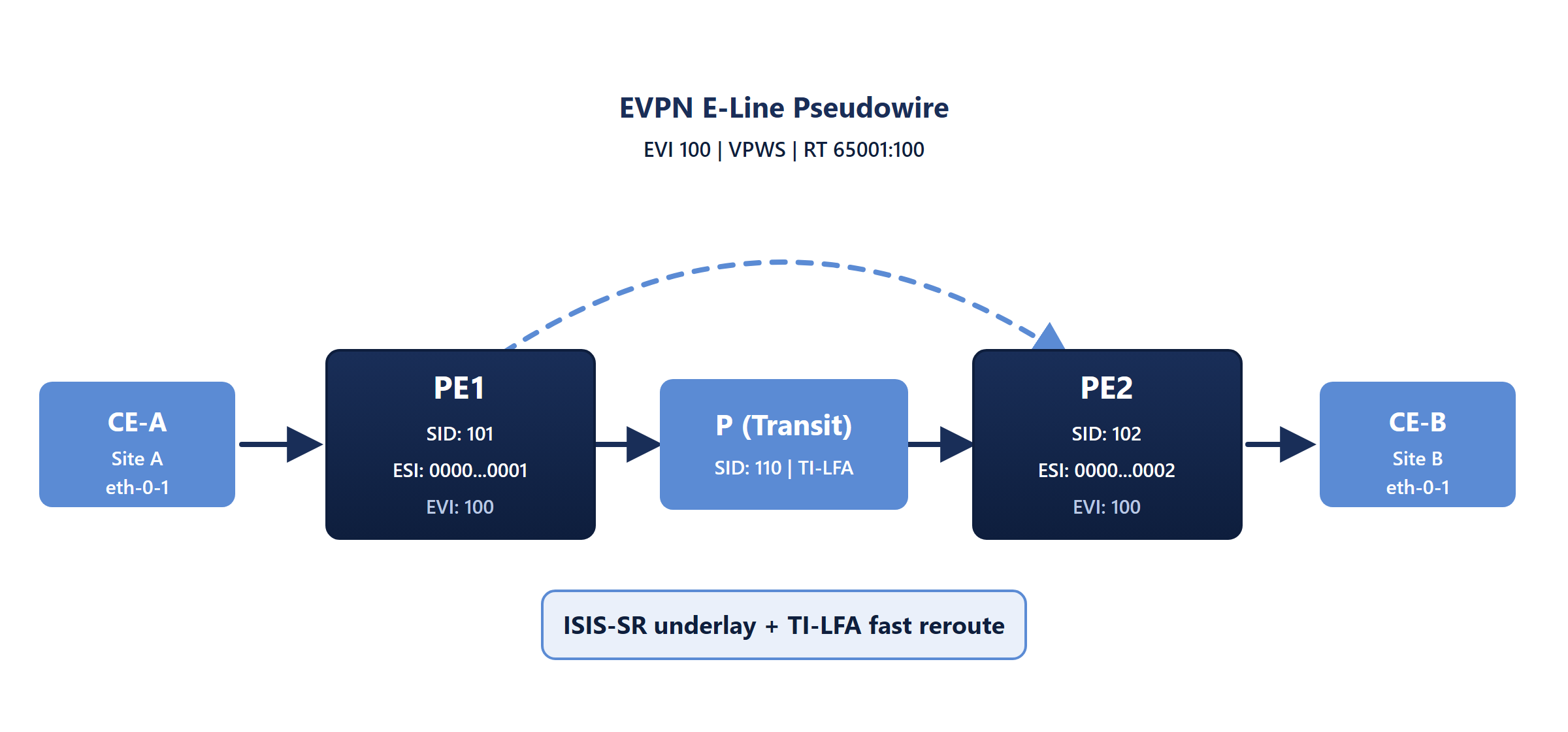
EVPN Route Types for E-LINE
EVPN E-LINE (VPWS) relies on the following BGP route types for control-plane signaling. Note that Type 2 (MAC/IP) routes are used by E-LAN, not by E-LINE:
- Route Type 1 (Ethernet Auto-Discovery): carries the VPWS service instance (the local vpn-id / xconnect id) between the two endpoints. On a multi-homed segment it also provides per-Ethernet-Segment and per-EVI AD routes for fast convergence and mass withdrawal.
- Route Type 4 (Ethernet Segment): advertised by every PE that shares a multi-homed Ethernet segment. It drives Designated Forwarder (DF) election so exactly one PE forwards for the segment at a time.
Single-Homed E-LINE Configuration
! OcNOS - ISIS-SR underlay (representative node PE1, loopback 10.10.100.1)
router isis OCNOS
 is-type level-2-only
 metric-style wide
 mpls traffic-eng router-id 10.10.100.1
 mpls traffic-eng level-2
 capability cspf
 dynamic-hostname
 fast-reroute ti-lfa level-2 proto ipv4
 net 49.0001.0000.0000.0001.00
 passive-interface loopback1
 segment-routing mpls
!
interface loopback1
 ip address 10.10.100.1/32
 prefix-sid index 101
!
interface ce0
 description To-P2-ce2
 load-interval 30
 ip address 10.66.12.1/24
 mtu 9216
 label-switching
 isis network point-to-point
 isis circuit-type level-2-only
 ip router isis OCNOS
 no isis hello padding
!
commit

! OcNOS - BGP EVPN route reflector (P2, loopback 10.10.100.2)
router bgp 65000
 bgp router-id 10.10.100.2
 no bgp inbound-route-filter
 neighbor EVPN-RRC peer-group
 neighbor EVPN-RRC remote-as 65000
 neighbor EVPN-RRC update-source loopback1
 neighbor 10.10.100.3 peer-group EVPN-RRC
 neighbor 10.10.100.4 peer-group EVPN-RRC
 neighbor 10.10.100.5 peer-group EVPN-RRC
 neighbor 10.10.100.6 peer-group EVPN-RRC
 !
 address-family l2vpn evpn
 neighbor EVPN-RRC activate
 neighbor EVPN-RRC route-reflector-client
 exit-address-family
!
commit

! OcNOS - BGP EVPN on the PE (PE4, loopback 10.10.100.4)
router bgp 65000
 bgp router-id 10.10.100.4
 neighbor 10.10.100.2 remote-as 65000
 neighbor 10.10.100.2 update-source loopback1
 !
 address-family l2vpn evpn
 neighbor 10.10.100.2 activate
 exit-address-family
!
commit

! OcNOS - EVPN E-LINE (VPWS) single-homed service on PE4
! Local vpn-id 301 cross-connects to remote target-mpls-id 302 on PE5.
evpn mpls enable
evpn mpls vtep-ip-global 10.10.100.4
!
evpn mpls id 301 xconnect target-mpls-id 302
 host-reachability-protocol evpn-bgp ELINE-SH
!
mac vrf ELINE-SH
 rd 10.10.100.4:300
 route-target both evpn-auto-rt
!
interface xe15.300 switchport
 encapsulation dot1q 300
 mtu 9216
 access-if-evpn
  map vpn-id 301
!
commit
! Remote end PE5 (10.10.100.5) mirrors this with:
!   evpn mpls id 302 xconnect target-mpls-id 301
! (confirmed by the xconnect output: local VPN-ID 301, remote VPN-ID 302, PE-IP 10.10.100.5)Multi-Homed E-LINE Configuration
Multi-homing attaches a CE to two PE routers at once for redundancy. The Ethernet segment is defined by placing the CE-facing link into a port-channel and giving that port-channel a shared system-MAC on both PEs. The resulting Ethernet Segment Identifier (ESI) enables DF election and fast failover using EVPN Type 1 and Type 4 routes. Multi-homing requires the evpn-mpls-mh hardware profile and a reload.
! OcNOS - EVPN E-LINE multi-homed service on PE5 (loopback 10.10.100.5)
! CE4 is dual-homed to PE5 and PE6 through port-channel po111.
! The shared system-mac 0000.1111.aaaa yields ESI 00:00:00:11:11:aa:aa:00:00:00.

! Step 1: enable the multi-homing hardware profile (requires reload)
hardware-profile filter evpn-mpls-mh enable
!
commit

! Step 2: EVPN MPLS with multi-homing, and the VPWS cross-connect
evpn mpls enable
evpn mpls multihoming enable
evpn mpls vtep-ip-global 10.10.100.5
!
evpn mpls id 102 xconnect target-mpls-id 101
 host-reachability-protocol evpn-bgp ELINE-MH
!
mac vrf ELINE-MH
 rd 10.10.100.5:100
 route-target both evpn-auto-rt
!
! Step 3: shared Ethernet segment on the port-channel (ESI at interface level)
interface po111
 evpn multi-homed system-mac 0000.1111.aaaa
!
interface po111.100 switchport
 encapsulation dot1q 100
 mtu 9216
 access-if-evpn
  map vpn-id 102
!
commit
! PE6 (10.10.100.6) mirrors PE5: same 'evpn multi-homed system-mac 0000.1111.aaaa'
! on po111 and 'evpn mpls id 102 xconnect target-mpls-id 101'
! (confirmed by the Type-4 Ethernet-Segment routes and xconnect output from both .5 and .6).
!
! The remote single-homed end is PE4 (10.10.100.4):
!   evpn mpls id 101 xconnect target-mpls-id 102
!   mac vrf ELINE-MH, rd 10.10.100.4:100
!   interface xe15.100 -> map vpn-id 101
Verification Commands
! OcNOS - EVPN E-LINE verification (SR-MPLS underlay)

! ISIS-SR underlay and label state:
show isis topology
show mpls forwarding-table
show mpls ilm-table
!
! Segment-routing MPLS reachability to a remote loopback:
ping mpls isis-sr ipv4 10.10.100.6/32 detail
!
! EVPN E-LINE (VPWS) cross-connect state:
show evpn mpls xconnect
show evpn mpls xconnect tunnel
show evpn mpls xconnect tunnel label
!
! BGP EVPN control plane (Type 1 EAD; Type 4 ES appears on multi-homed segments):
show bgp l2vpn evpn summary
show bgp l2vpn evpn
!
! End-to-end data-plane test from the customer edge:
!   Single-homed:  CE1# ping 31.31.31.2
! Multi-homed: CE4# ping 11.11.11.1 and CE1# ping 11.11.11.2- EVPN-ELAN: Multipoint L2 Service
- EVPN-ETREE: Rooted Multipoint Service
- EVPN-L3VPN over ISIS-SR
- ISIS-SR with TI-LFA
- OcNOS-SP Product Page
- Contact IP Infusion
IP Infusion Engineering Team
Go deeper. Take it with you.
The product datasheet plus short, technical downloads that go further than this page.
OcNOS-SP Datasheet
Full OcNOS-SP specification: the access, cell site and aggregation feature set, software SKUs, supported hardware platforms, and the solution ordering guide.
Get the datasheetSR-MPLS Upgrade with OcNOS
Migrate SR-MPLS onto OcNOS on open hardware: Flex-Algo, TI-LFA, and a node-by-node cutover path.
Get the briefCloud & Service Provider WAN Transport
Cloud and service-provider WAN transport on open hardware: SR-MPLS, EVPN, and scale-tested forwarding.
Get the briefOcNOS-SP Datasheet
Quick form. Your PDF opens in a new tab immediately after submit.
✓ Opening your PDF in a new tab…
If it didn't open, use the link below.
SR-MPLS Upgrade with OcNOS
Quick form. Your PDF opens in a new tab immediately after submit.
✓ Opening your PDF in a new tab…
If it didn't open, use the link below.
Cloud & Service Provider WAN Transport
Quick form. Your PDF opens in a new tab immediately after submit.
✓ Opening your PDF in a new tab…
If it didn't open, use the link below.