BCM88850 / BCM88851 · Carrier-core · Internet-scale FIB · 400G ZR ready

Broadcom Jericho 2C+ Jericho 2C+ Routers Carrier-core class. 7.2 and 14.4 Tbps in 2RU.

Two open-hardware 2RU carrier-core routers qualified on OcNOS-SP: Edgecore AS9947-36XKB (7.2 Tbps of ports) and UfiSpace S9610-36D (14.4 Tbps). Internet-scale FIB, full IP/MPLS service plane, 400G ZR coherent optics.

14.4Tbps
Switch Capacity
18×400G
ZR+ capable ports of 36 (S9610)
2SKUs
OcNOS-SP Qualified
2RU
Pizza-Box Form Factor
01
The Routers

7.2 and 14.4 Tbps. Tier-2 backbone and Tier-1 super-spine.

Two platforms at different capacity tiers, covering the carrier-core envelope from 7.2 to 14.4 Tbps. Both run the same OcNOS-SP software; the port capacity is the choice, not the operating model. Each card links to the full vendor datasheet (PDF, hosted locally).

Edgecore· AS9947 series · Jericho 2C+
Carrier core · 7.2 Tbps of ports

AS9947-36XKB

Qualified on OcNOS-SP · ONIE pre-loaded
Ports
12 × 400G QSFP-DD + 24 × 100G QSFP28 (4 × 10G SFP+ combo with two QSFP28 ports)Breakout: 400G ports break out to 4×100G, 8×50G, 8×25G or 8×10G
Form
2RU · 440 × 649 × 87 mm
Power
421.5 W typical, no transceivers · AC/DC redundantFeatures: IEEE 1588v2 PTP · SyncE · 400G ZR ready
CPU/RAM
Intel Xeon D 8-core · 64 GB RAM · external TCAM
▌ Pick this when

Carrier core for tier-2 SP backbone, regional ISP, or NSP edge. 12 × 400G QSFP-DD coherent-ready uplinks and 24 × 100G drops, 7.2 Tbps of ports. The 4 × 10G SFP+ ports share two QSFP28 ports for legacy circuits.
UfiSpace· S9610 series · Jericho 2C+
Carrier core · 14.4 Tbps

S9610-36D

Qualified on OcNOS-SP · ONIE pre-loaded
Ports
36 × 400G QSFP-DDBreakout: 40G, 100G or 400G per port
Form
2RU · 436 × 762 × 88 mm
Power
933 W typical, no transceivers · AC/DC redundantFeatures: Class C PTP · SyncE · 400G ZR
CPU/RAM
Intel Skylake-D 8-core · 128 GB RAM · OP2 TCAM on premium SKU
▌ Pick this when

Full-capacity carrier core for Tier-1 backbone, IXP edge, or DCI super-spine. 14.4 Tbps with 36 × 400G QSFP-DD. Higher port capacity than the AS9947.

· 7.2 or 14.4 Tbps: pick by the role

AS9947 · 7.2 Tbps of portsmixed 100G/400G · sized for tier-2 SP backbone, regional ISP, NSP edge.
S9610 · 14.4 Tbpssized for Tier-1 backbone, IXP edge, DCI super-spine.
Port mixAS9947 has mixed 100G/400G, with 4 × 10G SFP+ combo ports. S9610 is 36 × 400G.
02
Inside the Silicon

Jericho 2C+: carrier-core routing in 2RU.

Jericho 2C+ (BCM88850, BCM88851) is Broadcom StrataDNX merchant routing silicon for carrier-core, IP backbone, and DCI super-spine roles. While Tomahawk and Trident are tuned for DC fabrics, J2C+ is built for the Internet routing role: deep TCAM for the FIB, on-chip and HBM-class buffers for absorbing asymmetric bursts, and a full IP/MPLS service plane in hardware.

The AS9947-36XKB exposes 7.2 Tbps of ports. The S9610-36D delivers 14.4 Tbps as 36 × 400G in 2RU. OcNOS-SP is the same across both.

Sources: the Broadcom BCM88850 product page and the linked vendor datasheets.

SeriesStrataDNX FIBDeep TCAM BufferDeep · HBM-class TimingClass C on S9610-36D Optics400G ZR / ZR+ ports

· Capacity at a glance

Jericho 2C+14.4 Tbps
The AS9947 exposes 7.2 Tbps of ports; the S9610 exposes 14.4 Tbps.

Why J2C+ replaces chassis routers in the right roles.

These four architectural choices are what move J2C+ from "merchant-silicon edge" to "merchant-silicon core."

PRINCIPLE 02

Deep buffer for transit.

HBM-class buffer absorbs the asymmetric bursts seen at IXP and transit interconnect. Up to 8 GB on the AS9947-36XKB, 16 GB on the S9610-36D.

Deep buffer · HBM-class
PRINCIPLE 03

Two capacity tiers in 2RU.

The AS9947 exposes 7.2 Tbps of ports; the S9610 exposes 14.4 Tbps as 36 × 400G.

Up to 14.4T
PRINCIPLE 04

400G ZR coherent optics.

QSFP-DD ports sized for 400G ZR and ZR+ pluggable coherent optics, with OIF-CMIS support in OcNOS-SP (23 W per QSFP-DD port on the AS9947-36XKB). On the S9610-36D, 18 of the 36 ports are ZR+ and OpenZR+ capable: build a transponder-free DWDM ring using routers.

400G ZR · OIF/CMIS
03
The Family Map

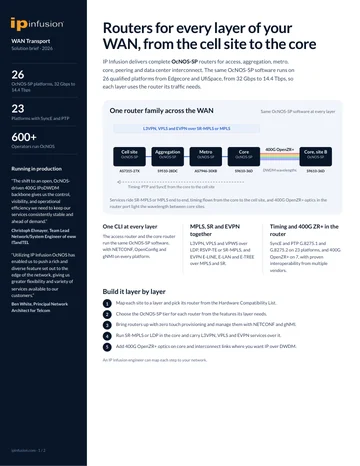
From cell-site to carrier core. All on OcNOS-SP.

A complete SP architecture on Broadcom merchant silicon: Q2U at the access edge, Q2A in metro aggregation, J2C+ in regional/national core. The NOS layer doesn't change.

QUMRAN 2U · BCM88284

Compact SP CSR · access edge.

~360 Gbps. Cell-site / FTTx pre-aggregation / Tier-3 metro. Q2U page →

~360 Gbps · 1RU
QUMRAN 2A · BCM88483

SP edge with deep buffer + 400G ZR.

800 Gbps. Metro aggregation, Tier-2 hub, deep-buffer backbone leaf. Q2A page →

800 Gbps · 1RU
QUMRAN 2C

Larger metro hub.

2.4 to 4.8 Tbps. Higher port density for tier-2 metro/regional roles. Same Q-family DNA.

2.4 to 4.8 Tbps
04
What OcNOS-SP Ships

Carrier-grade NOS, sized for Internet-scale routing.

OcNOS-SP exposes J2C+'s full carrier-core feature surface (Internet-scale FIB, MPLS service plane, IEEE 1588v2 timing, 400G ZR coherent) through one configuration model.

Full transit table + L3VPN.

IPv4/IPv6 routing with BGP-LU. Full L3VPN VPNv4/v6 service plane.

Segment Routing native, Flex-Algo.

SR-MPLS with TI-LFA fast reroute, Flex-Algorithm constraint paths, RSVP-TE for legacy interop. EVPN-MPLS overlays for multi-tenant L2/L3VPN.

PTP and SyncE in the core.

Hardware PTP at the carrier core, with Class C timing on the S9610-36D. Distribute timing to the metro and access tiers from one source.

PTP / SyncE

iPo-DWDM at the core.

400G ZR / ZR+ runs on the coherent-capable ports (all 12 × 400G on the AS9947, 18 of 36 on the S9610). Build transponder-free regional DWDM rings out of routers.

The full OcNOS-SP feature matrix.

OcNOS-SP runs on the cell-site Q2U, the metro Q2A, and the carrier-core J2C+. One configuration model, one automation surface, one operational team, across the entire SP fabric.

BGP · BGP-LU SR-MPLS / TI-LFA EVPN-MPLS · L3VPN PTP G.8275.1/2 SyncE G.8262 400G ZR / ZR+ RSVP-TE Telemetry / NETCONF
Day-0 to Day-2

ZTP, NETCONF and streaming telemetry.

Bring up a J2C+ in the rack with zero-touch provisioning. Stream telemetry with dial-in and dial-out, and manage configuration through NETCONF and OpenConfig YANG. The carrier core is as observable as the rest of your fabric.

ZTP IPv4/IPv6 Streaming telemetry NETCONF OpenConfig YANG Ansible

Three core profiles on one carrier-core chip.

J2C+ appears in Tier-1, Tier-2, and IXP architectures, each leveraging different sides of the same chip.

Replace the chassis with pizza-boxes.

"Our regional backbone runs on legacy chassis routers nearing end of life. We carry the full Internet routing table plus L3VPN. The next refresh should cost less and arrive sooner."

AS9947-36XKB at 7.2 Tbps of ports. Native SR-MPLS, with EVPN-MPLS for tenant services. Same OcNOS-SP software as the Q2A metro-aggregation routers two hops downstream.

SP · Tier-2 Backbone

14.4 Tbps super-spine in 2RU.

"Our national backbone needs 14 Tbps per node. Chassis routers fit, but we want pizza-box density and faster refresh cycles."

S9610-36D at 14.4 Tbps. 36 × 400G, 18 of them ZR+ capable. Same OcNOS-SP feature surface as the AS9947.

SP · Tier-1 Super-Spine

Internet exchange or super-spine.

"Our IXP needs to peer with hundreds of ASNs at 100G/400G. Burst patterns are pathological. Chassis architecture is correct but expensive."

Either the AS9947 (7.2 Tbps of ports) or the 14.4 Tbps S9610, depending on per-node capacity needs. Deep buffer absorbs IXP burst traffic. Internet FIB carries every peer's prefix advertisement. 400G coherent for inter-IXP DCI.

SP · IXP / DCI

The questions carrier-core architects ask.

Two open-hardware platforms at different capacity tiers: Edgecore AS9947-36XKB (BCM88851, 7.2 Tbps of ports, 12 × 400G + 24 × 100G) and UfiSpace S9610-36D (BCM88850, 14.4 Tbps, 36 × 400G). Both run OcNOS-SP with the same software and configuration model. Choose by the capacity tier and port mix the role requires.
Both platforms are built on Jericho 2C+ (BCM88851 on the AS9947-36XKB, BCM88850 on the S9610-36D) and run the same OcNOS-SP software; the difference is port capacity. The AS9947-36XKB exposes 7.2 Tbps of ports (12 × 400G + 24 × 100G), with a lower typical power draw. The S9610-36D exposes 14.4 Tbps as 36 × 400G. They use the same configuration model. Choose the AS9947 for a tier-2 SP backbone or regional ISP. Choose the S9610 for a Tier-1 backbone, IXP edge, or DCI super-spine where 14.4 Tbps in 2RU is required.
For many tier-2 and regional roles, yes. A 2RU J2C+ router with 7.2 to 14.4 Tbps of ports, a full Internet FIB, an MPLS service plane, IEEE 1588 timing, and 400G ZR coherent optics covers the core roles that mid-range chassis routers handle. A chassis router remains the right choice for Tier-1 internet backbones that need N+1 redundancy at the line-card level. For roles below that, J2C+ fits in 2RU, and the S9610-36D extends capacity to 14.4 Tbps.
Yes. Both qualified platforms support 400G ZR and ZR+ pluggable coherent optics, with OIF-CMIS support in OcNOS-SP. On the AS9947-36XKB, the 12 × 400G ports support these optics. On the S9610-36D, 18 of the 36 × 400G ports are ZR+ and OpenZR+ capable, so you can build a transponder-free metro or regional DWDM ring using routers. EVPN inter-DC extends the L2/L3 fabric across the optical span.
Different role, different scale. Q2U (BCM88284) is the access edge: ~360 Gbps, cell-site / Tier-3 metro. Q2A (BCM88483) is the metro aggregation: 800 Gbps with deep buffer + timing. Q2C is the larger metro hub: 2.4 to 4.8 Tbps with more port density. J2C+ (BCM88850 / BCM88851) is carrier-core: up to 14.4 Tbps with full Internet FIB. In a typical SP architecture: Q2U at the edge, Q2A in metro aggregation, Q2C / J2C+ in regional/national core. OcNOS-SP runs on all of them.
For SP edge or cell-site roles, use Q2U, which is sized for them. For metro aggregation, use Q2A, which is right-sized for the role. For DC fabric, use Trident or Tomahawk. For 800G uplinks, both qualified J2C+ platforms top out at 400G ports; TH5 is the silicon for 800G. J2C+ fits carrier-grade core and super-spine roles where Internet-scale FIB, deep buffers, and 400G coherent optics matter together.

Replacing a chassis router with merchant-silicon pizza-boxes?

30-minute architecture session with an OcNOS network architect. Bring your FIB-scale, capacity, and timing requirements, and leave with a sized BoM around AS9947-36XKB / S9610-36D.

Go deeper. Take it with you.

The product datasheet plus short, technical downloads that go further than this page.

Datasheet

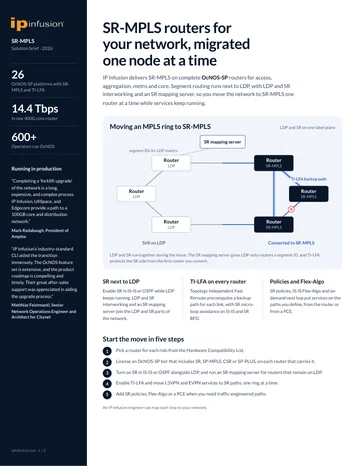
OcNOS-SP Datasheet

Full OcNOS-SP specification: the access, cell site and aggregation feature set, software SKUs, supported hardware platforms, and the solution ordering guide.

Get the datasheet
Solution Brief

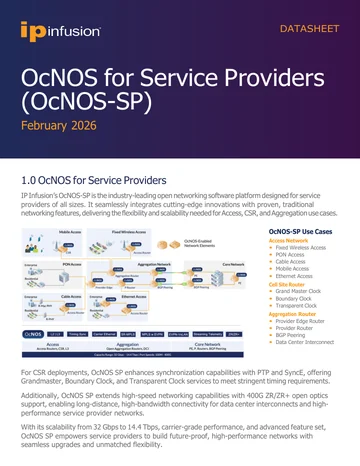
SR-MPLS Upgrade with OcNOS

Migrate SR-MPLS onto OcNOS on open hardware: Flex-Algo, TI-LFA, and a node-by-node cutover path.

Get the brief
Solution Brief

Cloud & Service Provider WAN Transport

Cloud and service-provider WAN transport on open hardware: SR-MPLS, EVPN, and scale-tested forwarding.

Get the brief