Access · Aggregation · Core · 800G ZR

Qumran3 open routers, from the access ring to the core.

Qumran3 is the current Broadcom StrataDNX routing silicon for carrier networks. Three parts carry the carrier roles: Qumran3U at 1.2 Tb/s for access, Qumran3A at 2.4 Tb/s for aggregation and Qumran3D at 25.6 Tb/s for core, edge, peering and DCI. IP Infusion plans OcNOS support for all three, delivered as complete routers on open hardware from UfiSpace and Edgecore.

1.2 to 25.6 Tb/saccess, aggregation and core
4 platformsfrom UfiSpace and Edgecore
800G ZRcoherent optics in a router port

Three chips cover access, aggregation and core.

Qumran3U

1.2 Tb/s · Access. Cell site and business aggregation, PON OLT uplinks and metro handoff, in a 1RU router.

BCM88400

Qumran3A

2.4 Tb/s · Aggregation. Carrier Ethernet, cell site routers, mobile backhaul, PON OLT, microwave access, aggregation routers and deep buffer top of rack.

BCM88490

Qumran3D

25.6 Tb/s · Core. Ethernet switching, carrier Ethernet, edge and core routers, peering, DCI and aggregation, with 800G ZR.

BCM88870

IP Infusion will deliver these parts as complete routers. UfiSpace and Edgecore build the open hardware around them, and IP Infusion will supply OcNOS, the platform, the optics and one support contract.

Common to all three. A hierarchical traffic manager, deep buffering, and Ethernet OAM, MPLS and Segment Routing. Port counts and buffer size are set by the platform builder, not by the chip. What differs between the parts is capacity.

Each part covers a different stage of the network.

Qumran3U sits where subscriber, mobile and business traffic first aggregates. Qumran3A carries the metro rings above it. Qumran3D carries, peers and hands that traffic to another site, over coherent optics in its own ports.

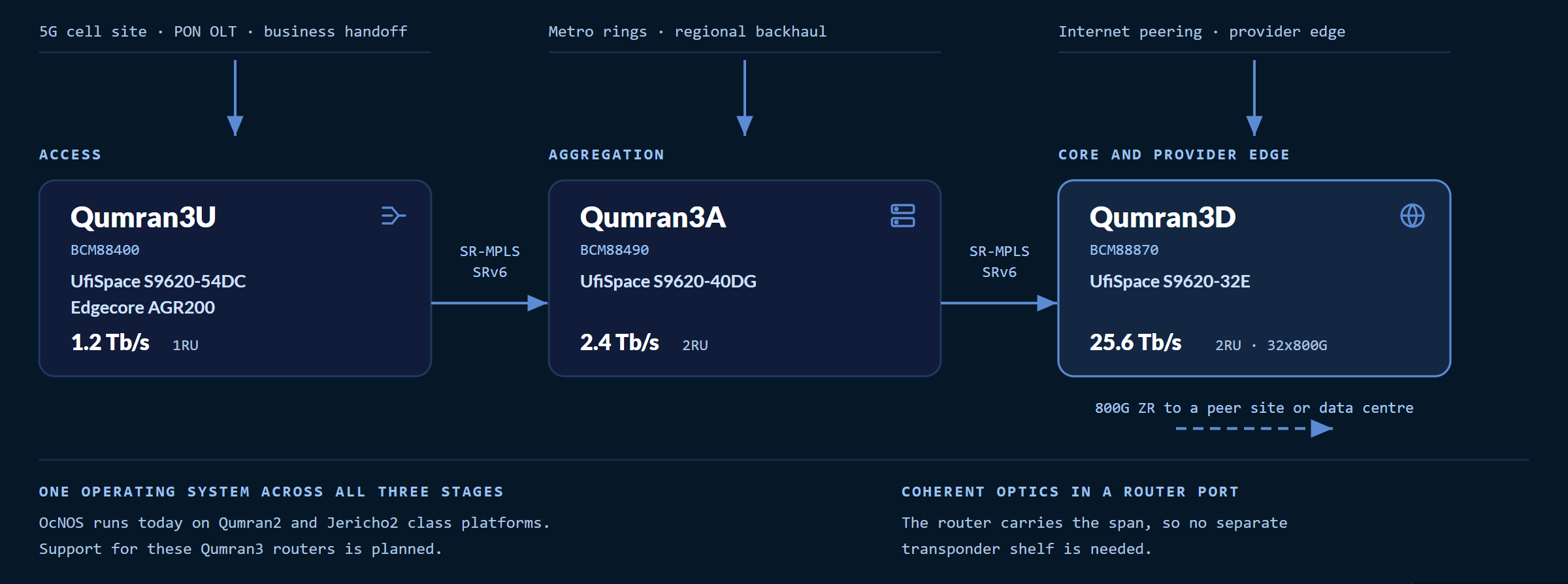
The three Qumran3 router roles in an operator network: Qumran3U at 1.2 Tb/s in 1RU for access, built as the UfiSpace S9620-54DC and the Edgecore AGR200; Qumran3A at 2.4 Tb/s for aggregation as the UfiSpace S9620-40DG; and Qumran3D at 25.6 Tb/s for core and provider edge as the UfiSpace S9620-32E, reaching a peer site over an 800G ZR coherent pluggable in a router port.
Access, aggregation and core, and a coherent span out of the core without a transponder shelf. OcNOS support for these platforms is planned.

Fewer devices at every stage of the network.

The three parts cover three stages of the network, under one operating system. Each card describes what changes at that stage.

One router in place of several devices

Cell site, business and PON OLT traffic aggregate into a single 1RU router. Timing and deep buffering are in the same device, so there is no separate timing appliance to power, cable and manage.

Access

Capacity added in ports rather than devices

Adding capacity has meant adding devices, each with its own power feed, its own cabling and its own management. A 2.4 Tb/s aggregation router absorbs that growth in ports on a device already in the rack.

Aggregation

Coherent optics remove the transponder shelf

Connecting sites over telco fiber has meant a separate shelf beside the router: another chassis, another power feed and a second management system for one link. With 800G ZR in a router port, the router carries the span, so the link is one device instead of two.

Core and interconnect

Reported savings. “A routing solution based on a single Qumran3D will save up to 66% more energy and up to 80% more rack space compared to previous generations.” Broadcom, October 2023.

Built by many. Delivered by one.

Broadcom builds the silicon. UfiSpace and Edgecore build the open hardware. IP Infusion brings it together and will deliver the finished router: OcNOS, the platform, the optics and one support contract.

Complete routers, not a network operating system

IP Infusion is a Broadcom Authorized Development Collaborator for StrataDNX. Its StrataDNX team has received direct training from Broadcom and works alongside Broadcom application engineers. One company delivers the software, the qualified open hardware, the optics interop and the support, so one vendor is accountable for the fix.

Service provider features in production

On the Qumran2 and Jericho2 platforms OcNOS supports today: MEF 3.0 certification for E-Line and E-LAN, achieved with OcNOS-SP-PLUS on the UfiSpace S9510-28DC, covers the business services these rings carry. Hierarchical QoS shapes and schedules by service and by tenant, so classes share a saturated uplink under a defined policy. SR-MPLS programs paths from the edge, adding capacity a node at a time without redesign.

Timing on the forwarding router

On rings shared with mobile transport, OcNOS runs G.8275.1 full timing on the router that is forwarding, and qualified platforms meet G.8273.2 Class C per-hop specs. The class binding depends on platform and release. The platform builders separately publish Class C accuracy with an integrated Stratum 3E OCXO on the Qumran3 routers below.

Coherent optics in production

OcNOS-SP sets transmit wavelength, modulation and FEC on the pluggable. That control runs today on eight Qumran2-class and Jericho2-class platforms, with proven interop from multiple vendors. Qumran3D would extend it to 800G.

Compared with a chassis. A single-chip 1RU or 2RU router replaces a chassis of line cards and supervisors. The trade-off is a larger failure domain, addressed at system level: every platform here publishes redundant hot-swap power and fans and a baseboard management controller. Node count depends on the topology.

Four open platforms cover the three roles.

UfiSpace and Edgecore build these routers today: two for access, one for aggregation and one for core. OcNOS support is planned across all four. Every figure below is the one the platform builder publishes.

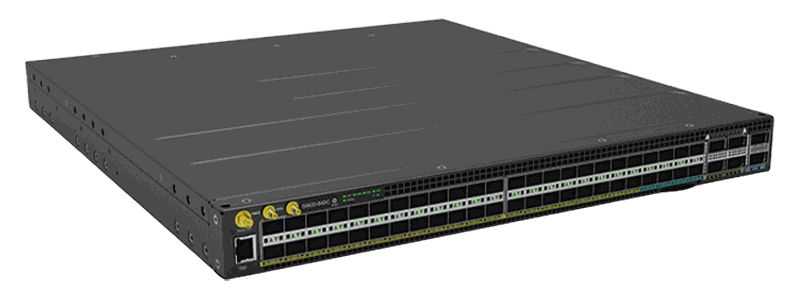
UfiSpace S9620-54DC open access router on Broadcom Qumran3U (BCM88400), front view

UfiSpace S9620-54DC

Broadcom Qumran3U (BCM88400)

Capacity
1.2 Tb/s
Buffer
4GB
Ports
40x 1/10/25G SFP28, 8x 1/10/25/50G SFP56, 4x 100G QSFP-DD, 2x 400G QSFP-DD

Mixed 25G to 400G aggregation with an internal GNSS receiver, Class C timing and 400G ZR and OpenZR+.

UfiSpace product page Access · 1RU
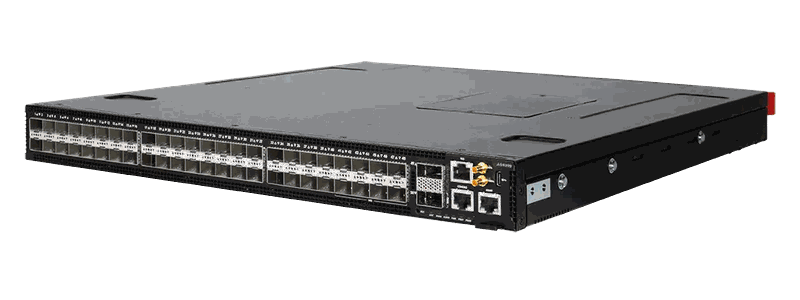
Edgecore AGR200 open access router on Broadcom Qumran3U (BCM88400), front view

Edgecore AGR200

Broadcom Qumran3U (BCM88400)

Capacity
1.2 Tb/s
Buffer
16GB
Ports
40x 25G SFP28, 8x 50G SFP56, 2x 400G QSFP-DD, one upgradeable to 800G

The same silicon with a deeper buffer and coherent optics up to 24 W. Also listed as AS7927-50X.

Edgecore product page Access · 1RU
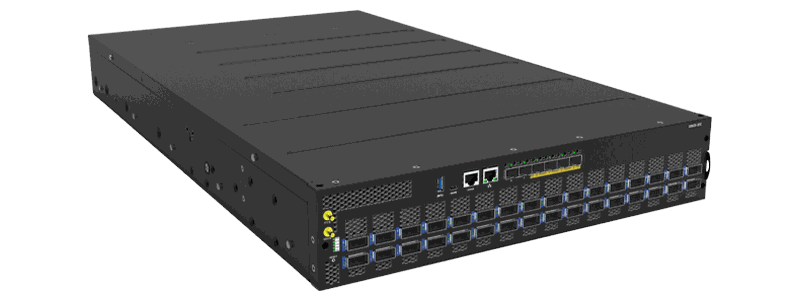
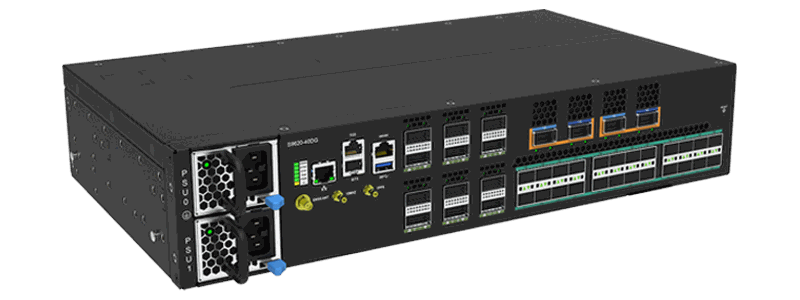
UfiSpace S9620-40DG open aggregation router on Broadcom Qumran3A (BCM88490), front view

UfiSpace S9620-40DG

Broadcom Qumran3A (BCM88490)

Capacity
2.4 Tb/s
Buffer
16GB
Ports
24x 1/10/25/50G SFP56, 12x 40/100G QSFP28, 4x 400G or 2x 800G QSFP-DD

High-density aggregation with 800G ZR, SRv6 and Class C timing.

UfiSpace product page Aggregation · 2RU
UfiSpace S9620-32E open core router on Broadcom Qumran3D (BCM88870), front view

UfiSpace S9620-32E

Broadcom Qumran3D (BCM88870)

Capacity
25.6 Tb/s
Buffer
32GB
Ports
32x 100/200/400/800G QSFP-DD, 4x 1/10/25G SFP28

32 ports of 800G for core, edge, peering and DCI, with 800G ZR.

UfiSpace product page Core · 2RU

Sourcing. Port and buffer figures are as published by UfiSpace and Edgecore for each platform. They differ between platforms on the same chip because both are board choices: the two Qumran3U routers above ship with a 4GB and a 16GB buffer. UfiSpace styles the access silicon as Qumran3u; this page uses Qumran3U, Qumran3A and Qumran3D throughout.

Qumran3 questions

What is Broadcom Qumran3?
Qumran3 is the current Broadcom family of StrataDNX routing processors for carrier networks. Three parts carry the carrier roles: Qumran3U at 1.2 Tb/s for access, Qumran3A at 2.4 Tb/s for aggregation, and Qumran3D at 25.6 Tb/s for core, edge, peering and DCI. Qumran devices are centralized routers, so packet processing, traffic management and switching sit in one device with no separate fabric, and a router fits in a fixed 1RU or 2RU box.
What are the Qumran3 part numbers?
Three parts carry the carrier roles: Qumran3U is BCM88400 at 1.2 Tb/s, Qumran3A is BCM88490 at 2.4 Tb/s, and Qumran3D is BCM88870 at 25.6 Tb/s.
What is the difference between Qumran3D, Qumran3A and Qumran3U?
Capacity is the difference. Qumran3U (BCM88400) runs at 1.2 Tb/s for access. Qumran3A (BCM88490) runs at 2.4 Tb/s for aggregation, with port rates from 1GE to 800GE. Qumran3D (BCM88870) runs at 25.6 Tb/s for core, edge, peering and DCI, at rates up to 800GE. Port counts and buffer size are set by the platform builder, not by the chip: the two Qumran3U routers on this page ship with different buffers.
Which open routers use Qumran3?
Four as of September 2026. On Qumran3U for access, UfiSpace builds the S9620-54DC and Edgecore builds the AGR200. On Qumran3A for aggregation, UfiSpace builds the S9620-40DG at 2.4 Tb/s. On Qumran3D for core, UfiSpace builds the S9620-32E at 25.6 Tb/s. OcNOS support for all four is planned.
Does Qumran3 support coherent ZR and ZR+ optics?
Yes, across the family. Broadcom states that Qumran3D supports emerging 800ZR+ optics for DCI and IPoDWDM. The platform builders publish coherent support at every stage: 400G ZR and OpenZR+ on the Qumran3U S9620-54DC, coherent optics up to 24 W on the Qumran3U AGR200, and 800G ZR on the Qumran3A S9620-40DG and the Qumran3D S9620-32E. The coherent pluggable sits in a router port, so no separate transponder shelf is needed.
How does Qumran3 differ from Jericho3?
Broadcom classes Qumran as centralized with no fabric interface, so the router sits in one device and builds a fixed standalone router. Jericho3 is classed as scalable and carries 160 ports of 100G fabric SerDes to Ramon3 fabric elements, so it builds a line card inside a chassis. Both use the Broadcom Elastic Pipe packet processor and a hierarchical traffic manager.
Does OcNOS support Qumran3?
OcNOS support for the Qumran3 family is planned. OcNOS already runs in production on Qumran2 and Jericho2 class platforms, including coherent optics control.
Next step

Planning a Qumran3 build-out?

Send us your topology and port counts, and our engineers will size the platform options with you.