SR-TE and egress peer engineering on OcNOS, with Vegvísir Traffic Dictator
In the CSR, MPLS and PLUS editions, all 26 OcNOS-SP routers run SR-TE policies, export the IS-IS topology over BGP-LS, take policies from a path computation element over PCEP, and allocate BGP Peer SIDs for egress peer engineering. Traffic Dictator, from Vegvísir Systems, computes the paths, and a joint lab validated the pair.
- Best for
- Operators moving to controller-based segment routing, with SR-TE policies and egress peer engineering.
- Running at
- AmplexVyve Broadband
How a constraint changes the path
Without a controller, every OcNOS router forwards on the IS-IS shortest path, with TI-LFA and Flex-Algo running in the routers. A controller makes the decisions that need a view of the whole network: a link affinity, a bandwidth reservation and the peering a service leaves by. OcNOS exports the topology over BGP-LS, Traffic Dictator computes the segment list, and OcNOS installs it from PCEP.
Pick a constraint
IGP shortest path, no controller
Every router forwards using IS-IS segment routing. The head-end pushes the node segment of R4, and the packet takes the direct link. OcNOS does this on its own.
- Path: R3 to R4
- Segment list: 16004
- Metric: 10, one hop
Stay on the yellow links
The policy requires links tagged YELLOW, so the direct link is excluded and the path goes through R2. No metric changed anywhere in the network. Traffic Dictator computed the segment list, and OcNOS installed it from PCEP.
- Path: R3 to R2 to R4
- Segment list: 16002, 16004
- Aggregate metric: 20, two hops
- Policy: R3_R4_YELLOW, affinity set YELLOW_ONLY
Reserve 40 Gbps on that path
The same policy includes a bandwidth figure. Traffic Dictator checked that both links had 40 Gbps free before it installed the path, and recorded the reservation in its own database.
- Path: R3 to R2 to R4
- Segment list: 16002, 16004
- Aggregate metric: 20, with 40 Gbps held
- Policy: R3_R4_YELLOW, bandwidth 40 Gbps
Choose the exit peer
R2 allocates BGP Peer SID 25600 for its peering with AS 101 and advertises it in BGP-LS. The segment list ends with that label, so it names the exit as well as the path to it. OcNOS allocates the Peer SID, and Traffic Dictator puts it in the segment list.
- Path: R3 to R2 to AS 101
- Segment list: 16002, 25600
- Aggregate metric: 10, one hop plus the exit
- Policy: R3_R2_EPE
The same exit, on blue links
Both constraints at once. The exit is still AS 101 and every link must carry the BLUE tag, so the path goes through R1. The affinity holds all the way to the border.
- Path: R3 to R1 to R2 to AS 101
- Segment list: 16001, 16002, 25600
- Aggregate metric: 20, two hops plus the exit
- Policy: R3_R2_EPE_BLUE, affinity set BLUE_ONLY
A simplified view of the joint lab topology. Segment lists, metrics and policy names are outputs recorded in the joint IP Infusion and Vegvísir application note.
Tested together in a joint lab
IP Infusion and Vegvísir Systems built the design together and published the results in a joint application note.
Routers: UfiSpace S9510-28DCRouter software: OcNOS 6.6.0Controller: Traffic Dictator 1.6Published: August 2025
| Capability | What the lab returned |
|---|---|
| Topology export | R3 exported the IS-IS level-2 database over BGP-LS: 5 nodes, 10 links and 19 prefixes, 34 entries in all. |
| Explicit path | Strict hops named in the policy, with a 2 Gbps reservation, installed segment list 16001, 16002, 16005. |
| Bandwidth | The 2 Gbps reservation was checked at computation time and appeared as reduced unreserved bandwidth on every link of the path. The affinity policies used the same mechanism at 40 Gbps. |
| Link affinity | Between the same two routers, BLUE returned 16004 at metric 10 and YELLOW returned 16002, 16004 at metric 20, with no metric changed. |
| Service mapping | Two L3VPN customers on separate service loopbacks each resolved over their own policy, with the expected transport and VPN labels on the transit router. |
| Path diversity | Two policies in the same disjoint group always took different links, with no affinities or explicit paths configured. |
| ECMP and anycast SID | A shared prefix SID advertised by two routers collapsed two segment lists into one. |
| Egress peer engineering | Segment list 16002, 25600, where the last label is the peering. Adding an affinity returned 16001, 16002, 25600. |
| Controller failover | With the primary controller stopped, the router redelegated every policy to the second controller. No state was synchronised between the two. |
| All controllers lost | The policies were withdrawn and the service routes resolved over IS-IS segment routing, with the BGP next hop unchanged. |
The lab ran on one router model. Platform and release support for each feature is listed in the OcNOS Feature Matrix below.
Operators building on OcNOS segment routing
“OcNOS gets us to our ultimate network goal of controller-based segment routing and provides the extensibility to fit our automation plans.”
Randy Horn, Vice President of Network Engineering, Vyve Broadband
Amplex
“We were looking for a lower-cost alternative to our current vendor for carrier-class equipment, as well as support for modern carrier network feature sets like SR-MPLS,” said Mark Radabaugh, President of Amplex.
Read the announcement →Vyve Broadband
Vyve Broadband standardized its architecture, configuration and management on OcNOS.
Read the announcement →Routers for the head-end and the border
Every OcNOS-SP router runs SR policies, PCEP and BGP-LS. The joint lab used the UfiSpace S9510-28DC.
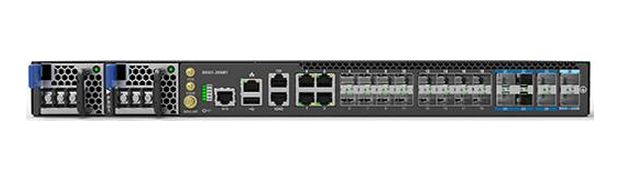
Cell site
UfiSpace S9501-28SMT
Qumran UX · 120 Gbps
8 × 10G, 16 × 1G, 4 × 1G RJ45
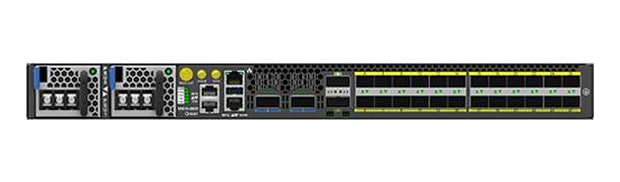
Aggregation, joint lab router
UfiSpace S9510-28DC
Qumran 2A · 800 Gbps
24 × 10/25G, 2 × 40/100G, 2 × 100/400G
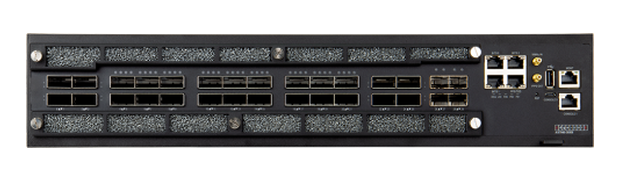
Metro and provider edge
Edgecore AS7946-30XB
Qumran 2C · 2.4 Tbps
4 × 25G, 22 × 100G, 4 × 400G
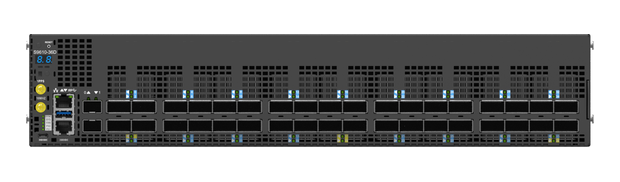
Core and peering
UfiSpace S9610-36D
Jericho 2C+ · 14.4 Tbps
36 × 400G, 18 ZR+ capable
See every qualified router on the OcNOS Hardware Compatibility List.
SR-TE features in OcNOS-SP
OcNOS runs the router half: SR policies, PCEP, BGP-LS and the Peer SIDs for egress peer engineering. These features are part of the CSR, MPLS and PLUS editions.
| Feature | Routers | Editions | First release |
|---|---|---|---|
| Segment routing policy (traffic engineering) | 26 of 26 | CSR, MPLS, PLUS | 4.0 |
| Segment routing policy hop limit | 26 of 26 | CSR, MPLS, PLUS | 7.0.0 |
| PCEP, stateful PCE and PCEP extensions for segment routing | 26 of 26 | CSR, MPLS, PLUS | 4.0 |
| BGP-LS distribution for IS-IS SR and OSPF SR | 26 of 26 | CSR, MPLS, PLUS | 4.0 |
| BGP-LS extensions for BGP egress peer engineering | 26 of 26 | CSR, MPLS, PLUS | 5.0 |
| BGP-LS advertisement of IGP TE performance metrics | 26 of 26 | CSR, MPLS, PLUS | 5.1 |
| TI-LFA fast reroute | 26 of 26 | CSR, MPLS, PLUS | 4.0 |
| IS-IS Flex-Algo and traffic steering for Flex-Algo | 26 of 26 | CSR, MPLS, PLUS | 6.6.0 |
| SR ECMP on IS-IS and OSPF | 26 of 26 | CSR, MPLS, PLUS | 6.5.3 |
| BGP on-demand next hop and auto steering | 26 of 26 | MPLS, PLUS | 6.2.0 |
| Service mapping over an SR policy | 25 of 26 | CSR, MPLS, PLUS | 4.2 |
| RSVP-TE fast reroute, one-to-one and facility backup | 26 of 26 | CSR, MPLS, PLUS | 1.0 |
Support varies by router: check the OcNOS Feature Matrix.
Questions about SR-TE on OcNOS.
Solution brief and joint application note.
The two-page brief for your team, and the full lab write-up with every configuration on both sides, the session output and the failure tests.
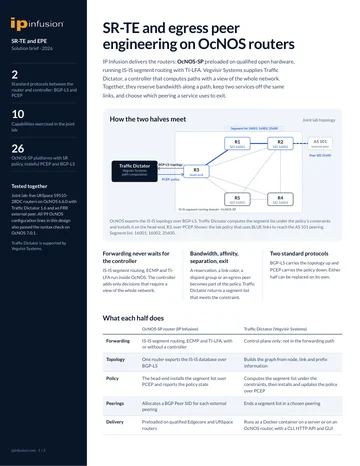
SR-TE and EPE Solution Brief
The joint IP Infusion and Vegvísir design on two pages: what the OcNOS router does, what Traffic Dictator does, and the constraints tested in the joint lab.
Get the brief
Segment Routing Application Note
The full engineering write-up: the validated lab, every configuration on both sides, the BGP-LS and PCEP session output, the computed segment lists, and the failure tests, step by step.
Get the application noteSR-TE and EPE Solution Brief
Quick form. Your PDF opens in a new tab immediately after submit.
✓ Opening your PDF in a new tab…
If it didn't open, use the link below.
Segment Routing Application Note
Quick form. Your PDF opens in a new tab immediately after submit.
✓ Opening your PDF in a new tab…
If it didn't open, use the link below.
Plan traffic engineering on your network.
We size the OcNOS routers and editions for your head-ends and border routers, and put you in touch with Vegvísir Systems for the controller.
Would you like us to reach out?
Leave your details and an IP Infusion engineer will walk through what traffic engineering would look like on your network. We will only be in touch if you would like us to be.