Broadband aggregation routers for fiber and fixed wireless ISPs
IP Infusion delivers the broadband aggregation router: OcNOS-SP preloaded on qualified routers that collect OLT and fixed wireless uplinks, shape each service, and carry it to the core over EVPN, VPLS or L3VPN on MPLS or SR-MPLS, under one support contract.
Keep voice and video ahead of bulk traffic
In the busy hour, every service on an OLT or tower uplink competes for the same capacity. OcNOS-SP gives each service VLAN its own queue with a shaped rate, so voice and IPTV do not wait behind bulk downloads.
The same busy uplink, two ways to queue it
One shared queue. Every service waits in the same uplink queue. When bulk downloads fill it in the busy hour, voice and IPTV packets may wait behind them.
Service queuing. Each service VLAN gets its own queue with a shaped rate. Strict priority serves voice first, WFQ shares capacity among the other queues, and WRED can drop packets before bulk queues fill.
Illustrative.
ISPs aggregating broadband on OcNOS
BroadStar
OcNOS aggregates customer traffic back to the core for symmetric fiber broadband, up to 10G, to multiple dwelling units across the US.
Read the story →DIGI
OLT aggregation running in all five markets, on UfiSpace and Edgecore hardware in the same deployment.
Read the story →Broadlinc
OcNOS SP on UfiSpace hardware for MPLS routing in a grant-funded fixed wireless build-out in rural Kentucky.
Read the story →“Aggregating all of our customer traffic back to our core network using IP Infusion’s platform provides a clear ROI in just a few months rather than the years it would take if we used other solutions.”
Tyler Bell, CEO of Broadstar
What OcNOS-SP runs on the aggregation router
Queuing, multicast, services and redundancy for the access edge, from the OcNOS Feature Matrix.
| Capability | What it does | Where |
|---|---|---|
| Service queuing | Maps each service to a VLAN and shapes each VLAN | All OcNOS-SP |
| Queuing hierarchy | One, two or three queuing levels, with shaping per queue and per port | All OcNOS-SP |
| Scheduling and WRED | Strict priority and WFQ per queue, with weighted random early drop | All OcNOS-SP |
| Policing | Single-rate and two-rate three-color markers | All OcNOS-SP |
| IPTV multicast | IGMPv2 and v3, IGMP snooping and proxying, PIM-SM | All OcNOS-SP |
| Single and double VLAN tagging | 802.1Q and 802.1ad | All OcNOS-SP |
| EVPN, VPLS and VPWS | EVPN E-LINE and E-LAN, plus VPLS and VPWS, over MPLS | All OcNOS-SP |
| L3VPN | BGP/MPLS IP VPNs with ECMP, IPv4 and IPv6 | All OcNOS-SP |
| SR-MPLS with TI-LFA | Segment routing over IS-IS or OSPF, with Flex-Algo and precomputed backup paths | All OcNOS-SP |
| Redundant uplinks | SR ECMP, BFD and VRRPv3 | All OcNOS-SP |
| EVPN-VXLAN | Layer 2 EVPN over an IP network | Selected platforms |
Support varies by platform, service type and license: check the OcNOS Feature Matrix.
Aggregation routers by site
Pick the router by the access it collects and the uplink it needs.

POP and tower sites
UfiSpace S9500-22XST
Qumran AX · 300 Gbps
8 × 10G, 8 × 25G, 2 × 100G, 4 × 1G RJ45
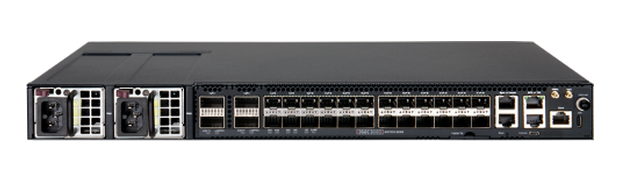
Pre-aggregation
Edgecore AS7535-28XB
Qumran 2A · 800 Gbps
24 × 25G, 2 × 100G, 2 × 400G
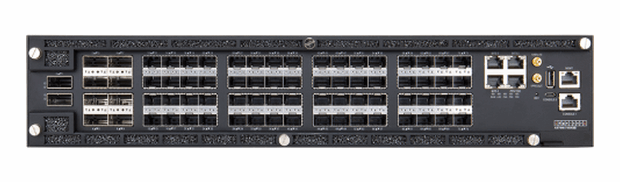
Dense OLT uplinks
Edgecore AS7946-74XKSB
Qumran 2C · 2.4 Tbps
64 × 10G/25G, 10 × 100G, 2 × 100G QSFP-DD
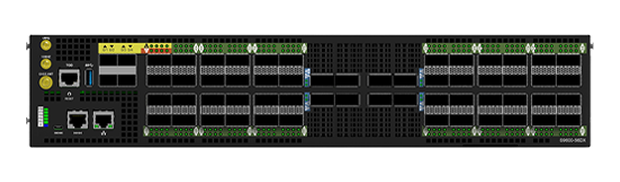
Regional aggregation
UfiSpace S9600-56DX
Qumran 2C · 4.8 Tbps
48 × 100G, 8 × 400G
Aggregation routers hand traffic to the metro network and the IP core. Running a virtual BNG? See the netElastic vBNG solution. See every qualified router on the OcNOS Hardware Compatibility List.
Questions about the broadband aggregation router.
Datasheet and solution briefs.
The OcNOS-SP datasheet and two briefs to share with your team. Quick form, and the PDF downloads immediately.
OcNOS-SP Datasheet
The full OcNOS-SP overview: roles, protocols, timing, and the validated hardware, in one PDF.
Get the datasheetSR-MPLS Upgrade with OcNOS
Move an MPLS network to SR-MPLS on OcNOS-SP routers, one router at a time, with TI-LFA from the first router you convert.
Get the briefService Provider WAN Transport
OcNOS-SP routers for every layer of the WAN, from the cell site to the core, with timing and 400G OpenZR+.
Get the briefPlan your broadband aggregation.
We map your OLT and tower sites, services and uplinks to qualified routers and a queuing design that fits them.
OcNOS-SP Datasheet
Quick form. Your PDF will download immediately after submit.
✓ Opening your PDF in a new tab.
If it did not open, use the link below.
SR-MPLS Upgrade with OcNOS
Quick form. Your PDF will download immediately after submit.
✓ Opening your PDF in a new tab.
If it did not open, use the link below.
Service Provider WAN Transport
Quick form. Your PDF will download immediately after submit.
✓ Opening your PDF in a new tab.
If it did not open, use the link below.