What Is Network Disaggregation?
Network disaggregation is the separation of a router or switch into parts that are bought separately: the network operating system software, and open hardware built on merchant silicon. A disaggregated network lets the operator choose, license and upgrade each part on its own schedule instead of buying one closed appliance. IP Infusion develops OcNOS, a commercial network operating system, and ships it as software and as complete, validated systems on 40+ open hardware platforms.
In a disaggregated network, what is separated?
A traditional router or switch is sold as one product: the vendor designs the hardware, writes the software, and supports both as a unit. Disaggregation splits that unit along standard interfaces, so each layer can come from the supplier that fits the job.
Silicon and hardware
The box: a merchant silicon forwarding chip, CPU, ports, power and cooling, built by a hardware manufacturer. The same chip family appears in systems from several manufacturers, so the hardware becomes a choice rather than a lock.
Network operating system
The software: routing protocols, the forwarding control that programs the chip, and the CLI and APIs. The NOS installs on the hardware through ONIE, the open installer most open switches and routers ship with.
Automation and assurance
The tools above: provisioning, configuration and monitoring through standard interfaces such as NETCONF, YANG and gNMI streaming telemetry, instead of one vendor's element manager.
How a disaggregated network works in practice
Disaggregation changes how a network is bought and built, not how packets are forwarded. A disaggregated router runs the same protocols as any other router; what changes is who supplies each part and how they are joined.
- Hardware arrives open. The switch or router ships with an installer environment instead of a locked software image. The operator, or the systems supplier, loads the chosen NOS onto it.
- The NOS drives the silicon. The operating system programs the forwarding chip through the silicon vendor's software interface, so the same NOS can run on hardware from different manufacturers built around the same chip.
- Operations stay uniform. Because the NOS is the same across roles and hardware suppliers, the CLI, the configuration models and the telemetry stream stay the same too. Automation is written once.
- Lifecycles decouple. Software upgrades follow the NOS release train. Hardware refreshes follow silicon generations. Neither forces the other.
Three ways to build a disaggregated network
Disaggregated network architecture is less a single design than a spectrum, set by how much of the integration the operator wants to own.
Self-integrated
The operator buys hardware from one supplier and a NOS from another, then tests, qualifies and supports the combination in house. Maximum choice, and the largest engineering load.
Validated system
A software vendor validates its NOS on named hardware models and ships the pair as one supported system. The architecture stays disaggregated, while the integration and support burden moves to the supplier.
Disaggregated chassis
A large chassis router is rebuilt from standalone line-card and fabric boxes on merchant silicon, joined by cables instead of a backplane. The same separation principle, applied inside one logical router.
What disaggregation gives you, and what it asks of you
The benefits are structural. The costs are mostly integration work, and they are real. Both belong in the business case.
Benefits
- Supplier choice per role. Cell site, aggregation, core and data center roles can each use the hardware that fits, from more than one manufacturer.
- Separate cost lines. Hardware and software are priced separately, so each can be compared and negotiated on its own terms.
- One operating model. A single NOS across roles means one CLI, one set of YANG models and one automation codebase.
- Silicon on your schedule. A new chip generation arrives as new hardware under the same software, rather than a new product line.
Trade-offs
- Integration. Someone has to confirm that the software, the hardware, the optics and the release train work together. In a self-integrated network that someone is the operator.
- Support model. When a port flaps, the fault can sit in the NOS, the hardware or the optic. Two contracts with two suppliers make that call slower.
- Validation burden. Feature support varies by chip. Every feature, scale target and upgrade path needs checking per hardware model and per release.
- Skills. Teams used to one integrated vendor need to own supplier selection and lifecycle planning.
A validated system addresses the first three directly. One supplier tests the NOS on each listed platform, publishes which features run on which hardware, and supports the software and hardware as one product. For OcNOS that record is public: the OcNOS Feature Matrix maps every feature to the platforms that support it, and the Hardware Compatibility List lists 40+ qualified platforms.
Disaggregated networking for service providers and data centers
Disaggregation took hold first where networks are large, repetitive and cost sensitive. That describes both operator transport networks and data center fabrics.
Service provider networks
Tier 2 and Tier 3 ISPs, regional telcos, carriers, and mobile and broadband operators use open cell site, aggregation and core routers, including IP over DWDM with coherent optics in the router port.
Data center and AI fabrics
Leaf-spine EVPN-VXLAN fabrics for large enterprise data centers and MSPs, and lossless Ethernet AI fabrics for GPU clusters and neoclouds, all built on open switches.
OEM products
Networking product companies take disaggregation one step further and embed a commercial NOS in their own hardware instead of writing one.
OcNOS: disaggregated software, delivered as validated systems
IP Infusion develops OcNOS as commercial networking software and ships it as complete, validated systems. OcNOS-SP runs on qualified service provider routers built on Broadcom Qumran and Jericho silicon, and OcNOS-DC on qualified data center switches built on Broadcom Trident and Tomahawk silicon, 40+ platforms in all. The hardware comes from Edgecore, UfiSpace and Celestica.
| Broadcom silicon | OcNOS edition | Qualified platforms | Capacity per system | Roles on the HCL |
|---|---|---|---|---|
| Qumran UX | OcNOS-SP | 7 | 32 to 120 Gbps | Cell site, aggregation, edge |
| Qumran AX | OcNOS-SP | 3 | 300 Gbps | Aggregation, cell site |
| Qumran 2U | OcNOS-SP | 2 | 360 Gbps | Aggregation |
| Qumran MX | OcNOS-SP | 2 | 800 Gbps | Aggregation, edge |
| Qumran 2A | OcNOS-SP | 2 | 800 Gbps | Aggregation, IPoDWDM |
| Qumran 2C | OcNOS-SP | 7 | 2.4 to 4.8 Tbps | Core, aggregation, IPoDWDM |
| Qumran 2C+ | OcNOS-SP | 1 | 7.2 Tbps | Core, IPoDWDM |
| Jericho2C+ | OcNOS-SP | 2 | 7.2 to 14.4 Tbps | Core, IPoDWDM |
| Trident3 X2 | OcNOS-DC | 3 | 120 Gbps | Management network |
| Trident3 X4, X5, X7 | OcNOS-DC | 7 | 1.08 to 3.2 Tbps | Data center |
| Trident4 | OcNOS-DC | 2 | 12.8 Tbps | Data center, IPoDWDM |
| Tomahawk2, 3, 4 | OcNOS-DC | 3 | 6.4 to 25.6 Tbps | Data center |
| Tomahawk5 | OcNOS-DC | 3 | 51.2 Tbps | Data center, IPoDWDM |
- One Feature Matrix for every platform. The Feature Matrix maps every OcNOS feature to the qualified platforms that support it, so the validation question in the trade-offs above has a published answer.
- Licence tiers. OcNOS is licensed in tiers named IPBASE, MGMT, MPLS, CSR and PLUS.
- Three ways to buy. OcNOS software for hardware you choose from the HCL, pre-integrated OcNOS Systems ready to deploy, or OcNOS for OEMs embedded in your own product. IP Maestro adds assurance across the network.
Integrated, self-integrated and validated disaggregated networks
The same network can be bought three ways. The differences are in who integrates, who supports and how much choice remains.
| Question | Traditional integrated | Self-integrated disaggregated | Validated disaggregated system |
|---|---|---|---|
| Hardware source | The router vendor only | Any manufacturer the operator selects | Named platforms from several manufacturers |
| Software source | Bundled with the hardware | Licensed separately | Licensed separately, qualified on each platform |
| Who integrates | The vendor | The operator | The software supplier |
| Who answers a fault | One vendor | Two or more suppliers | One supplier for software and hardware |
| Feature coverage per platform | Vendor datasheet | Operator testing | Published per platform |
| Hardware refresh | Follows the vendor roadmap | Operator choice | Operator choice within the qualified list |
| Operations across roles | Can differ by product line | One NOS if chosen that way | One NOS across roles |
Network Disaggregation FAQ
What is network disaggregation?
In a disaggregated network, what is separated?
What are the benefits of a disaggregated network for a service provider?
What are the hidden costs of disaggregated networks?
What should be validated before adopting a disaggregated network?
Can you run timing on a disaggregated network?
Is disaggregated networking the same as open networking?
Keep reading
- Open networking: the wider approach that disaggregation enables, and where IP Infusion fits.
- What is a network operating system: the software half of a disaggregated router or switch.
- What is a white box switch and what is a white box router: the hardware half.
- AI networking switches: disaggregated switches for GPU cluster fabrics.
- OcNOS-SP for service provider routing and OcNOS-DC for data center and AI fabrics.
- Open NOS options for the data center, compared.
Planning a disaggregated network? Start from the roles.
List the roles, port speeds and features you need. The Hardware Compatibility List shows which qualified platforms fit each role, the Feature Matrix shows what runs on each, and an IP Infusion engineer can take it from there.
Go deeper. Take it with you.
Two short, technical downloads that go further than this page: the full OcNOS-SP datasheet and the full OcNOS-DC datasheet.
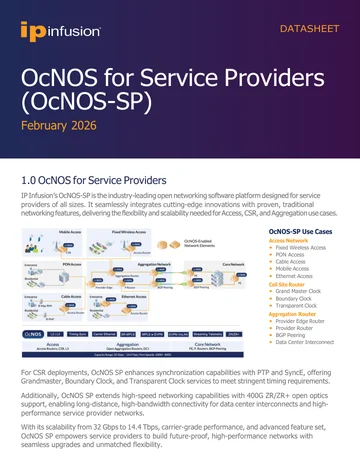
OcNOS-SP Datasheet
Full OcNOS-SP specification: the access, cell site and aggregation feature set, software SKUs, supported hardware platforms, and the solution ordering guide.
Get the datasheet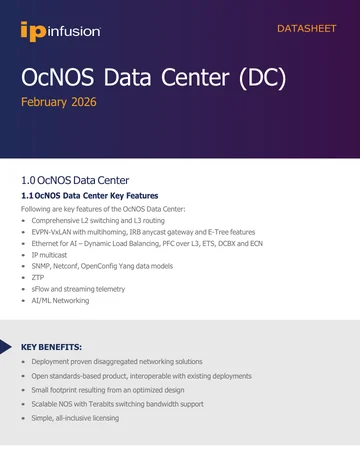
OcNOS-DC Datasheet
Full OcNOS-DC specification: the EVPN-VXLAN and Ethernet for AI feature set, software SKUs, supported hardware platforms, and the solution ordering guide.
Get the datasheetOcNOS-SP Datasheet
Quick form. Your PDF opens in a new tab immediately after submit.
✓ Opening your PDF in a new tab…
If it didn't open, use the link below.
OcNOS-DC Datasheet
Quick form. Your PDF opens in a new tab immediately after submit.
✓ Opening your PDF in a new tab…
If it didn't open, use the link below.