For decades, Service Provider (SP) networks and Data Center (DC) fabrics operated as separate worlds: distinct hardware form factors, protocol dialects, and operating systems built for entirely different jobs. Today, that boundary isn’t blurring. It’s dissolving.
5G, edge computing, and the explosion of AI and GPU cluster traffic mean the modern network can no longer choose between scale and agility. It needs SP-grade reliability and multi-tenancy fused with DC-grade automation and high-speed fabrics. Here’s why this convergence is the defining network shift of the decade.
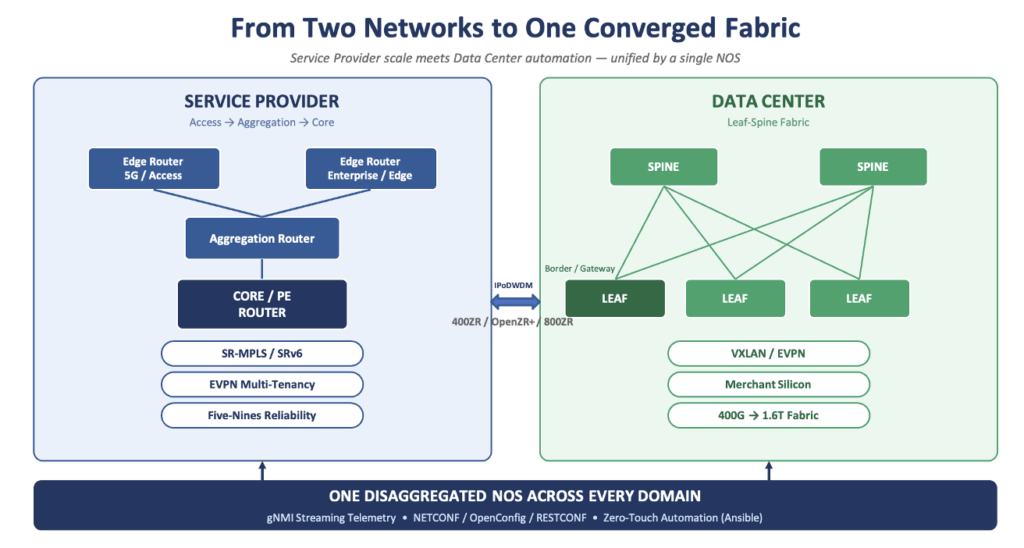
The Tale of Two Silos
To see where the industry is going, it helps to see where it came from. Two networks evolved in parallel, each shaped by a different architectural philosophy, different silicon, and a different idea of what “scale” even means.
The Service Provider Legacy: Integrated, and Built to Scale Up
SP networks were built for the long haul, prioritizing massive geographic scale, deep routing tables, and “five nines” (99.999%) reliability. The guiding philosophy was integration: one vendor controlled the hardware, the silicon, and the NOS as a single vertically-integrated stack.
- The Gear: Heavy, proprietary chassis routers built on custom SP silicon, with deep buffers and massive TCAM-based forwarding tables sized for internet-scale routing and granular per-customer QoS.
- The Tech: Complex protocol stacks (MPLS, BGP, RSVP-TE) built to isolate customer traffic and guarantee strict QoS across vast distances.
- The NOS: Monolithic and tightly coupled to its silicon, built for protocol depth and stability, not agility.
- The Scale Model: Scale-up: bigger line cards, denser chassis, fewer boxes doing more.
- The Trade-off: Rock-solid stability, but slow, manual, operationally heavy provisioning, and a roadmap tied to one vendor.
The Data Center Legacy: Open, and Built to Scale Out
The modern cloud data center evolved around speed, agility, and massive east-west bandwidth, and it inverted the SP philosophy. Instead of integration, the DC world bet on openness: disaggregating hardware from software so operators could choose merchant silicon and NOS independently.
- The Gear: Standardized, fixed-form-factor switches on merchant silicon in scalable leaf-spine topologies, with shallower buffers than SP chips but high port density and low latency.
- The Tech: Cloud-native network operating systems, VxLAN/EVPN virtualization, API-first management.
- The NOS: Lightweight and disaggregated from its hardware, built API-first for automation and rapid iteration.
- The Scale Model: Scale-out: capacity grows horizontally, by adding more standardized switches to the fabric.
- The Trade-off: Unmatched automation and hardware flexibility, but historically thin on the traffic engineering and multi-tenant isolation carrier-grade delivery demands.
The Catalyst for Convergence
Today’s applications don’t respect the SP/DC boundary. 4K video, AI workloads, and autonomous edge deployments all expect local data-center latency and service-provider reach in the same session.
The scale of this shift shows up in the numbers: the data center switch market is projected to grow from $17.9B in 2025 to $28.5B by 2031, as operators replace 25–100GbE fabrics with 400G and 800G to keep up with AI workloads (Mordor Intelligence). 2026 marks the first year of volume 1.6 Tbps deployments, with AI/ML infrastructure spend growing roughly 39% annually (Dell’Oro Group). That growth isn’t staying inside the data center. It’s pushing into the metro and WAN, wherever AI traffic needs to move. Call it a third scaling model: not scale-up or scale-out, but scale-across: the same fabric economics extending horizontally, from rack to metro to core.
Building the Modern Converged Network
Organizations building next-generation networks want a hybrid architecture that refuses to compromise. Here’s what the new standard looks like:
1. SP-Grade Scale and Multi-Tenancy
Segment Routing (SR-MPLS/SRv6) and advanced EVPN bring carrier-grade traffic engineering into the data center and out to the edge, enabling deep, secure multi-tenancy for thousands of workloads without the overhead of legacy protocols.
2. Cloud-Native Automation and Manageability
CLI configuration and reactive SNMP polling are giving way to API-first NOSes built on NETCONF/OpenConfig, RESTCONF, and gNMI streaming telemetry for real-time visibility, while automation tools like Ansible, born in the data center, now provision the SP core for zero-touch deployment and closed-loop remediation.
3. High-Speed, Merchant Silicon Fabrics
The monolithic chassis is giving way to scale-out fabrics on merchant silicon, which now deliver the deep buffers and routing features once reserved for custom SP chips, at DC-grade power efficiency and economics. As AI clusters push toward 1.6 Tbps, that economics matters as much in the metro and WAN core as inside the data center.
4. IP and Optical Convergence: IPoDWDM and Open ZR/ZR+
Convergence extends past the packet layer, too. Coherent pluggable optics (400ZR, OpenZR+, now 800ZR) let a router light its own DWDM wavelength directly from a port, collapsing the router-to-transponder-to-line-system chain into a single hop: fewer boxes, less power, one less operational domain. What was a multi-year discussion is becoming real deployment in 2026 (WWT).
Convergence in Practice
This isn’t hypothetical. Open NOSes like IP Infusion’s OcNOS, built for merchant-silicon hardware, already carry SR-MPLS, EVPN, precision timing, and IPoDWDM with open ZR/ZR+ optics across access, aggregation, transport, and data center use cases, each on the hardware best suited to that domain. That’s the practical shape of convergence: not one box doing everything, but one NOS, one CLI, and one telemetry model underneath it all, so operators get a single automation toolchain instead of retraining for every layer that used to be a separate stack.
The Takeaway
The era of “SP vs. DC” is over. We’re entering the era of the Universal Network.
By demanding SP-grade reliability alongside DC-grade agility, organizations are building networks that accelerate the business behind them. It’s no longer scale-up versus scale-out. It’s scale-across: one NOS, from the data center to the edge to the core. The mandate is clear: break down the silos, embrace open automation, and build for a world where the data center extends everywhere.
Ready to see what a converged, disaggregated network architecture looks like for your organization? Talk to the IP Infusion team: https://www.ipinfusion.com/contact/
