There is no single best network operating system. Community SONiC suits data center teams that can engineer and support it themselves, commercial SONiC narrows that to vendor-backed leaf and spine builds, and proprietary platforms bundle hardware and software. OcNOS runs complete IP Infusion routers and switches across both transport and the data center.
The network operating system market is undergoing a structural shift. Proprietary NOS vendors no longer have a monopoly on carrier-grade features. Open networking platforms have matured to the point where mission-critical service provider deployments — hundreds of nodes, millions of subscribers — run on open, disaggregated architectures. The question for most operators is no longer whether to adopt open networking, but which path to take.
This is Part 4 of the IP Infusion NOS comparison series — the definitive summary.
The Four NOS Options in 2024
| Option | Examples | Model | Best For |
|---|---|---|---|
| Proprietary | Cisco IOS-XR, Juniper Junos, Nokia SR OS | Closed HW+SW bundle | Operators wanting single-vendor simplicity with budget flexibility |
| Commercial SONiC | Dell OS10, Arista EOS-based, Cisco SONiC | Open HW, SONiC-derived SW | Pure DC leaf/spine, Broadcom-only, large engineering teams |
| Community SONiC | Azure SONiC, SONiC-VS | Open source, DIY | Hyperscalers with dedicated NOS engineering teams |
| OcNOS (IP Infusion) | OcNOS-SP, OcNOS-DC | Open HW, commercial SW | SP + DC, full protocol stack, production support required |
Full Capability Matrix
| Capability | Proprietary | Commercial SONiC | Community SONiC | OcNOS |
|---|---|---|---|---|
| SR-MPLS + TI-LFA | ✓ | Partial | Limited | ✓ Full |
| EVPN (E-LINE/E-LAN/E-TREE/L3VPN) | ✓ | DC-focused | DC-focused | ✓ Full SP+DC |
| Flex-Algo (network slicing) | ✓ | Limited | No | ✓ |
| IPoDWDM / coherent optics | ✓ (vendor-specific) | No | No | ✓ 100G/400G ZR+ |
| PTP / IEEE 1588v2 (5G timing) | ✓ | Limited | No | ✓ |
| VPLS | ✓ | No | No | ✓ |
| BGP RPKI | ✓ | Partial | Partial | ✓ OcNOS 7.0+ |
| Container / K8s on NOS | ✓ (IOS-XR) | No | No | ✓ OcNOS 7.0+ |
| gNMI on-change telemetry | ✓ | ✓ | Partial | ✓ OcNOS 7.0+ |
| Hardware independence | ✗ | ✓ (Broadcom-focused) | ✓ (Broadcom-focused) | ✓ Multi-silicon |
| 24×7 production support | ✓ | ✓ (vendor) | ✗ | ✓ IP Infusion TAC |
| Defined product roadmap | ✓ | Partial | ✗ | ✓ |
| Time to production | Fast (pre-integrated) | Medium | Slow (DIY) | Fast (pre-validated) |
| Hardware TCO | High (captive) | Low–Medium | Low (DIY overhead) | Low (white-box) |
Decision Framework

Bottom Line
There is no universally correct NOS answer. The right choice depends on your use case, team capabilities, and risk tolerance. What has changed is that the argument for staying with proprietary NOS — that open alternatives lack the features and support quality required for production — is no longer accurate. OcNOS has 900+ customers, 10,000+ production deployments, TL 9000 certification, and MEF 3.0 compliance to substantiate that claim.
- OcNOS vs SONiC: the full data-center comparison
- OcNOS vs proprietary network operating systems
- Try OcNOS free: demo VM
- Contact IP Infusion
IP Infusion Marketing Team
Go deeper. Take it with you.
Two short, technical downloads that go further than this page: the full OcNOS-SP datasheet and the full OcNOS-DC datasheet.
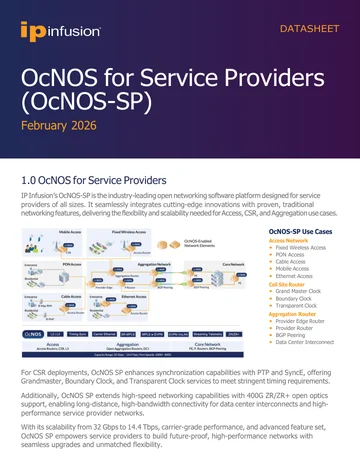
OcNOS-SP Datasheet
Full OcNOS-SP specification: the access, cell site and aggregation feature set, software SKUs, supported hardware platforms, and the solution ordering guide.
Get the datasheet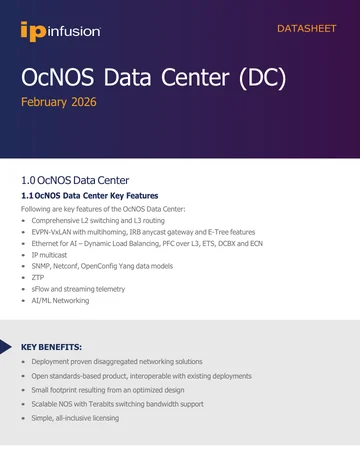
OcNOS-DC Datasheet
Full OcNOS-DC specification: the EVPN-VXLAN and Ethernet for AI feature set, software SKUs, supported hardware platforms, and the solution ordering guide.
Get the datasheetOcNOS-SP Datasheet
Quick form. Your PDF opens in a new tab immediately after submit.
✓ Opening your PDF in a new tab…
If it didn't open, use the link below.
OcNOS-DC Datasheet
Quick form. Your PDF opens in a new tab immediately after submit.
✓ Opening your PDF in a new tab…
If it didn't open, use the link below.