OcNOS vs SONiC: two open data-center network operating systems, compared
OcNOS is a commercial, vendor-supported data-center NOS, validated per platform and licensed separately from the switch. SONiC is an open-source NOS, run as a community build or through a vendor distribution. Both run on the same class of open Broadcom merchant-silicon hardware, so this is a comparison of two operating systems and their support models, not open versus proprietary. Scoped to the data center and AI fabric.
OcNOS and SONiC at a glance
Both are legitimate ways to run an open data-center fabric on white-box hardware. The difference is the operating model: an open-source NOS you (or a distribution vendor) integrate and support, versus a commercial NOS delivered validated and supported per platform.
What is the same
- Both run on open ONIE white boxes on Broadcom merchant silicon, via SAI
- Both build BGP EVPN-VXLAN leaf-spine fabrics
- Both support RoCEv2 lossless for AI and RDMA back-end fabrics
- Both offer OpenConfig-based, model-driven management
What is different
- OcNOS is one integrated, vendor-validated image; SONiC is containerized microservices you or a distro integrate
- Support: one accountable vendor versus community self-support or a distribution vendor
- OcNOS bundles per-platform validation and a single support contract; with an open-source NOS that work sits with your team or with a distribution vendor
| Dimension | OcNOS-DC (IP Infusion) | SONiC (open source · community & commercial) |
|---|---|---|
| Type & governance | Commercial NOS from IP Infusion, single-vendor governance. | Open-source NOS, originated at Microsoft in 2016 and hosted under the Linux Foundation and SONiC Foundation since 2022, aligned with the Open Compute Project. |
| Support model | Single-vendor commercial support and SLAs across the whole stack, per validated platform. | A spectrum: community builds are self-supported. Several switch and silicon vendors ship commercial distributions that add vendor support and SLAs, in most cases alongside their own switch, server, and storage lines. |
| Who integrates & validates | Delivered integrated and validated per platform on the OcNOS Hardware Compatibility List. | Community: the operator owns the build, hardware validation, and patching. A commercial distribution assumes that work instead. |
| Hardware & silicon | Open ONIE white boxes on Broadcom merchant silicon (Trident, Tomahawk) via the HCL. | Open ONIE white boxes on Broadcom and other merchant silicon via SAI. The same class of open hardware. |
| Underlay routing | Integrated BGP, OSPF, and IS-IS routing stack. | BGP underlay via the open-source FRRouting (FRR) suite. FRR also provides OSPF, carried in the newer SONiC routing framework and in commercial distributions; IS-IS coverage varies by distribution. |
| EVPN-VXLAN overlay | BGP EVPN-VXLAN leaf-spine, MAC-VRF, and active-active multi-homing. | BGP EVPN-VXLAN, deployed at hyperscale operators. Feature depth and multi-homing behavior vary by build and by distribution. |
| AI / RDMA fabric | RoCEv2 lossless profile: PFC, ECN, ETS, and PFC deadlock detection across the validated DC platforms, with dynamic load balancing and Dynamic-ECN on the higher-end Tomahawk platforms. Check the Feature Matrix per platform. | RoCEv2, PFC, and ECN, widely used in AI back-end fabrics. The lossless profile is tuned and validated by the operator or by the distribution. |
| Control-plane model | One integrated image: routing, switching, and management in a single release train with one CLI. | Containerized microservices with the SAI hardware abstraction and a Redis state store; routing via FRR. |
| Telemetry & management | Industry-standard transactional CLI (explicit commit), plus NETCONF and OpenConfig. | gNMI and OpenConfig, config_db.json, and KLISH or click CLI; the CLI experience varies by distribution. |
| On-switch extensibility | Feature development is vendor-roadmap-driven. | Containerized microservices and SAI let operators and vendors add containers and data-plane support, which suits teams that write their own network software. |
| Lifecycle & upgrades | One validated image per platform with a vendor-owned release train and upgrade behavior. | Warm-reboot and ISSU behavior varies by ASIC, platform, and distribution; community builds are re-validated by the operator. |
| Licensing | Commercially licensed software, decoupled from the hardware purchase. | The community edition has no software license fee; commercial distributions are licensed by their vendor. |
| Best-fit user | Operators who want open-hardware economics with one accountable vendor and turnkey per-platform validation. | Teams with in-house network-software engineering (community), or adopters of a commercial distribution; strongest at data-center and AI-fabric scale. |
SONiC capabilities vary by community build and by distribution; this reflects publicly documented information as of September 2026. OcNOS capabilities are per IP Infusion product documentation and the OcNOS Feature Matrix.
Bottom line, who should pick which
Choose OcNOS-DC when you want open-hardware economics with EVPN-VXLAN and RoCEv2 delivered as one validated, commercially supported product, the software licensed separately from the switch, and one vendor accountable across the stack. SONiC fits teams with the in-house network-software engineering to integrate and operate an open-source NOS, or teams standardizing on a vendor that ships its own distribution.
Same hardware, different software
This is the point most comparisons miss. OcNOS and SONiC both run on open, ONIE-enabled white-box switches built on Broadcom merchant silicon, using the SAI hardware abstraction to drive the ASIC. The same Edgecore or UfiSpace switch can boot either NOS. So the decision is not open versus proprietary hardware; it is a choice between two operating systems and, above all, two operating and support models on the same open hardware.
Architecture: containerized SONiC vs integrated OcNOS
SONiC is a cloud-native, containerized NOS. OcNOS is a single integrated image. Each model has real strengths.
SONiC decouples functions into containers over a Redis state store, which is useful for automation and modularity. OcNOS presents one integrated system, which simplifies validation, upgrades, and the support path. Neither model is universally better; they suit different operating teams.
Where the three models differ
Integration, validation, and patching are table stakes: community SONiC leaves them with your team, and both a commercial distribution and OcNOS take them on. The rows that decide a purchase are the ones below that: which hardware you can buy, who you reach when it matters, and who owns the roadmap.
| Dimension | Community SONiC | Commercial SONiC | OcNOS |
|---|---|---|---|
| Integration, validation, patching | your team | the distribution vendor | IP Infusion |
| Hardware choice | any SAI platform you validate | the distribution platform list | multi-vendor, second-sourceable |
| Support path | community forums | the vendor support organization | direct to IP Infusion engineering |
| Roadmap influence | upstream contribution | the distribution vendor roadmap | direct to the OcNOS roadmap |
| Codebase governance | the SONiC community | the SONiC community | IP Infusion |
| Scope | data center | data center | data center and service provider |
On the first row a commercial distribution and OcNOS do the same job. The difference shows up below it. Most OEM distributions are the software layer of that vendor's own switch line, so the platform list and the switch purchase travel together, and the more hardware-neutral distributions are the exception. OcNOS is licensed separately from the hardware and validated across an open multi-vendor list, so the platform stays a separate decision you can re-tender. And because IP Infusion is a focused networking vendor, the support path and the roadmap conversation reach the team that writes the code.
In the data center and AI fabric
This is where the two are closest. Both build the same standards-based fabric on the same silicon class, and the difference is who validates it on the switch you buy and who supports it afterwards.
Both OcNOS-DC and SONiC build this standards-based EVPN-VXLAN fabric, including the lossless RoCEv2 back-end for GPU clusters, on the same class of open Broadcom hardware. Platform names are representative; the right switch depends on your port mix and scale. Specs reflect publicly documented information as of September 2026.
The open hardware both run on
The same open switches carry either NOS. This is a representative set of validated OcNOS data-center platforms from Edgecore and UfiSpace:
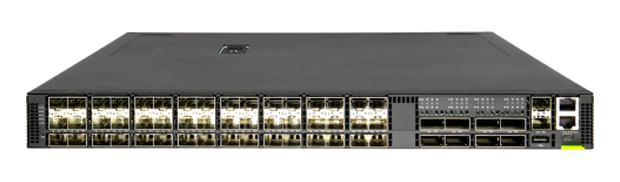
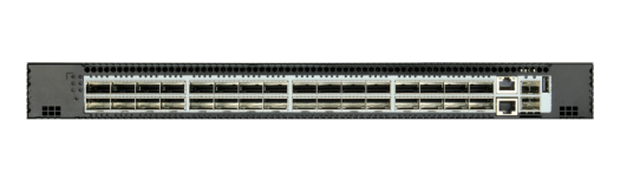
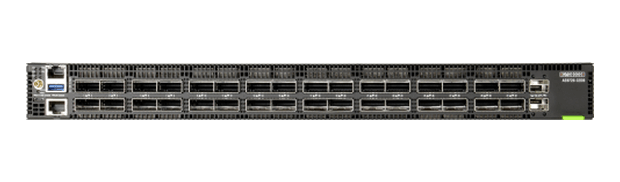
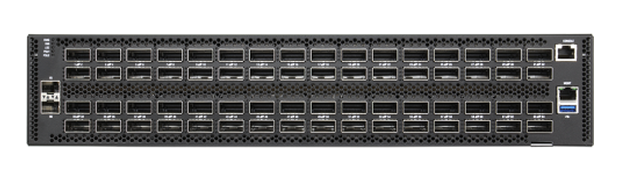
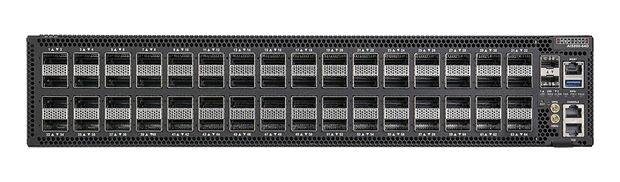
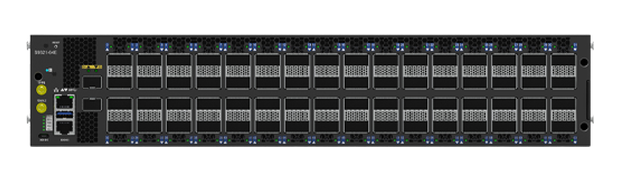
See the full validated set on the Hardware Compatibility List.
Data-center fabrics both build well
EVPN-VXLAN leaf-spine
A standards-based BGP EVPN-VXLAN fabric on open Trident and Tomahawk hardware, with MAC-VRF and active-active multi-homing. Both NOSes build this; the difference is the delivery and support model.
AI / GPU back-end fabric
A lossless RoCEv2 back-end for GPU clusters, with PFC, ECN, and dynamic load balancing on Tomahawk-4 and Tomahawk-5 spines. OcNOS-DC delivers it as a validated, supported build on each platform on the Hardware Compatibility List.
400G and 800G spine
High-radix spines on Broadcom Tomahawk-4 (400G) and Tomahawk-5 (800G, 51.2T) open platforms, the merchant-silicon class behind modern data-center and AI designs.
Enterprise and edge DC
A supported open-networking fabric for teams that want white-box economics without owning the NOS build pipeline, hardware validation, and patch cycle themselves.
Market context
Industry analysts project SONiC's fastest growth in AI back-end (scale-out) fabrics, where hyperscalers and neocloud providers adopt it to diversify hardware sourcing and gain infrastructure control. That growth has put a spotlight on the enterprise-readiness question. Community SONiC is free to license, but it shifts integration, hardware validation, security hardening, and day-2 operations onto the operator's team, which is why several switch and silicon vendors now sell supported distributions, generally alongside their own hardware lines. OcNOS-DC addresses the same need from a different starting point: a commercial NOS that arrives validated and supported per platform, from a single vendor, on the same open hardware.
When each option fits
You have the engineering depth
Your team can own the build pipeline, per-platform validation, CVE tracking, and day-2 operations, and you want maximum control and an open, vendor-neutral codebase at data-center scale.
Community codebase, vendor support
You want the SONiC codebase and ecosystem with a vendor absorbing validation, maintenance, and support under an SLA. This fits when you are already standardizing on that vendor and want networking to arrive with the servers and storage.
Hardware freedom and a direct line
You want the switch and the software to stay separate decisions, so the platform can be re-tendered without changing NOS. You want to reach the engineers who write the code rather than a tier queue, and you want one CLI and one contract if your network also runs service-provider roles.
Beyond the data center
This comparison is scoped to the data center, which is where SONiC is designed to run. If your network also extends into service-provider or transport roles, that is a different use case and a different product line. OcNOS-SP carries a carrier-grade routing set, including MPLS, segment routing, and telecom timing, that is out of scope on this page. See OcNOS-SP and the OcNOS vs Cisco comparison for that discussion.
Where OcNOS fits
SONiC is a widely deployed data-center NOS, and a vendor distribution is a supported way to run it, generally on that vendor's own hardware. OcNOS-DC is built for the other case: when you want the switch and the network operating system to stay separate decisions across an open multi-vendor platform list, a direct line to the engineers who write the code, and one CLI and one contract if your network also runs service-provider roles.
SONiC is an open-source project hosted by the Linux Foundation and the SONiC Foundation; it originated at Microsoft. Microsoft is a trademark of Microsoft Corporation. Broadcom and its product names are trademarks of Broadcom Inc. The names of commercial SONiC distributions and of other products and companies referred to here are the trademarks of their respective owners. IP Infusion is not affiliated with, endorsed by, or sponsored by the SONiC project, the Linux Foundation, Microsoft, Broadcom, or any SONiC distribution vendor. Comparisons reflect publicly documented information as of September 2026 and are provided for evaluation purposes only.