This design scales SR-MPLS transport across multiple IS-IS domains, each with its own SRGB and topology. BGP Labeled Unicast (BGP-LU) stitches the domains at the ASBR by swapping each domain's SR labels into the next, building an end-to-end underlay. EVPN then delivers L2VPN and L3VPN services PE-to-PE over that underlay. IP Infusion runs it on OcNOS carrier-grade routers.
Part of IP Infusion’s guide to Segment Routing.
Scaling IS-IS Segment Routing to nationwide or global service provider networks requires partitioning the network into multiple IGP domains. Each IS-IS domain operates independently with its own SRGB and topology. BGP Labeled Unicast (BGP-LU) stitches these SR domains together at the ASBR (Autonomous System Border Router) level, enabling end-to-end EVPN services without requiring a single flat IS-IS domain or full-mesh BGP between all PEs.
Multi-Domain Architecture
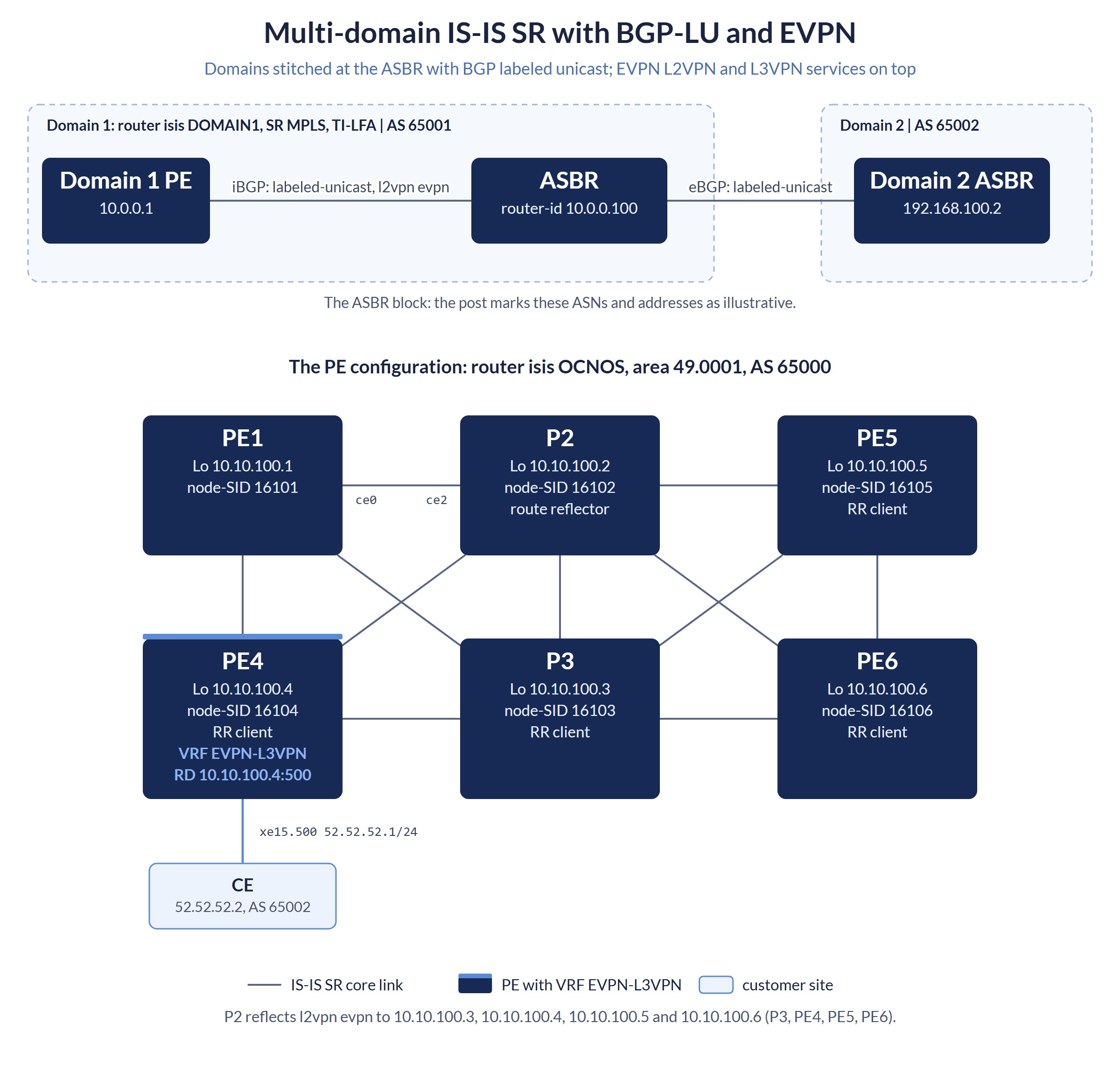
BGP-LU: Stitching SR Domains
BGP Labeled Unicast distributes MPLS-labeled IPv4/IPv6 prefixes (loopback addresses) between SR domains. The ASBR:
- Receives the SR label for a PE loopback from Domain 1’s IS-IS
- Re-originates it into Domain 2 with a new BGP-allocated label
- Programs its forwarding table to swap the incoming label to the outgoing SR label
This allows PE1 in Domain 1 to reach PE2 in Domain 2 using a two-label stack: the BGP-LU label (outer) and the EVPN service label (inner).
Run this post's commands in your browser
The OcNOS CLI Lab is a simulation of the OcNOS command line, set up with this post's network. There is nothing to install, and you can move and resize the lab window while you read.
Open the OcNOS CLI Lab
The lab opens in a window next to this post, set up with this post's network.
ASBR Configuration: BGP-LU Label Stitching
! OcNOS ASBR: BGP-LU label stitching between two IS-IS SR domains
! ASNs and addresses below are illustrative; adapt them to your deployment.
!
! Step 1: IS-IS Segment Routing in the domain
router isis DOMAIN1
 is-type level-2-only
 metric-style wide
 net 49.0001.0000.0000.0100.00
 dynamic-hostname
 fast-reroute ti-lfa level-2 proto ipv4
 segment-routing mpls
!
! Step 2: BGP Labeled Unicast to advertise loopbacks across the domain boundary
router bgp 65001
 bgp router-id 10.0.0.100
 !
 ! iBGP to Domain 1 PEs (EVPN control plane)
 neighbor 10.0.0.1 remote-as 65001
 neighbor 10.0.0.1 update-source loopback1
 !
 ! eBGP to the Domain 2 ASBR for BGP-LU
 neighbor 192.168.100.2 remote-as 65002
 !
 ! BGP Labeled Unicast address family (allocate and advertise SR loopback labels)
 address-family ipv4 labeled-unicast
  neighbor 10.0.0.1 activate
  neighbor 192.168.100.2 activate
 exit-address-family
 !
 ! EVPN sessions: PE-to-PE across domains
 address-family l2vpn evpn
  neighbor 10.0.0.1 activate
 exit-address-family
!
commit
PE Configuration: EVPN Services Across Domains
! OcNOS PE: IS-IS Segment Routing + EVPN L2VPN/L3VPN
!
! Step 1: IS-IS Segment Routing underlay (PE1)
!   Prefix-SID is configured on the loopback, NOT under router isis
interface loopback1
 ip address 10.10.100.1/32
 prefix-sid index 101
!
interface ce0
 description To-P2-ce2
 load-interval 30
 ip address 10.66.12.1/24
 mtu 9216
 label-switching
 isis network point-to-point
 isis circuit-type level-2-only
 ip router isis OCNOS
 no isis hello padding
!
router isis OCNOS
 is-type level-2-only
 metric-style wide
 mpls traffic-eng router-id 10.10.100.1
 mpls traffic-eng level-2
 capability cspf
 dynamic-hostname
 fast-reroute ti-lfa level-2 proto ipv4
 net 49.0001.0000.0000.0001.00
 passive-interface loopback1
 segment-routing mpls
!
! Step 2: MP-BGP EVPN route reflector (P2)
router bgp 65000
 bgp router-id 10.10.100.2
 no bgp inbound-route-filter
 neighbor EVPN-RRC peer-group
 neighbor EVPN-RRC remote-as 65000
 neighbor EVPN-RRC update-source loopback1
 neighbor 10.10.100.3 peer-group EVPN-RRC
 neighbor 10.10.100.4 peer-group EVPN-RRC
 neighbor 10.10.100.5 peer-group EVPN-RRC
 neighbor 10.10.100.6 peer-group EVPN-RRC
 !
 address-family l2vpn evpn
  neighbor EVPN-RRC activate
  neighbor EVPN-RRC route-reflector-client
 exit-address-family
!
! Step 3: EVPN MPLS, IRB and VTEP global IP (PE4)
evpn mpls enable
!
evpn mpls irb
!
evpn mpls vtep-ip-global 10.10.100.4
!
! Step 4: IP VRF with L3VNI for the L3VPN service (PE4)
ip vrf EVPN-L3VPN
 rd 10.10.100.4:500
 route-target both 500:500
 l3vni 5000
!
! Step 5: Access sub-interface bound to the VRF (PE4)
interface xe15
 mtu 9216
!
interface xe15.500
 encapsulation dot1q 500
 ip vrf forwarding EVPN-L3VPN
 ip address 52.52.52.1/24
 mtu 9216
!
! Step 6: MP-BGP on the PE: EVPN family + per-VRF IPv4 family (PE4)
!   VRF address family is the flat "address-family ipv4 vrf <NAME>" form
router bgp 65000
 bgp router-id 10.10.100.4
 neighbor 10.10.100.2 remote-as 65000
 neighbor 10.10.100.2 update-source loopback1
 !
 address-family l2vpn evpn
  neighbor 10.10.100.2 activate
 exit-address-family
 !
 address-family ipv4 vrf EVPN-L3VPN
  redistribute connected
  neighbor 52.52.52.2 remote-as 65002
  neighbor 52.52.52.2 activate
 exit-address-family
!
commit
Verification Commands
! OcNOS verification commands
!
! IS-IS SR topology, metrics and next-hops (PE1):
show isis topology
!
! MPLS SR label forwarding table / FTN entries (PE1):
show mpls forwarding-table
!
! MPLS incoming label map / ILM entries on a transit router (PE1):
show mpls ilm-table
!
! SR-MPLS data-plane reachability test to a remote loopback (PE1):
ping mpls isis-sr ipv4 10.10.100.6/32 detail
!
! EVPN BGP session state for the L2VPN EVPN family (P2 RR and PE4):
show bgp l2vpn evpn summary
!
! EVPN MPLS binding and PE-to-PE tunnel state (PE4):
show evpn mpls
show evpn mpls tunnel
!
! EVPN Type-5 IP-prefix routes received from remote PEs (PE4):
show bgp l2vpn evpn prefix-route
!
! Per-VRF MPLS forwarding table and detailed prefix entries (PE4):
show mpls vrf-forwarding-table
show mpls vrf-table
!
! VRF route table, local plus routes learned via MP-BGP (PE4):
show ip route vrf EVPN-L3VPN database
!
! End-to-end reachability from PE to remote CE over the VRF (PE4):
ping 60.60.60.60 vrf EVPN-L3VPN- EVPN-L3VPN: Single Domain
- SR-MPLS Fundamentals
- LDP to SR Migration
- OcNOS-SP Product Page
- Contact IP Infusion
IP Infusion Engineering Team
Go deeper. Take it with you.
The product datasheet plus short, technical downloads that go further than this page.
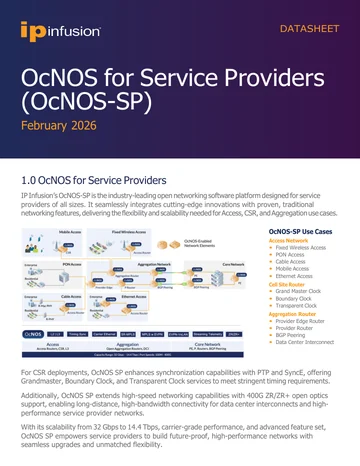
OcNOS-SP Datasheet
Full OcNOS-SP specification: the access, cell site and aggregation feature set, software SKUs, supported hardware platforms, and the solution ordering guide.
Get the datasheet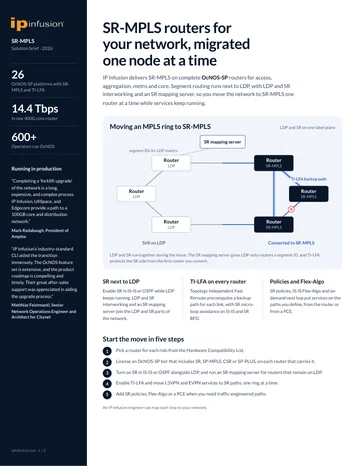
SR-MPLS Upgrade with OcNOS
Migrate SR-MPLS onto OcNOS on open hardware: Flex-Algo, TI-LFA, and a node-by-node cutover path.
Get the brief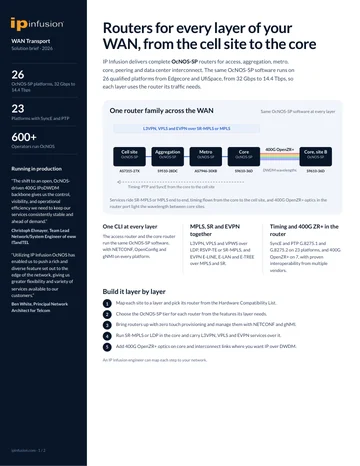
Cloud & Service Provider WAN Transport
Cloud and service-provider WAN transport on open hardware: SR-MPLS, EVPN, and scale-tested forwarding.
Get the briefOcNOS-SP Datasheet
Quick form. Your PDF opens in a new tab immediately after submit.
✓ Opening your PDF in a new tab…
If it didn't open, use the link below.
SR-MPLS Upgrade with OcNOS
Quick form. Your PDF opens in a new tab immediately after submit.
✓ Opening your PDF in a new tab…
If it didn't open, use the link below.
Cloud & Service Provider WAN Transport
Quick form. Your PDF opens in a new tab immediately after submit.
✓ Opening your PDF in a new tab…
If it didn't open, use the link below.