
OcNOS-SP: the service provider router.
Carrier-grade router software for SR-MPLS, EVPN, Carrier Ethernet, PTP and SyncE timing, and 400G IPoDWDM. IP Infusion ships it as a complete router on 26 qualified Edgecore and UfiSpace platforms, in editions sized to each role from the cell site to the IP core.
Complete routers for every SP role.
OcNOS-SP is the software, and IP Infusion ships the complete router. One vendor for the software, the qualified hardware, and the support contract, from the cell site to the IP core.
The complete router, on one PO
Hardware, the OcNOS-SP license, and IP Infusion support on one PO and one support contract. No separate procurement for the software and the bare-metal router, and one vendor answers for both when a link goes down.
One OcNOS family across every SP role
OcNOS-SP editions share one CLI and one automation model across the cell site router, the metro and aggregation nodes, the SR-MPLS core, and the IPoDWDM edge. Each router runs the edition its role needs, with one toolchain for the whole network.
Licensed by edition and capacity
OcNOS-SP comes in IPBASE, MPLS, CSR and PLUS editions, each sized to the platform's capacity. IEEE 1588v2 timing and SyncE are in CSR and PLUS. PLUS also adds initial SRv6 support on selected routers, with more in development.
Pre-loaded and qualified as an OcNOS System
Want it racked and running? OcNOS-SP ships pre-loaded on qualified Edgecore and UfiSpace platforms, tested and shipped by IP Infusion as a complete OcNOS System.
OcNOS SystemsCarrier-grade features on open hardware.
Carrier Ethernet services on open hardware
E-Line, E-LAN and E-Tree services over MPLS and EVPN, with CFM, Y.1731 performance monitoring and a three-level queuing hierarchy for per-service shaping. OcNOS earned MEF 3.0 Carrier Ethernet certification (E-Line, E-LAN, E-Tree) on the UfiSpace S9510-28DC.
TI-LFA Protection
Topology-Independent Loop-Free Alternate computes a loop-free backup path for each protected destination ahead of time. A link or node failure moves traffic to it without waiting for the IGP to reconverge.
Fast Reroute400G ZR and OpenZR+ in the router
On 7 of the 26 routers, 400G ZR and OpenZR+ coherent pluggables in QSFP-DD ports carry DCI and metro wavelengths from the router itself, without a separate transponder shelf.
IEEE 1588v2 & SyncE for mobile backhaul
PTP boundary clock with the G.8275.1 full on-path and G.8275.2 partial timing profiles, plus SyncE frequency synchronization, on 23 of the 26 routers. 11 routers can also act as a grandmaster with antenna compensation.
TimingBGP peering and controller export
BGP peering with RPKI invalid-route rejection. BGP-LS exports the IGP and segment routing topology to controllers, and PCEP lets a controller program SR paths.
One support contract: software, hardware, RMA
Buy the router as an OcNOS System and one contract covers OcNOS-SP, the qualified Edgecore or UfiSpace platform, and RMA coordination. One vendor answers for the whole router.
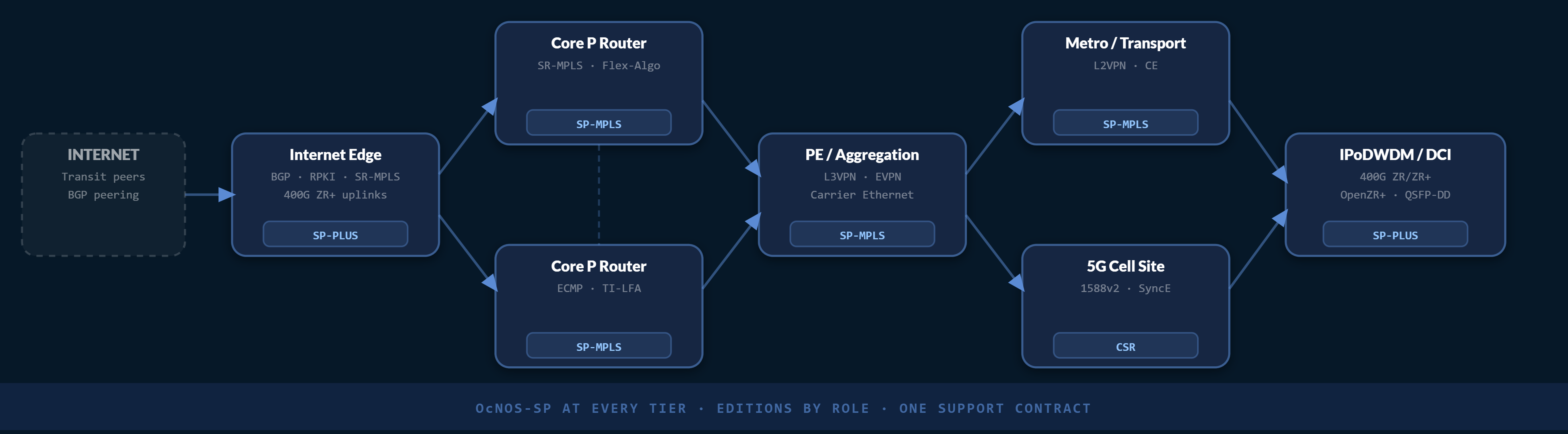
OcNOS-SP routers at every tier.
From internet peering and the SR-MPLS core to the 5G cell site and the IPoDWDM edge, every node is a complete OcNOS router, running the edition its role needs. One CLI and one vendor, from end to end.
SKU & platform comparison
OcNOS-SP ships in four editions. Buy the router as an OcNOS System and one IP Infusion contract supports the software and the hardware.
| OcNOS-SP: Service Provider | SP-IP-BASE | SP-MPLS | CSR | SP-PLUS | ||
|---|---|---|---|---|---|---|
| Layer 2 / Layer 3 | • | • | • | • | ||
| EVPN-VXLAN | • | • | • | • | ||
| Carrier Ethernet | • | • | • | |||
| MPLS w/ EVPN | • | • | • | |||
| SR-MPLS | • | • | • | |||
| SRv6 (initial support) | • | |||||
| Timing Synchronization (1588v2 / SyncE) | • | • | ||||
| Qualified Platforms | ||||||
| ASIC | Capacity | Port Speeds | SP-IP-BASE | SP-MPLS | CSR | SP-PLUS |
| QUX | 32 to 120G | 1/10G | • | • | • | |
| QAX | 300G | 1/10/25/100G | • | • | • | |
| Q2U | 360G | 25/100G | • | • | • | |
| QMX | 800G | 10/100G | • | • | • | |
| Q2A | 800G | 25/100/400G | • | • | • | |
| Q2C | 2.4 to 4.8T | 25/100/400G | • | • | • | |
| Q2C+ | 7.2T | 25/100/400G | • | • | • | |
| J2C+ | 7.2 to 14.4T | 10/100/400G | • | • | • | |
*Feature support depends on the platform and edition. Check each router in the Feature Matrix. 26 qualified SP platforms; 400G ZR and OpenZR+ run on 7 of them.
Open routing on the merchant silicon you choose.
Carrier-grade routing on merchant silicon and open hardware. Separate the software from the hardware to lower CapEx and OpEx, with one accountable vendor for all of it.
Want the platform-by-platform detail? OcNOS-SP is commercial carrier-grade software with IP Infusion support behind it, so there is no in-house routing stack to integrate and maintain. Ask our engineers to map OcNOS-SP routers against your current network.
OcNOS-SP in production
Carriers, regional ISPs, and broadband operators running OcNOS-SP on open hardware.

MetaLINK Technologies deployed IP Infusion OcNOS SP on Edgecore and UfiSpace open networking switches for aggregation, with full interoperability across…

Africell Sierra Leone deployed IP Infusion OcNOS SP on Edgecore hardware to build an open IP/MPLS backbone that backhauls both…

Amplex Internet upgraded its carrier-class aggregation network with OcNOS SP on Edgecore and UfiSpace hardware, reaching 100GB capacity without the…

BroadStar deployed OcNOS SP on white box switches to replace its Juniper hardware, delivering symmetric broadband with up to 10G…
Ready to deploy OcNOS-SP?
Talk to a network engineer about your topology, or download the free OcNOS VM.
Frequently asked questions
Where OcNOS-SP fits next
Would you like us to reach out?
Leave your details and a member of the IP Infusion team will be glad to help you scope OcNOS-SP for your network. We'll only be in touch if you'd like us to.
OcNOS 7.0 SP Datasheet
Quick form: your PDF will download immediately after submit.
✓ Opening your PDF in a new tab…
If it didn't open, use the link below.