Core, PE and peering routers for the full internet table
IP Infusion delivers the IP core and peering router: OcNOS-SP preloaded on qualified routers that hold the full internet BGP table in hardware, validate routes with RPKI and run an SR-MPLS core with TI-LFA, under one support contract.
Every role in the core runs OcNOS-SP
OcNOS-SP runs the PE router at the service edge, the P router in the SR-MPLS core, the peering router at the internet edge and the route reflector. You size each role by hardware and license.
Operators running open core and peering routers.
A full-table internet edge in Switzerland and backbones in Austria, Canada and Sierra Leone, all on OcNOS in production.
“From a technical standpoint, OcNOS checked every box: full BGP table in hardware, dual-stack from day one, and a feature set that holds up against the traditional vendors.” Markus Wellauer, Co-CEO, NWP Services GmbH (NWPS)
What OcNOS-SP runs in the core and at the peering edge
Every row below runs on all 26 OcNOS-SP platforms unless marked, from the OcNOS Feature Matrix.
| Capability | What it does | Where |
|---|---|---|
| Full internet BGP table | Held in hardware, IPv4 and IPv6, on a platform with an external TCAM in the forwarding path | Selected platforms |
| RPKI | Rejects routes that fail origin validation at the edge | All OcNOS-SP, from 7.0 |
| BGP FlowSpec and RTBH | Pushes DDoS filters and blackhole routes to the edge. See DDoS mitigation. | All OcNOS-SP |
| Large communities, Add-Path, PIC Edge | Tags routes for peering policy, advertises multiple paths and speeds convergence at the edge | All OcNOS-SP |
| Route reflection and confederations | Scale iBGP without a full mesh | All OcNOS-SP |
| BGP-LS and egress peer engineering | Exports the topology and egress peer segments to a controller, which steers traffic to a chosen peer | All OcNOS-SP |
| Segment routing over IS-IS and OSPF | One label-switched path for every service between sites | All OcNOS-SP |
| TI-LFA | A precomputed loop-free backup path per destination | All OcNOS-SP |
| Flex-Algo | A second forwarding plane, for example low latency, on the same IS-IS topology | All OcNOS-SP |
| SR-TE with PCEP | Explicit paths computed by a PCE | All OcNOS-SP |
| SRv6, initial support | L3VPN and EVPN services over an IPv6 data plane, with more SRv6 capability in development | 10 of 26 platforms |
| LDP and SR interworking | An SR mapping server adds segment routing next to an LDP core, node by node | All OcNOS-SP |
| L3VPN and EVPN over MPLS | Customer services at the PE router | All OcNOS-SP |
Support varies by platform and license. Check each model in the OcNOS Feature Matrix.
Routers by role
Size the core for capacity and buffering. Size the peering edge for the forwarding path that holds the table.
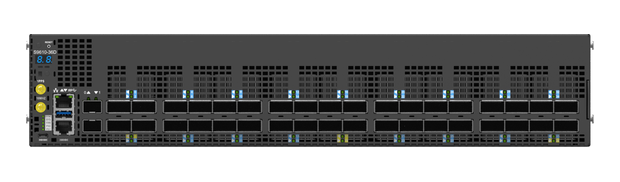
Core (P) router
UfiSpace S9610-36D
Jericho 2C+ · 14.4 Tbps
36 × 400G
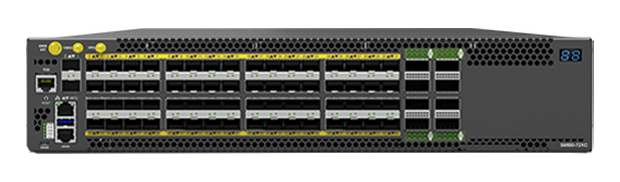
Full-table peering edge
UfiSpace S9600-72XC
Qumran 2C · 2.4 Tbps
64 × 25G, 8 × 100G, with OP2 external TCAM
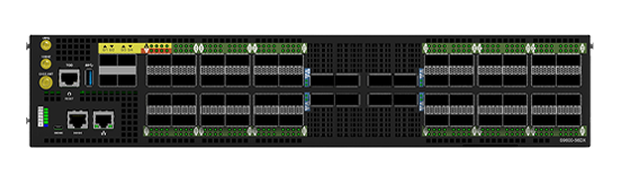
Service edge (PE)
UfiSpace S9600-56DX
Qumran 2C · 4.8 Tbps
4 × 25G, 48 × 100G, 8 × 400G
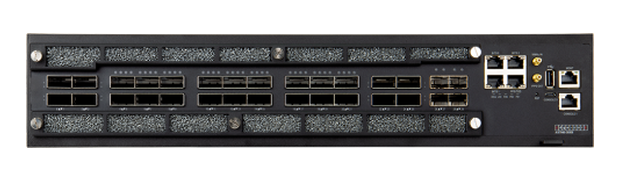
Compact PE
Edgecore AS7946-30XB (AGR400)
Qumran 2C · 2.4 Tbps
4 × 25G, 22 × 100G, 4 × 400G
NWP Services runs the S9600-72XC with OP2 external TCAM to hold the full table. See every qualified router on the OcNOS Hardware Compatibility List.
Questions about the core and the peering edge.
Datasheet, solution brief, and reference architecture.
The OcNOS-SP datasheet, the SR-MPLS upgrade brief, and the open IP core reference architecture to share with your team. Quick form, and the PDF downloads immediately.
OcNOS-SP Datasheet
The full OcNOS-SP overview: roles, protocols, timing, and the supported hardware, in one PDF.
Get the datasheetSR-MPLS Upgrade with OcNOS
Move an MPLS network to SR-MPLS on OcNOS-SP routers, one router at a time, with TI-LFA from the first router you convert.
Get the briefOpen IP Core Reference Architecture
A validated design for the service provider core and peering edge: dual-plane SR-MPLS, full-table peering with RPKI, route reflection, and day-2 operations.
Get the reference architecturePlan your core and peering edge.
We map your PE, P and peering roles to qualified routers, the segment routing design and the support plan.
OcNOS-SP Datasheet
Quick form. Your PDF will download immediately after submit.
✓ Opening your PDF in a new tab.
If it did not open, use the link below.
SR-MPLS Upgrade with OcNOS
Quick form. Your PDF will download immediately after submit.
✓ Opening your PDF in a new tab.
If it did not open, use the link below.
Open IP Core Reference Architecture
Quick form. Your PDF opens in a new tab immediately after submit.
✓ Opening your PDF in a new tab…
If it didn't open, use the link below.
Would you like us to reach out?
Leave your details and a member of the IP Infusion team will be glad to help you design your IP core and peering network. We'll only be in touch if you'd like us to.