Offenes vBNG: netElastic Subscriber Management auf einem OcNOS-Netz
Ein virtuelles BNG terminiert Breitbandteilnehmer in Software auf Standardservern. IP Infusion und netElastic liefern es als eine offene Architektur: OcNOS übernimmt Aggregation und Edge-Routing auf offener White-Box-Hardware, und das netElastic vBNG übernimmt Subscriber Management und Carrier-Grade NAT. Validiert von IP ArchiTechs, im Produktivbetrieb bei Amplex.
Offene Architektur, geliefert als Komplettlösung
Partner liefern OcNOS-Router und -Switches, das netElastic vBNG und Services als eine integrierte Lösung.
Open Networking als Basis, sodass Sie nicht an einen proprietären Stack gebunden sind.
Server für Teilnehmer hinzufügen, Router für Kapazität hinzufügen. Keines erzwingt das andere.
Zentral oder verteilt auf demselben OcNOS-Transport, ohne Redesign für einen Wechsel.




Eine Subscriber Edge, aufgebaut aus zwei offenen Ebenen
Die offene Subscriber Edge teilt sich klar in zwei Teile. netElastic verantwortet den Teilnehmer: Session-Terminierung, Authentifizierung, Policy und Carrier-Grade NAT. IP Infusion verantwortet das Netz darunter: Aggregation und Edge-Routing auf offener Hardware.
 +
+

| Schicht | Verantwortlichder Spezialist | Was es bewirkt |
|---|---|---|
| Subscriber-Terminierung | netElastic vBNG | Terminiert PPPoE-, IPoE- und L2TP-Sessions, authentifiziert über RADIUS, vergibt Adressen und wendet Policy und hierarchisches QoS pro Teilnehmer an. |
| IPv4-Einsparung | netElastic CGNAT | Carrier-Grade NAT44 teilt öffentliche IPv4-Adressen zwischen Teilnehmern, bis zu 100 pro Adresse, mit einstellbarem Logging. Integriert mit dem vBNG oder eigenständig. |
| Aggregation und Edge-Routing | OcNOS | Baut den ISIS-SR-Core, SR-MPLS mit TI-LFA Fast Reroute und EVPN-MPLS-Layer-2-Dienste auf, die Teilnehmer-Traffic zum vBNG transportieren. |
| Offene Hardware | OcNOS | Betreibt die Aggregations- und Edge-Router auf qualifizierten White Boxes von Edgecore, UfiSpace und weiteren. Das vBNG läuft auf standardisierten x86-Servern. |
Vom Anschluss bis zum Internet, auf einem offenen Netz
Teilnehmer-Traffic tritt an der Access-Edge ein, wird von OcNOS auf offenen Routern aggregiert und über ein ISIS-SR- und EVPN-MPLS-Netz zum netElastic vBNG transportiert, das die Session terminiert und CGNAT anwendet, bevor der Traffic Peering und Internet erreicht.
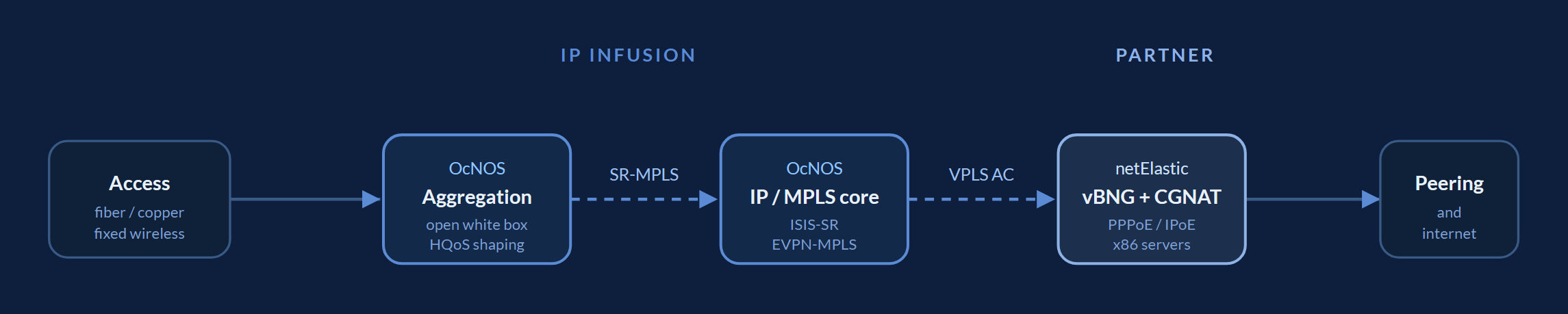
Breitbandzugang
Glasfaser- (PON und OLT), Kupfer- (DSL) und Fixed-Wireless-Teilnehmeranschlüsse treten an der Access-Edge in das Netz ein.
Aggregationsrouter
OcNOS auf einer offenen White Box aggregiert Teilnehmer-VLANs und formt den Traffic mit hierarchischem QoS vor dem Core.
IP- und MPLS-Core
Ein ISIS-SR-Core mit SR-MPLS und TI-LFA transportiert Layer-2-Dienste der Teilnehmer über EVPN-MPLS zum vBNG.
vBNG und CGNAT
Das netElastic vBNG terminiert die Session, authentifiziert den Teilnehmer, vergibt eine Adresse und wendet CGNAT an.
Zentral oder verteilt, derselbe offene Transport
Das vBNG kann zentral oder verteilt sitzen. netElastic unterstützt beides, und derselbe OcNOS-Transport trägt jede Variante. Die Wahl hängt von Latenz, Fehlerdomänen, Betriebskosten und Geografie ab.
Zentral: vBNG und CGNAT am Core gebündelt
Access-Netze transportieren Teilnehmer-Traffic zurück zum Core, wo ein Pool aus netElastic vBNG und CGNAT ihn vor dem Internet aufbereitet. Hardware, Platz, Strom und Kühlung werden minimiert, weil die Teilnehmerfunktionen an einem Ort liegen.

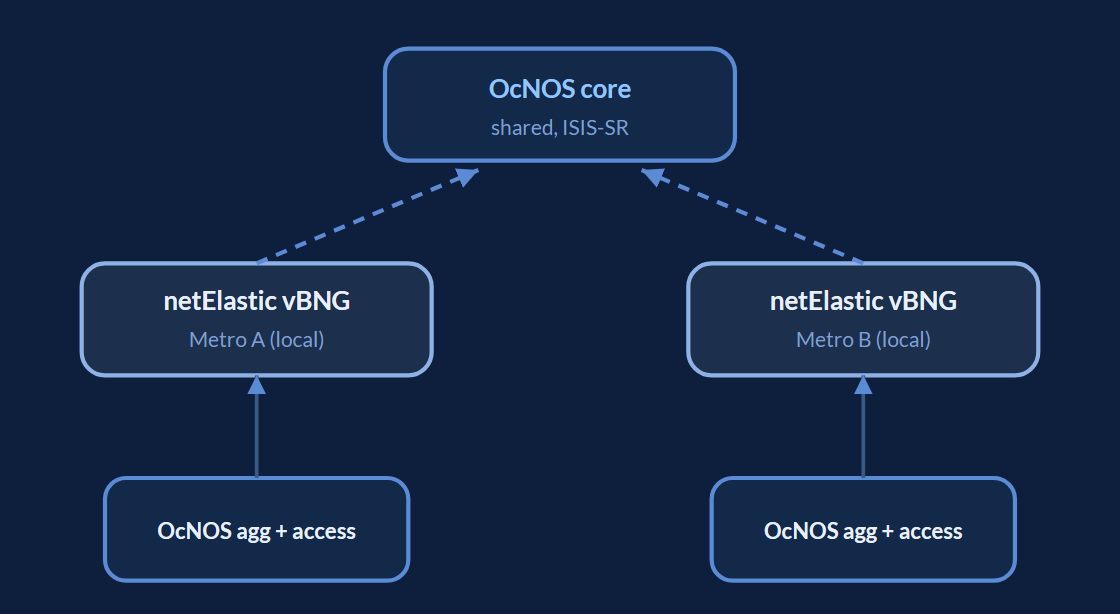
Verteilt: ein lokales vBNG nahe jeder Metro
Ein netElastic vBNG sitzt nahe jeder Metro oder Region und terminiert Teilnehmer lokal, dann übergibt es aufbereiteten Traffic an den OcNOS-Core. Die Latenz sinkt, lokale Dienste bleiben lokal, und ein Fehler in einer Region breitet sich nicht auf die anderen aus.
netElastic vBNG und Carrier-Grade NAT
netElastic entwickelt virtuelle Netzwerksoftware für Breitbandanbieter. Sein vBNG und CGNAT laufen auf standardisierten x86-Servern, sodass die Teilnehmerkapazität durch zusätzliche Server wächst, statt ein Edge-Chassis auszutauschen. Die folgenden Zahlen stammen von netElastic.
Jede Zugangsart
Terminiert PPPoE, IPoE und L2TP mit Dual-Stack IPv4 und IPv6, DHCP sowie RADIUS-Authentifizierung, Accounting und Change of Authorization.
Skalierung auf x86
Bis zu 1 Terabit pro Sekunde auf einem 2-HE-Server, 2.000 bis 128.000 Teilnehmer pro Server, mit getrennter Control Plane und Data Plane, die mit den Serverkernen skaliert.
Carrier-Grade NAT
NAT44 von 10G bis 1 Tbit/s, über 50.000 Teilnehmer, bis zu 100 pro öffentlicher Adresse, mit einstellbarem Logging für die Compliance.
Hochverfügbarkeit
Ein zweites vBNG im Active-Active- oder Active-Standby-Modus oder ein georedundantes Paar bietet N+1-Redundanz für Wartung, Upgrades und Failover.
Mehr zum OcNOS-Transport
Die oben beschriebene Aufgabenteilung zeigt, was OcNOS unter dem vBNG trägt: den ISIS-SR-Core, EVPN-Layer-2-Dienste und offene Hardware. Die vollständigen Details zu Aggregation und Edge-Routing finden Sie hier.
Die Übergabe in echter Konfiguration
Diese Auszüge stammen aus dem validierten Referenzdesign von IP ArchiTechs, das OcNOS mit dem netElastic vBNG über EVPN-MPLS kombiniert. OcNOS baut den EVPN-Layer-2-Dienst mit Active-Active-Multihoming auf; netElastic terminiert die Teilnehmer am anderen Ende.
! Enable EVPN-MPLS forwarding (requires reboot)
evpn mpls enable
evpn mpls multihoming enable
! MAC-VRF for the subscriber service
mac vrf ORANGE
 rd 100.127.0.7:1
 route-target both evpn-auto-rt
evpn mpls vtep-ip-global 100.127.0.7
evpn mpls id 1
 host-reachability-protocol evpn-bgp ORANGE
! Access-facing attachment circuit into the EVPN service
interface xe44.10 switchport
 encapsulation dot1q 10-50
 access-if-evpn
  map vpn-id 1
Quelle: validiertes Design von IP ArchiTechs, EVPN-Multihoming über MPLS, OcNOS zum netElastic vBNG. Prüfen Sie vor der Implementierung die aktuelle Syntax in den OcNOS Configuration Guides unter documentation.ipinfusion.com.
! Bundle the dual-homed link into a port-channel
interface xe10
 channel-group 1 mode active
! Shared ESI system-MAC for active-active forwarding
interface po1
 evpn multi-homed system-mac 0200.0000.0001 load-balancing port-active
! Double-tagged subscriber service on the bundle
interface po1.532 switchport
 encapsulation dot1q 532 inner-dot1q 10-50
 rewrite pop
 access-if-evpn
  map vpn-id 1
Zwei Aggregations-PEs teilen sich eine ESI-System-MAC, sodass beide gleichzeitig für den dual angebundenen Access weiterleiten. Ein PE-Ausfall wird mit nur wenigen verlorenen Paketen umgeleitet. Quelle: validiertes Design von IP ArchiTechs.
# RADIUS authentication group
radius authentication group RADIUS_AUTH
 nas-ip-address 100.127.0.6
 server 1 ipv4-address 192.168.0.2 port 1812 key netelastic
# BRAS subscriber management and IPoE template
bras
 domain IPA_DOMAIN
  bind authentication-template RADIUS_AUTH
  bind accounting-template RADIUS_ACCT
  bind-pool 1 TEST
 ipoe template IPOE_TEST
  authentication-type ipv4 dhcpv4 option
 vci-configuration
  interface eth-trunk1.532
   ipoe template IPOE_TEST
   max-ipox-session 32000
Das vBNG empfängt denselben doppelt getaggten Dienst (äußeres Tag 532), den OcNOS über EVPN-MPLS liefert, terminiert jeden Teilnehmer, authentifiziert über RADIUS und vergibt eine Adresse. Quelle: validiertes Design von IP ArchiTechs; siehe netElastic vBNG.
Im Einsatz in echten Breitbandnetzen
Die offene Subscriber Edge ist heute im Einsatz. Amplex Internet betreibt OcNOS-Aggregation mit dem netElastic vBNG, und die Kombination ist von IP ArchiTechs als Referenzdesign dokumentiert.
Amplex Internet, Ohio
Amplex hat sein Netz mit OcNOS-Aggregationsroutern auf Edgecore- und UfiSpace-Hardware modernisiert. OcNOS von IP Infusion "verbindet die Customer Edge von Amplex mit den virtuellen Broadband Network Gateways von netElastic" und ergänzt SR-MPLS mit TI-LFA unter 50 ms, bei Interoperabilität mit der installierten Basis an Juniper- und Ciena-Geräten.
Referenzarchitektur von IP ArchiTechs
Das unabhängige Netzwerk-Engineering-Unternehmen IP ArchiTechs hat das validierte Design veröffentlicht, das OcNOS mit dem netElastic vBNG über EVPN-MPLS kombiniert, mit Active-Active-Multihoming für Hochverfügbarkeit.
Next Gen Fibre, Irland
Next Gen Fibre hat sein irisches Breitbandnetz mit dem netElastic vBNG und CGNAT skaliert. Eine Implementierung von netElastic und ITcare, mit Splynx für das Subscriber Management.
Offenes vBNG: Antworten
Was ist ein virtuelles BNG (vBNG)?
Stellt IP Infusion ein BNG her?
Worin unterscheidet sich ein vBNG von einem klassischen Hardware-BNG?
Wie migriert man ohne Ausfall von einem bestehenden BNG?
Wie arbeiten OcNOS und das netElastic vBNG zusammen?
Sollte das vBNG zentral oder verteilt sein?
Welche Teilnehmerskalierung unterstützt das netElastic vBNG?
Was bringt netElastic CGNAT?
Ist diese offene Subscriber Edge im Produktivbetrieb bewährt?
Auf welcher Hardware läuft die offene Subscriber Edge?
Die offene vBNG-Architektur zum Mitnehmen
Ein kurzer technischer Download, der über diese Seite hinausgeht: der Architektur-Brief zum offenen vBNG.
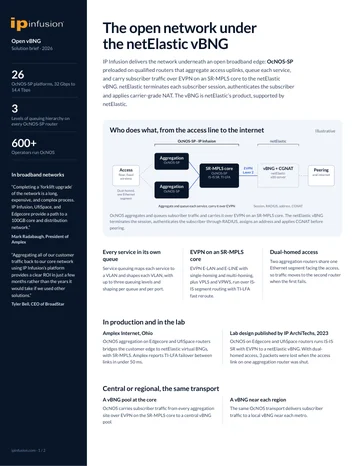
Architektur-Brief zum offenen vBNG
Kurzes Formular. Ihr PDF öffnet sich unmittelbar nach dem Absenden in einem neuen Tab.
✓ Ihr PDF wird in einem neuen Tab geöffnet…
Falls es sich nicht geöffnet hat, nutzen Sie den untenstehenden Link.
Gestalten Sie Ihre offene Subscriber Edge
Nennen Sie uns die Zugangsnetze und die Teilnehmerzahl, die Sie versorgen, und ein Ingenieur von IP Infusion hilft Ihnen, den OcNOS-Transport zu gestalten und das netElastic vBNG zu dimensionieren, zentral oder verteilt.
Möchten Sie, dass wir Sie kontaktieren?
Hinterlassen Sie Ihre Kontaktdaten, und ein Ingenieur von IP Infusion hilft Ihnen, eine offene Subscriber Edge mit OcNOS und dem netElastic vBNG zu gestalten. Wir melden uns nur, wenn Sie es wünschen.