The decision to invest in AI infrastructure centers on GPUs. But GPU compute efficiency is ultimately gated by the network connecting them. In large-scale AI training clusters, the network fabric is not infrastructure support — it is a primary determinant of how much of your GPU investment actually delivers productive compute cycles.
A suboptimal network can reduce GPU utilization by up to 50% during the compute-exchange-update phase of distributed training. When GPU clusters cost thousands of dollars per hour to operate, network inefficiency is a direct revenue loss.
Why the Network is the AI Bottleneck
Modern AI training uses distributed data parallelism: multiple GPU nodes process data simultaneously and periodically synchronize gradients. The synchronization step — the All-Reduce operation — requires all GPUs to exchange gradient data through the network simultaneously. This creates extreme traffic bursts that expose every weakness in the fabric:
- Packet loss — RoCEv2 (RDMA over Converged Ethernet) is loss-sensitive. A single dropped packet triggers retransmission that stalls the entire GPU collective operation until the packet is recovered.
- Latency spikes — jitter during All-Reduce operations extends Job Completion Time (JCT) proportionally to the number of GPUs in the cluster.
- Congestion spreading — without proper flow control, congestion on one link spreads to others through head-of-line blocking, degrading the entire fabric.
The Three AI Fabric Design Decisions
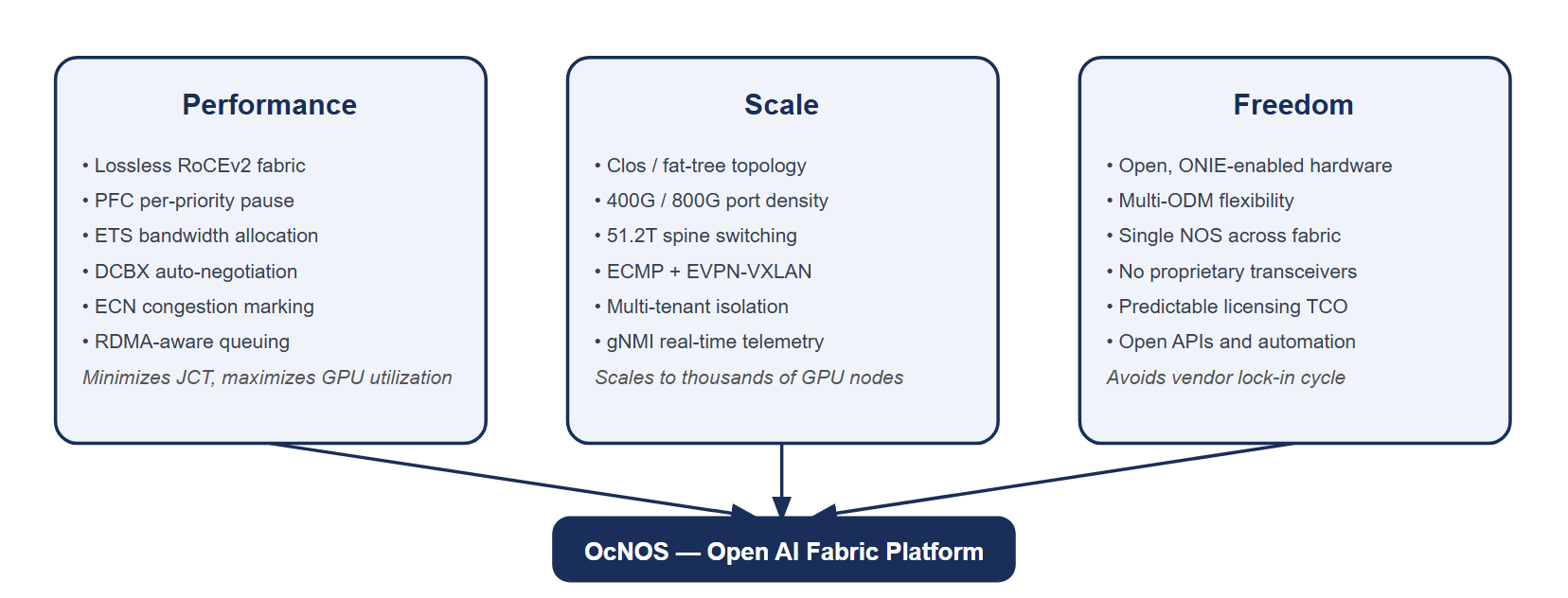
OcNOS AI Fabric Capabilities
OcNOS 7.0 delivers a complete lossless AI fabric stack on Broadcom Tomahawk 5-based open hardware:
- Priority-Based Flow Control (PFC) — per-priority pause frames prevent RoCEv2 packet drops at the switch level
- Enhanced Transmission Selection (ETS) — allocates guaranteed bandwidth to RoCEv2 traffic classes (typically 70–80% of fabric bandwidth)
- DCBX — automatically negotiates PFC and ETS parameters with GPU servers, eliminating manual server-side configuration
- Explicit Congestion Notification (ECN) — signals congestion to senders before queues fill, enabling proactive rate reduction
- EVPN-VXLAN multi-tenancy — isolates multiple AI workloads or tenants on the same physical fabric
Open vs. Proprietary AI Fabric: TCO at Scale
| Factor | Proprietary (Arista, Cisco) | OcNOS on Open Hardware |
|---|---|---|
| Spine switch (51.2T, 64x800G) | $150K–$250K per switch | $60K–$100K per switch |
| NOS licensing | Per-feature or bundle; complex | All-inclusive per platform |
| Transceiver lock-in | Often required for warranty | Third-party optics supported |
| Hardware vendor flexibility | Single vendor | UfiSpace, Edgecore, Celestica, others |
| Automation interfaces | Vendor-specific APIs | gNMI, NETCONF, OpenConfig, Ansible |
For a 100-node GPU cluster requiring 10 spine switches, the hardware cost difference alone is $500K–$1.5M over a 3-year lifecycle.
- OcNOS 7.0 for Data Centers — AI Fabric Details
- AI Fabric Solutions
- OcNOS-DC Product Page
- IP Infusion kontaktieren
IP Infusion Engineering Team
Gehen Sie tiefer. Nehmen Sie es mit.
Das Produktdatenblatt und kurze, technische Downloads, die über diese Seite hinausgehen.
OcNOS-DC Datenblatt
Vollständige OcNOS-DC Spezifikation: Funktionsumfang für EVPN-VXLAN und Ethernet for AI, Software-SKUs, unterstützte Hardware-Plattformen und der Solution Ordering Guide.
Datasheet abrufenOcNOS 800G verlustfreie AI Fabric
Non-blocking RoCEv2-Fabric auf Broadcom Tomahawk 4/5 Spines: SKU-Stufen, validierte Plattformen und Deployment-Architektur.
Brief anfordernEVPN-VXLAN Rechenzentrums-Fabric
Carrier-Grade-Leaf-Spine-Rechenzentrums-Fabric: symmetrisches IRB, Type-2/Type-5-Routen und verteiltes Anycast-Gateway.
Brief anfordernOcNOS-DC Datenblatt
Kurzes Formular. Ihr PDF öffnet sich unmittelbar nach dem Absenden in einem neuen Tab.
✓ Ihr PDF wird in einem neuen Tab geöffnet…
Falls es sich nicht geöffnet hat, nutzen Sie den untenstehenden Link.
OcNOS 800G verlustfreie AI Fabric
Kurzes Formular. Ihr PDF öffnet sich unmittelbar nach dem Absenden in einem neuen Tab.
✓ Ihr PDF wird in einem neuen Tab geöffnet…
Falls es sich nicht geöffnet hat, nutzen Sie den untenstehenden Link.
EVPN-VXLAN Rechenzentrums-Fabric
Kurzes Formular. Ihr PDF öffnet sich unmittelbar nach dem Absenden in einem neuen Tab.
✓ Ihr PDF wird in einem neuen Tab geöffnet…
Falls es sich nicht geöffnet hat, nutzen Sie den untenstehenden Link.