The decision to invest in AI infrastructure centers on GPUs. But GPU compute efficiency is ultimately gated by the network connecting them. In large-scale AI training clusters, the network fabric is not infrastructure support — it is a primary determinant of how much of your GPU investment actually delivers productive compute cycles.
A suboptimal network can reduce GPU utilization by up to 50% during the compute-exchange-update phase of distributed training. When GPU clusters cost thousands of dollars per hour to operate, network inefficiency is a direct revenue loss.
Why the Network is the AI Bottleneck
Modern AI training uses distributed data parallelism: multiple GPU nodes process data simultaneously and periodically synchronize gradients. The synchronization step — the All-Reduce operation — requires all GPUs to exchange gradient data through the network simultaneously. This creates extreme traffic bursts that expose every weakness in the fabric:
- Packet loss — RoCEv2 (RDMA over Converged Ethernet) is loss-sensitive. A single dropped packet triggers retransmission that stalls the entire GPU collective operation until the packet is recovered.
- Latency spikes — jitter during All-Reduce operations extends Job Completion Time (JCT) proportionally to the number of GPUs in the cluster.
- Congestion spreading — without proper flow control, congestion on one link spreads to others through head-of-line blocking, degrading the entire fabric.
The Three AI Fabric Design Decisions
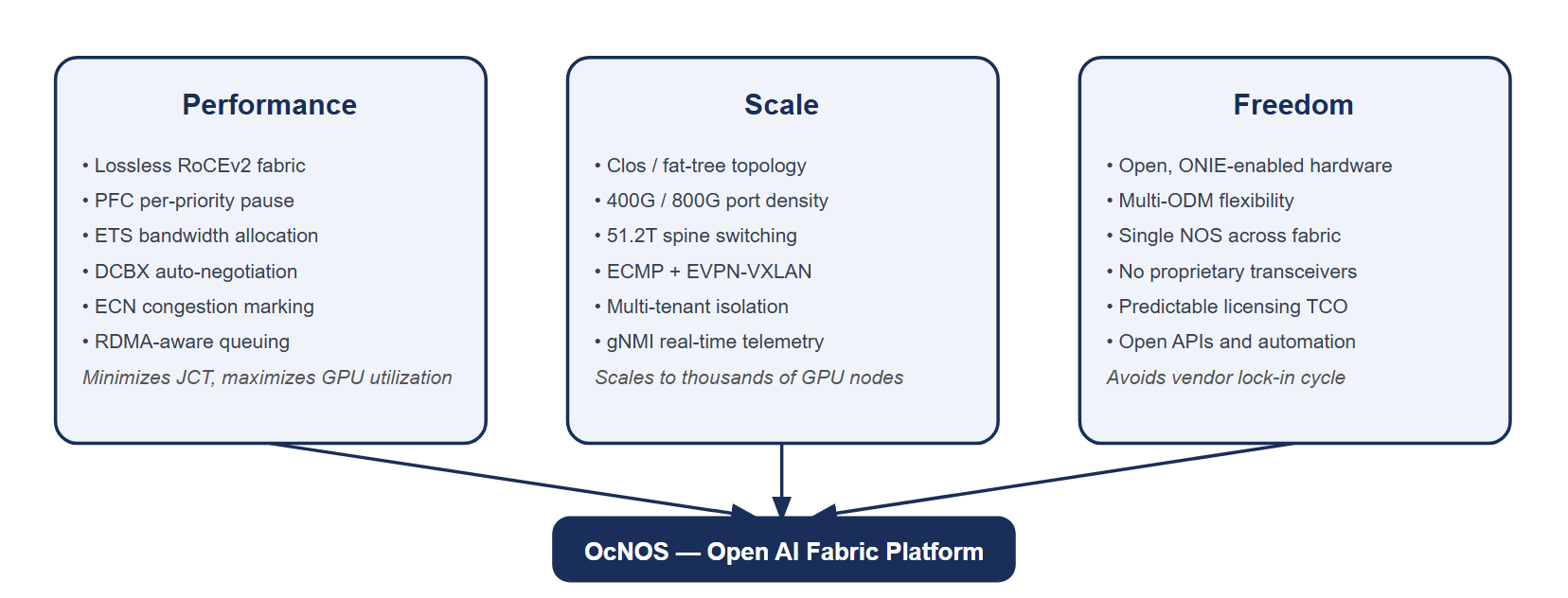
OcNOS AI Fabric Capabilities
OcNOS 7.0 delivers a complete lossless AI fabric stack on Broadcom Tomahawk 5-based open hardware:
- Priority-Based Flow Control (PFC) — per-priority pause frames prevent RoCEv2 packet drops at the switch level
- Enhanced Transmission Selection (ETS) — allocates guaranteed bandwidth to RoCEv2 traffic classes (typically 70–80% of fabric bandwidth)
- DCBX — automatically negotiates PFC and ETS parameters with GPU servers, eliminating manual server-side configuration
- Explicit Congestion Notification (ECN) — signals congestion to senders before queues fill, enabling proactive rate reduction
- EVPN-VXLAN multi-tenancy — isolates multiple AI workloads or tenants on the same physical fabric
Open vs. Proprietary AI Fabric: TCO at Scale
| Factor | Proprietary (Arista, Cisco) | OcNOS on Open Hardware |
|---|---|---|
| Spine switch (51.2T, 64x800G) | $150K–$250K per switch | $60K–$100K per switch |
| NOS licensing | Per-feature or bundle; complex | All-inclusive per platform |
| Transceiver lock-in | Often required for warranty | Third-party optics supported |
| Hardware vendor flexibility | Single vendor | UfiSpace, Edgecore, Celestica, others |
| Automation interfaces | Vendor-specific APIs | gNMI, NETCONF, OpenConfig, Ansible |
For a 100-node GPU cluster requiring 10 spine switches, the hardware cost difference alone is $500K–$1.5M over a 3-year lifecycle.
- OcNOS 7.0 for Data Centers — AI Fabric Details
- AI Fabric Solutions
- OcNOS-DC Product Page
- IP Infusion 문의
IP Infusion Engineering Team
더 깊이 살펴보십시오. 자료를 소장하십시오.
제품 데이터시트와 이 페이지보다 한층 더 깊이 있는 간결한 기술 다운로드 자료입니다.
OcNOS-DC 데이터시트
OcNOS-DC 전체 사양: EVPN-VXLAN 및 Ethernet for AI 기능 세트, 소프트웨어 SKU, 지원 하드웨어 플랫폼, 솔루션 주문 가이드.
Datasheet 받기OcNOS 800G 무손실 AI Fabric
Broadcom Tomahawk 4/5 스파인 기반의 논블로킹 RoCEv2 fabric: SKU 등급, 검증된 플랫폼, 도입 아키텍처를 다룹니다.
브리프 받기EVPN-VXLAN 데이터센터 패브릭
통신사업자급 leaf-spine 데이터센터 패브릭: 대칭 IRB, Type-2/Type-5 경로, 그리고 분산 애니캐스트 게이트웨이.
브리프 받기OcNOS-DC 데이터시트
간단한 양식입니다. 제출하면 PDF가 즉시 새 탭에서 열립니다.
✓ 새 탭에서 PDF를 여는 중입니다…
열리지 않았다면 아래 링크를 이용해 주십시오.
OcNOS 800G 무손실 AI Fabric
간단한 양식입니다. 제출하면 PDF가 즉시 새 탭에서 열립니다.
✓ 새 탭에서 PDF를 여는 중입니다…
열리지 않았다면 아래 링크를 이용해 주십시오.
EVPN-VXLAN 데이터센터 패브릭
간단한 양식입니다. 제출하면 PDF가 즉시 새 탭에서 열립니다.
✓ 새 탭에서 PDF를 여는 중입니다…
열리지 않았다면 아래 링크를 이용해 주십시오.