The decision to invest in AI infrastructure centers on GPUs. But GPU compute efficiency is ultimately gated by the network connecting them. In large-scale AI training clusters, the network fabric is not infrastructure support; it is a primary determinant of how much of your GPU investment actually delivers productive compute cycles.
A suboptimal network can reduce GPU utilization by up to 50% during the compute-exchange-update phase of distributed training. When GPU clusters cost thousands of dollars per hour to operate, network inefficiency is a direct revenue loss.
Why the Network is the AI Bottleneck
Modern AI training uses distributed data parallelism: multiple GPU nodes process data simultaneously and periodically synchronize gradients. The synchronization step (the All-Reduce operation) requires all GPUs to exchange gradient data through the network simultaneously. This creates extreme traffic bursts that expose every weakness in the fabric:
- Packet loss: RoCEv2 (RDMA over Converged Ethernet) is loss-sensitive. A single dropped packet triggers retransmission that stalls the entire GPU collective operation until the packet is recovered.
- Latency spikes: jitter during All-Reduce operations extends Job Completion Time (JCT) proportionally to the number of GPUs in the cluster.
- Congestion spreading: without proper flow control, congestion on one link spreads to others through head-of-line blocking, degrading the entire fabric.
The Three AI Fabric Design Decisions
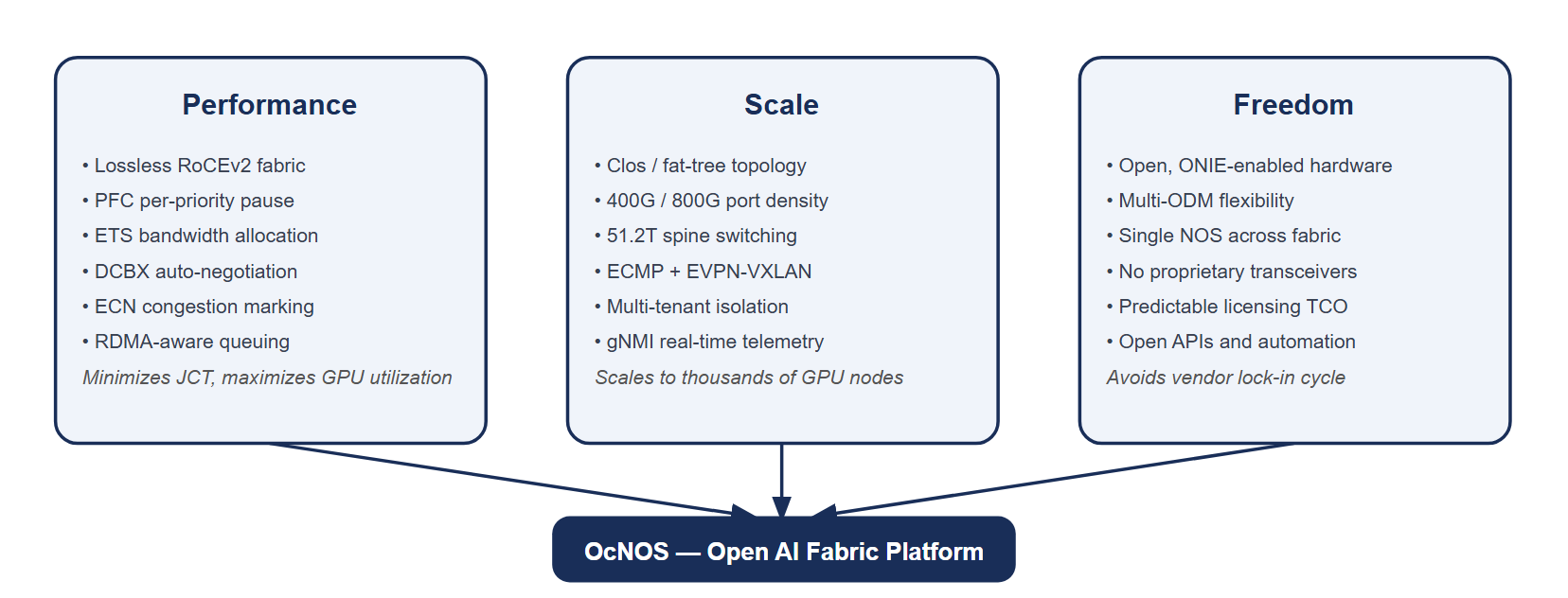
OcNOS AI Fabric Capabilities
OcNOS 7.0 delivers a complete lossless AI fabric stack on Broadcom Tomahawk 5-based open hardware:
- Priority-Based Flow Control (PFC): per-priority pause frames prevent RoCEv2 packet drops at the switch level
- Enhanced Transmission Selection (ETS): allocates guaranteed bandwidth to RoCEv2 traffic classes (typically 70-80% of fabric bandwidth)
- DCBX: automatically negotiates PFC and ETS parameters with GPU servers, eliminating manual server-side configuration
- Explicit Congestion Notification(ECN): signals congestion to senders before queues fill, enabling proactive rate reduction
- EVPN-VXLAN multi-tenancy: isolates multiple AI workloads or tenants on the same physical fabric
Open vs. Proprietary AI Fabric: TCO at Scale
| 評価項目 | Proprietary (Arista, Cisco) | OcNOS on Open Hardware |
|---|---|---|
| Spine switch (51.2T, 64x800G) | $150K-$250K per switch | $60K-$100K per switch |
| NOS licensing | Per-feature or bundle; complex | All-inclusive per platform |
| Transceiver lock-in | Often required for warranty | Third-party optics supported |
| Hardware vendor flexibility | 単一ベンダー | UfiSpace, Edgecore, Celestica, others |
| Automation interfaces | Vendor-specific APIs | gNMI, NETCONF, OpenConfig, Ansible |
For a 100-node GPU cluster requiring 10 spine switches, the hardware cost difference alone is $500K-$1.5M over a 3-year lifecycle.
- OcNOS 7.0 for Data Centers: AI Fabric Details
- AI Fabric Solutions
- OcNOS-DC Product Page
- IP Infusion へお問い合わせ
IP Infusion Engineering Team
さらに詳しく。資料をお持ち帰りください。
製品データシートと、このページよりもさらに踏み込んだ簡潔で技術的なダウンロード資料です。
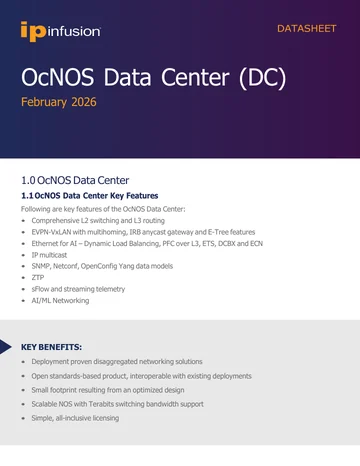
OcNOS-DC データシート
OcNOS-DC の完全な仕様。EVPN-VXLAN と Ethernet for AI の機能セット、ソフトウェア SKU、サポート対象ハードウェアプラットフォーム、ソリューション発注ガイドを収録しています。
データシートを入手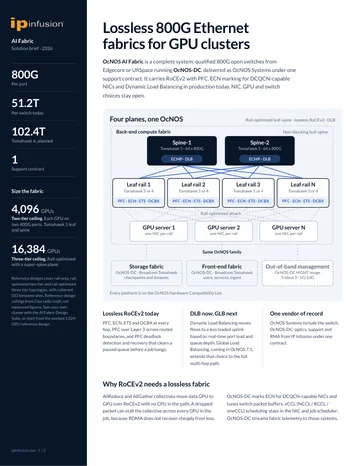
OcNOS 800G ロスレス AI Fabric
Tomahawk 5 スパイン上のロスレス RoCEv2 ファブリック:SKU 階層、認定済みプラットフォーム、導入アーキテクチャ。
概要資料を入手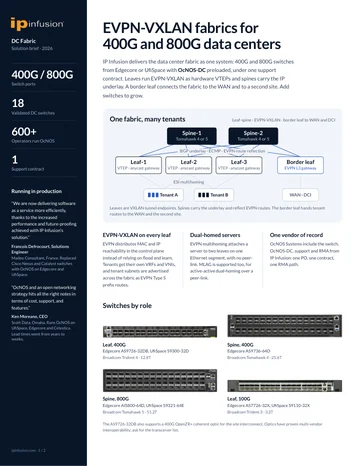
EVPN-VXLAN データセンターファブリック
EVPN-VXLAN によるリーフスパイン型データセンターファブリック:テナントごとの VRF と VNI、EVPN マルチホーミング、BGP unnumbered、ルートターゲットフィルタリング。
概要資料を入手OcNOS-DC データシート
簡単なフォームです。送信後すぐに PDF が新しいタブで開きます。
✓ PDF を新しいタブで開いています…
開かない場合は、下記のリンクをご利用ください。
OcNOS 800G ロスレス AI Fabric
簡単なフォームです。送信後すぐに PDF が新しいタブで開きます。
✓ PDF を新しいタブで開いています…
開かない場合は、下記のリンクをご利用ください。
EVPN-VXLAN データセンターファブリック
簡単なフォームです。送信後すぐに PDF が新しいタブで開きます。
✓ PDF を新しいタブで開いています…
開かない場合は、下記のリンクをご利用ください。