

The Fastest Path from Wireless ISP to Carrier-Grade
Unify Fixed Wireless, XGS-PON, and 5G on one open, line-rate access fabric.
Modern Access Networks Are Multiplatform by Default
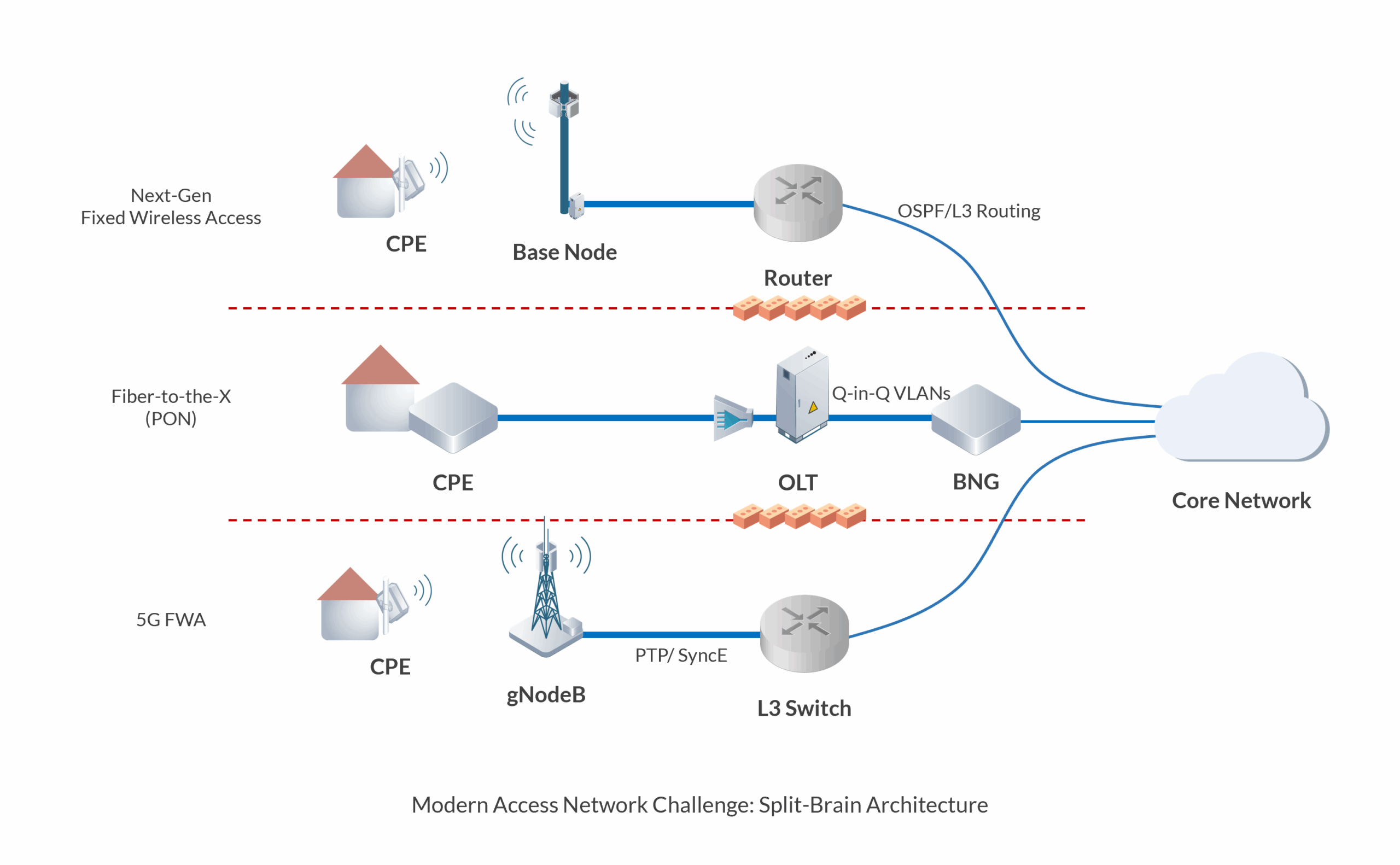
The Operational Bottleneck. Operators increasingly blend next-generation fixed wireless access (ngFWA), XGS-PON, and 5G to reach every subscriber. Each access type introduces its own control plane, tools, and bandwidth profile. Running separate stacks creates operational silos and prevents consistent subscriber QoS.
1. Domain Fragmentation
Running separate domains for Fiber and Wireless creates fragmented tools, inconsistent policies, and doubled operational costs.
2. Hardware Limits
Legacy CPU-based routers hit performance ceilings with ngFWA micro-bursts and XGS-PON density.
The Architectural Fix: Merchant Silicon + OcNOS
OcNOS provides the complete fix:. A unified EVPN control plane to merge your services, running on merchant silicon to guarantee line-rate performance.
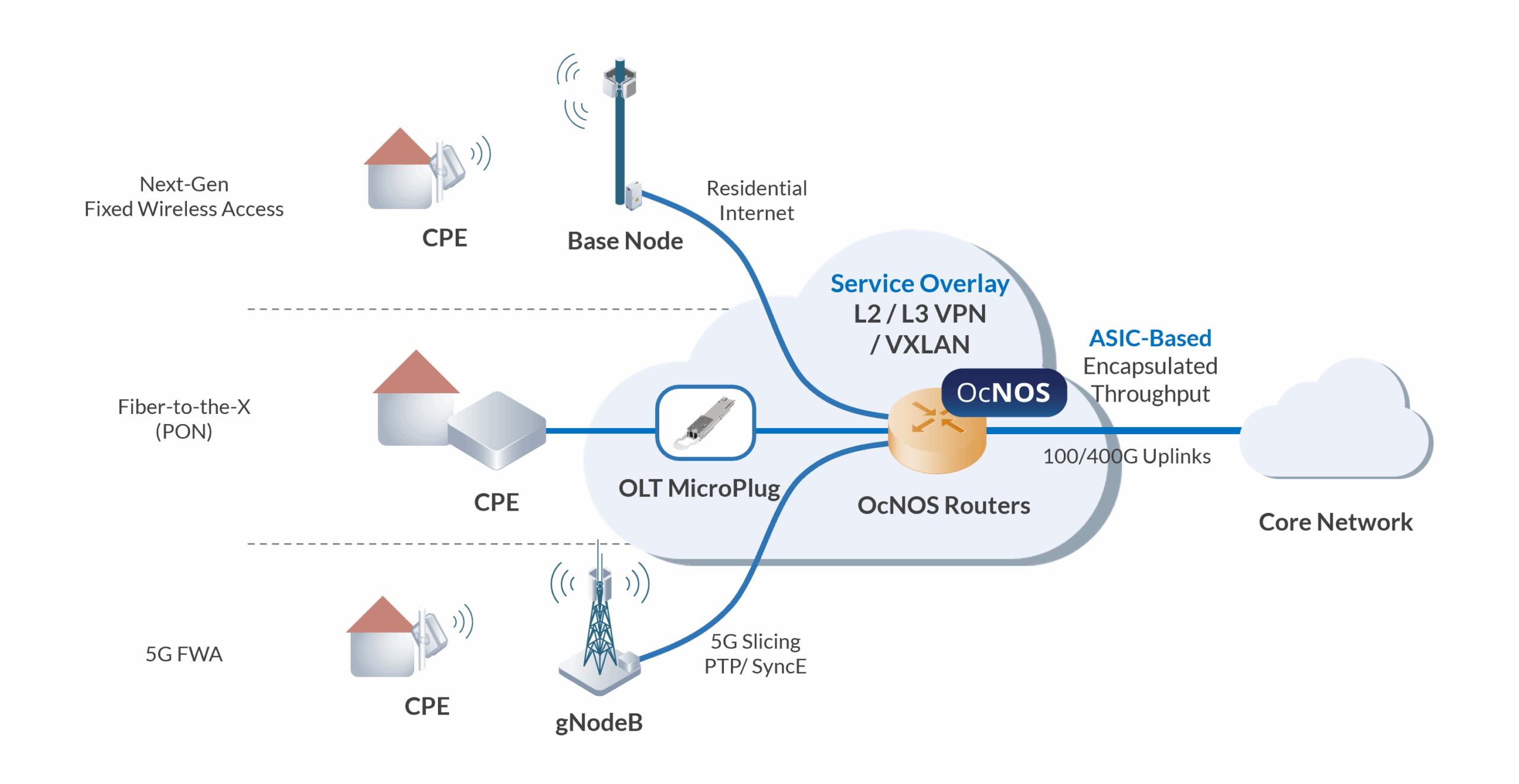
The Solution: Converged Glass, Air, and 5G on a Single OcNOS Fabric
1. Unified Multi-Tenancy
Slice 5G, Fiber, and Wireless on one wire using EVPN/VXLAN.
2. Hybrid Economics
Terminate PON and ngFWA on the same hub. Optimize ROI by offloading dense areas to fiber.
3. Seamless Migration
Interoperate with LDP-MPLS for a graceful, no-rip-and-replace migration.
4. Line-Rate Performance
Move routing from CPU to ASIC. Achieve 100G+ throughput with deep buffers to absorb micro-bursts.
The Architecture Gap: ASIC vs. CPU
A simple comparison shows where CPU routers (like MikroTik) hit limits and ASIC routers scale.
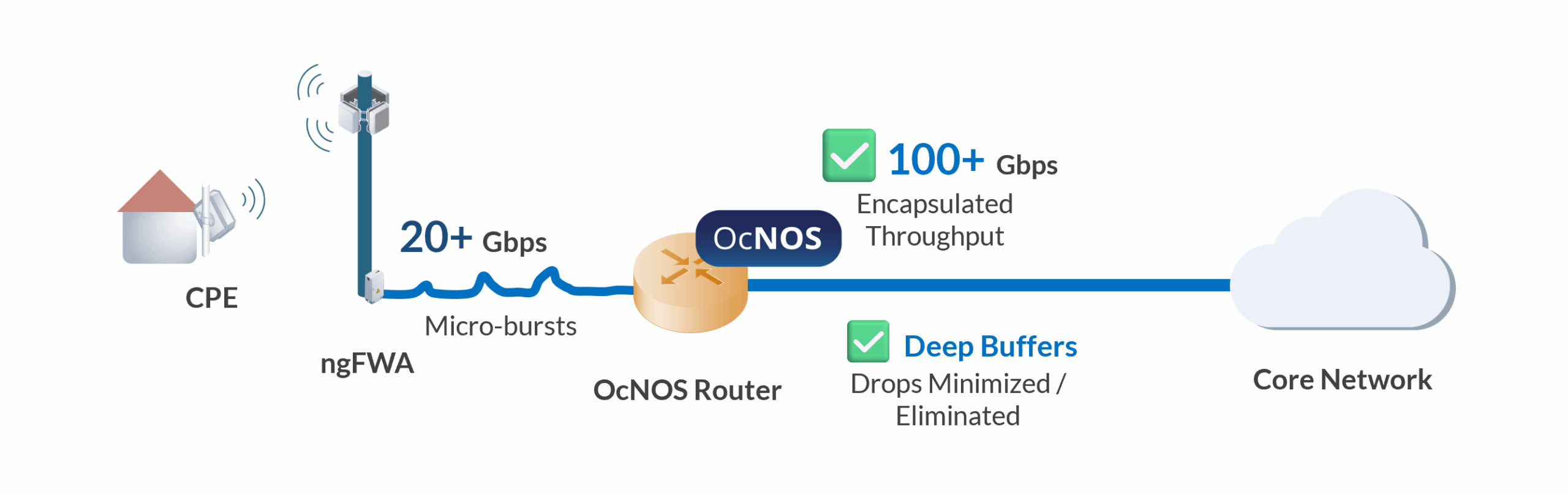
Optimized Modern Network Transport for ngFWA with OcNOS

ngFWA Growth Wall with Legacy CPU-Based Routers
“We were looking to make the conversion from a switched network to a routed network… IP Infusion was able to provide the needed features at a lower price point, allowing for a faster ROI versus other solutions.”
Ken Vedder, Network Engineer, Amplex Internet
Choose Your OcNOS SP
*Feature support is platform-dependent, refer to the Feature Matrix for details.
“OcNOS provided the perfect balance of price, performance, and availability for our rural broadband expansion.”
TJ Scott, Chief Operating Officer and General Manager of Broadlinc
Common Technical Questions
What is “Unified Access” and how does OcNOS deliver it?
Unified Access means consolidating Mobile (CSR), Broadband (BNG/PON), and Enterprise/Metro into one common IP/MPLS fabric. OcNOS delivers this using open standards: Segment Routing (SR-MPLS), EVPN, and advanced QoS, running on cost-efficient merchant-silicon hardware (Broadcom Qumran).
Will OcNOS integrate with my existing Cisco, Juniper, or MikroTik network?
Yes. OcNOS is fully standards-based and interoperates with Cisco ASR/CSR, Juniper MX/QFX, MikroTik CCR, and others. It supports familiar CLI conventions and clean BGP/OSPF/IS-IS/EVPN interoperability, making phased migrations easy.
Is EVPN/MPLS too complex for small and mid-size operators?
Not with OcNOS. We provide pre-built templates and validated designs for WISPs, ISPs, and rural operators. Most customers deploy EVPN-VPWS or EVPN-VLAN services without needing deep MPLS expertise, while gaining superior stability, scale, and redundancy.
Why not continue using high-end CPU routers (e.g., MikroTik) for aggregation?
CPU routers hit performance limits with 10–100Gbps traffic, micro-bursts, and high PPS loads, causing jitter and packet drops. OcNOS runs on hardware ASICs with deep buffers (4–8GB), delivering deterministic line-rate performance for XGS-PON, 5G backhaul, and enterprise traffic.
What hardware platforms does OcNOS support?
OcNOS is validated on leading whitebox vendors such as UfiSpace and Edgecore. Each platform undergoes full IPI certification for optics, forwarding, timing, and thermal performance to ensure predictable behavior in production networks.
How is support handled for both hardware and software?
IP Infusion provides a single point of support. If an issue is software-related, our TAC handles it directly. If hardware is at fault, we manage the RMA with the platform vendor. You get one support path.
How does OcNOS licensing compare to routers from the traditional OEMs?
OcNOS uses a simple perpetual or subscription model decoupled from hardware. No port-activation fees, no proprietary line cards. Operators typically see over 50% lower TCO over 5 years compared to closed chassis systems from traditional vendors.
Can I start small and scale up later?
Absolutely. Many operators begin with a single aggregation router or PON/BNG node, then scale horizontally as subscribers and traffic grow. OcNOS supports pay-as-you-scale deployments without forklift upgrades.
How long does it take to deploy OcNOS in a brownfield network?
Typical deployments range from a few days for small ISP/WISP turn-ups to several weeks for larger multisite rollouts. We provide migration guides, staging templates, and remote engineering support to ensure predictable cutovers.
OcNOS® Virtual Machine
Free Download

Get Started Today!
Speak with an IP Infusion expert to discuss your specific needs and learn how we can help you unlock the full potential of your network with open networking solutions.