The Juniper MX204 has been a mainstay of service-provider peering and aggregation, valued for full-table BGP, MPLS, and metro Ethernet in a compact package. With Juniper setting its end-of-life milestone in 2026 and support continuing for years after, many operators are using the refresh cycle to ask a broader question: does the next router need to be a proprietary appliance at all?
To answer that objectively, the independent network consultancy IP ArchiTechs put IP Infusion OcNOS through a structured evaluation as an MX204 alternative and published the results. IP ArchiTechs is vendor-agnostic, so the assessment reflects field experience rather than a vendor pitch.
What IP ArchiTechs validated
The evaluation ran OcNOS on the UfiSpace S9600-72XC, an open router built on Broadcom Qumran2c silicon. Their finding: recent Qumran2 support gave OcNOS the route scale to act as a full-table border and peering router, a reach open hardware did not have before. The platform covered the MX204 core roles with a feature set spanning Segment Routing, EVPN, and precision timing, and the OcNOS VM is publicly available for hands-on testing.
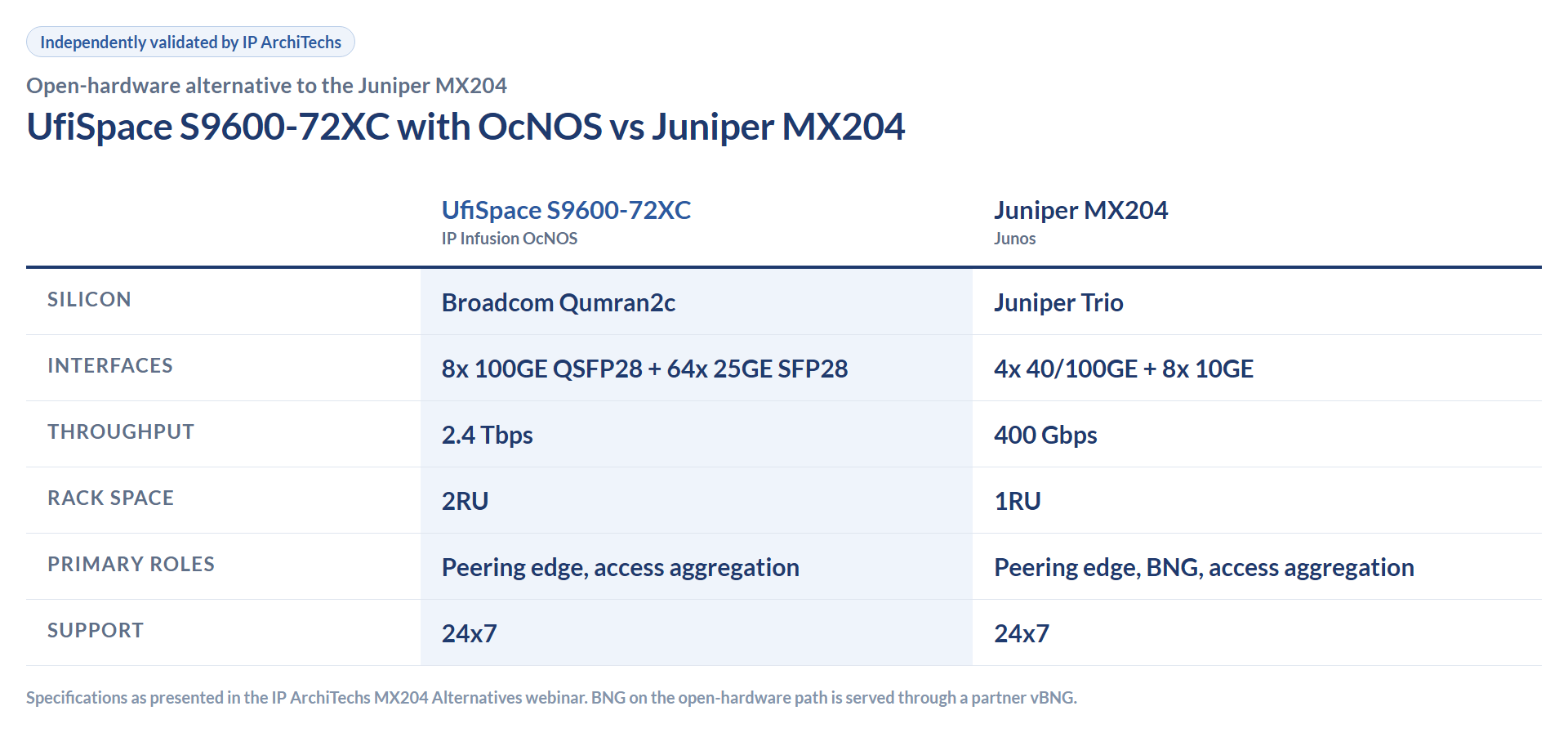
The drivers IP ArchiTechs cited were practical rather than ideological: lead time and cost. Open hardware from multiple ODMs removed the single-vendor supply constraint that made appliance refreshes slow and expensive during the period when both were hardest to get.
Where OcNOS fits, and where it does not
OcNOS on open hardware maps cleanly to the MX204 peering-edge, aggregation, and metro roles. One honest distinction: the MX204 also serves as a BNG. On the open-networking path, subscriber management is handled by a partner vBNG rather than on the router itself, so a BNG-centric site needs that in the design.
This post covers the independent validation and where operators have already switched. For the full capability and platform-by-platform mapping, including a Junos-to-OcNOS command reference, use the OcNOS vs Juniper comparison guide.
Operators who have replaced Juniper
The case is not theoretical. Recent open-networking deployments have displaced Juniper in production:
- Vyve Broadband moved its core to OcNOS on Edgecore hardware with RocNet Supply, replacing Cisco and Juniper across a multi-node footprint. Bericht lesen.
- Celerity Internet and WispWest deployed OcNOS with IP Maestro on UfiSpace hardware, consolidating a mixed Juniper and MikroTik estate across edge, border, and core. Read the announcement.
- BroadStar runs OcNOS on open switches in place of Juniper to deliver symmetric broadband to multi-dwelling units. See more customer stories.
How a migration works
- Lab validation. Download the OcNOS VM and test your BGP, MPLS, and EVPN configurations before touching production.
- Parallel deployment. Bring OcNOS hardware up alongside the MX204, synchronize routing state, and confirm forwarding.
- Incremental cutover. Shift traffic node by node using normal BGP path control.
- Decommission. Retire the legacy hardware after a validation window.
IP Infusion partners provide migration support, including configuration conversion and cutover assistance.
- Try the OcNOS VM, free
- OcNOS-SP-Produktseite
- OcNOS vs proprietary network operating systems
- Talk to IP Infusion
IP Infusion
Juniper, MX204, and Junos are trademarks of Juniper Networks. IP Infusion is independent and not affiliated with Juniper Networks. Specifications reflect the IP ArchiTechs MX204 Alternatives webinar.
Gehen Sie tiefer. Nehmen Sie es mit.
Das Produktdatenblatt und kurze, technische Downloads, die über diese Seite hinausgehen.
OcNOS-SP Datenblatt
Vollständige OcNOS-SP Spezifikation: Funktionsumfang für Access, Cell Site und Aggregation, Software-SKUs, unterstützte Hardware-Plattformen und der Solution Ordering Guide.
Datasheet abrufenDas Netzwerk demokratisieren: der offene Nachfolger von Juniper
The carrier-grade case for moving off Juniper: the end-to-end open OcNOS model, validated multi-vendor hardware, no optics lock-in, and side-by-side cost scenarios.
Brief anfordernJunos-zu-OcNOS-CLI-Spickzettel
Side-by-side Junos and OcNOS for the protocol areas your team uses daily: BGP, OSPF, IS-IS, LDP, SR-MPLS, EVPN-VXLAN, EVPN-MPLS, MPLS-TE, ACL, QoS, NetConf, and interface/breakout.
Brief anfordernOcNOS-SP Datenblatt
Kurzes Formular. Ihr PDF öffnet sich unmittelbar nach dem Absenden in einem neuen Tab.
✓ Ihr PDF wird in einem neuen Tab geöffnet…
Falls es sich nicht geöffnet hat, nutzen Sie den untenstehenden Link.
Das Netzwerk demokratisieren: der offene Nachfolger von Juniper
Kurzes Formular. Ihr PDF öffnet sich unmittelbar nach dem Absenden in einem neuen Tab.
✓ Ihr PDF wird in einem neuen Tab geöffnet…
Falls es sich nicht geöffnet hat, nutzen Sie den untenstehenden Link.
Junos-zu-OcNOS-CLI-Spickzettel
Kurzes Formular. Ihr PDF öffnet sich unmittelbar nach dem Absenden in einem neuen Tab.
✓ Ihr PDF wird in einem neuen Tab geöffnet…
Falls es sich nicht geöffnet hat, nutzen Sie den untenstehenden Link.