Virtual Private LAN Service (VPLS) is one of the most widely deployed Layer 2 VPN technologies in service provider networks. While EVPN has become the modern successor, VPLS remains in active production across thousands of service provider deployments worldwide. Understanding how to configure and verify VPLS on OcNOS is essential for network engineers working in brownfield SP environments.
This guide builds a complete VPLS deployment from the ground up: OSPF underlay, LDP label distribution, and VPLS pseudowire configuration, with verification commands at each stage.
Network Topology
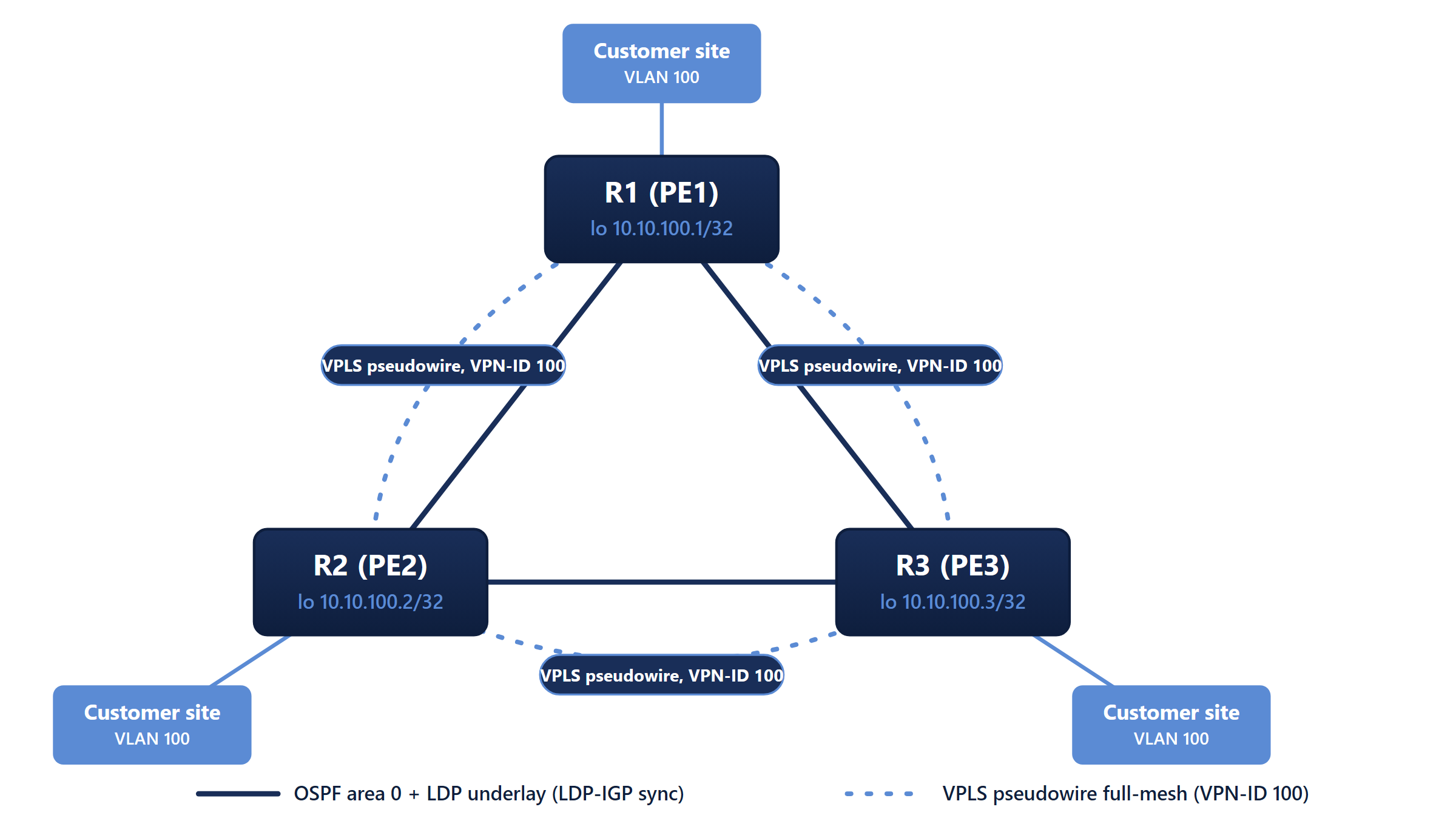
Step 1: Configure OSPF Underlay
OSPF provides the IP reachability between PE routers. On OcNOS, enable OSPF with network statements under the process, set the core links to point-to-point (this eliminates DR/BDR election), and mark the loopback passive. The core interface also carries MPLS, so label-switching and per-interface LDP are enabled on it as well.
! OcNOS: OSPF underlay on R1 (all PEs use the same config pattern)
!
router ospf 1
 router-id 10.10.100.1
 passive-interface lo enable
 network 10.10.100.1/32 area 0.0.0.0
 network 192.168.12.0/24 area 0.0.0.0
 network 192.168.13.0/24 area 0.0.0.0
!
interface ce0
 ip address 192.168.12.1/30
 mtu 9216
 label-switching
 mpls ldp-igp sync ospf holddown-timer 30
 ip ospf network point-to-point
 enable-ldp ipv4
!
interface lo
 ip address 127.0.0.1/8
 ip address 10.10.100.1/32 secondary
 ipv6 address ::1/128
!
commit
!
! Verify OSPF neighbors:
show ip ospf neighbor
! Expected: R2 and R3 in FULL state
!
! Verify loopback reachability to the remote PEs:
show ip route ospfStep 2: Enable LDP for Label Distribution
LDP binds MPLS labels to OSPF-learned prefixes, building the Label Switched Paths (LSPs) that VPLS pseudowires ride over. On OcNOS the LDP process is configured under router ldp, and LDP is turned up on each core link with enable-ldp ipv4 alongside label-switching (both already shown on interface ce0 in Step 1).
! OcNOS: LDP configuration on R1
!
router ldp
 router-id 10.10.100.1
 transport-address ipv4 10.10.100.1
!
commit
!
! Per-interface LDP is enabled on the core links (see interface ce0 in Step 1):
!   label-switching
!   enable-ldp ipv4
!
! Verify LDP session state (R2 and R3 should be OPERATIONAL):
show ldp session
!
! Verify the label-switched paths to the PE loopbacks:
show mpls forwarding-table
Step 3: Configure VPLS
VPLS creates a virtual Ethernet switch across the MPLS network. Each PE maintains LDP-signaled pseudowires to all other PEs in the VPLS instance, forwarding frames based on MAC learning, exactly like a physical Ethernet switch, but over MPLS. On OcNOS the instance is defined globally with mpls vpls <name> <vpls-id>, LDP signaling and each remote PE are declared inside it, and the CE-facing access port is bound with mpls-vpls <name>.
! OcNOS: VPLS configuration on R1
! VPLS-ID 100 connects CE-A (R1), CE-B (R3) and CE-C (R2) in one L2 broadcast domain
!
mpls vpls VPLS100 100
 signaling ldp
 !
 ! Pseudowire to R2 (PE2)
 vpls-peer 10.10.100.2
 !
 ! Pseudowire to R3 (PE3)
 vpls-peer 10.10.100.3
!
! Bind the CE-facing access port into the VPLS instance
interface ce2
 access-if-vpls
  mpls-vpls VPLS100
!
commit
!
! Verify the VPLS instance and pseudowire status:
show mpls vpls
! Expected: both peers UP (VC Type: Ethernet)
!
! Verify the VC table and assigned VC labels:
show mpls vc-table
Step 4: Verify End-to-End Connectivity
! OcNOS: End-to-end VPLS verification
!
! Confirm the MPLS forwarding entry toward a remote PE:
show mpls forwarding-table
!
! Confirm the VPLS instance and both pseudowires are up:
show mpls vpls
!
! Confirm the VC table shows both peers with assigned VC labels:
show mpls vc-table
!
! Confirm the LDP-signaled L2 circuit to each remote PE:
show ldp mpls-l2-circuit
VPLS vs. EVPN: When to Use Each
| 機能 | VPLS | EVPN |
|---|---|---|
| MAC learning | Data plane (flooding) | Control plane (BGP) |
| マルチホーミング | Complex (H-VPLS) | Native (EVPN MH) |
| BUM traffic | Flood-and-learn | Selective multicast |
| Fast convergence | Limited | Mass withdrawal + aliasing |
| L3 integration | Separate L3VPN needed | EVPN IRB (native) |
| Brownfield fit | Excellent | Good (with SR underlay) |
VPLS remains the right choice for brownfield deployments where EVPN migration is not yet planned. For new deployments, EVPN-ELAN delivers the same multipoint L2 service with superior scalability and faster convergence.
- EVPN-ELINE: Point-to-Point L2VPN over ISIS-SR
- EVPN-ELAN: Multipoint L2VPN over ISIS-SR
- LDP to SR Migration Guide
- OcNOS-SP Product Page
- IP Infusion へお問い合わせ
IP Infusion Engineering Team
さらに詳しく。資料をお持ち帰りください。
製品データシートと、このページよりもさらに踏み込んだ簡潔で技術的なダウンロード資料です。
OcNOS-SP データシート
OcNOS-SP の完全な仕様。アクセス、セルサイト、アグリゲーションの機能セット、ソフトウェア SKU、サポート対象ハードウェアプラットフォーム、ソリューション発注ガイドを収録しています。
データシートを入手OcNOS による SR-MPLS アップグレード
オープンハードウェア上の OcNOS へ SR-MPLS を移行。Flex-Algo・TI-LFA と、実証済みの Cisco 代替移行パスを解説します。
概要資料を入手クラウド & サービスプロバイダー WAN 伝送
open hardware上でのクラウドおよびservice provider向けWANトランスポート。SR-MPLS、EVPN、スケール検証済みのフォワーディングに対応します。
概要資料を入手OcNOS-SP データシート
簡単なフォームです。送信後すぐに PDF が新しいタブで開きます。
✓ PDF を新しいタブで開いています…
開かない場合は、下記のリンクをご利用ください。
OcNOS による SR-MPLS アップグレード
簡単なフォームです。送信後すぐに PDF が新しいタブで開きます。
✓ PDF を新しいタブで開いています…
開かない場合は、下記のリンクをご利用ください。
クラウド & サービスプロバイダー WAN 伝送
簡単なフォームです。送信後すぐに PDF が新しいタブで開きます。
✓ PDF を新しいタブで開いています…
開かない場合は、下記のリンクをご利用ください。