MACsec for AI Data Center Interconnect
AI infrastructure is now a strategic target
AI infrastructure has become a national-security asset, and this year's headlines show it is targeted from every direction: export-control evasion, insider risk, and state-backed espionage. Most of that attention lands on GPUs and the people around them. Less attention goes to the fiber between AI data centers, which carries the most valuable data an AI operator owns.
AI networking is moving beyond scale-up and scale-out to scale-across. Large models are now trained and served across several data centers working as one AI cluster, with each site constantly copying its progress (checkpoints) to the others. That means a company's most valuable AI data is always moving between sites, often over fiber leased from someone else. Encrypting these data center interconnect (DCI) links at line rate, without adding latency to AI traffic, is now a baseline requirement. MACsec on the router is the most direct way to meet it.
The weak link is the fiber you don't own
Once model weights, checkpoints, and training data leave your building, they ride on fiber and network equipment owned by someone else. Four risks follow:
- Silent interception. A fiber tap copies everything on the link without causing an outage anyone would notice.
- Exposure inside third-party networks. Carrier and colocation infrastructure carries your traffic in the clear unless you encrypt it first.
- Harvest now, decrypt later. Recorded model IP keeps its value for years, so data captured today is a liability long after it's stolen.
- Tampering in transit. An attacker on the path can inject or replay frames, quietly corrupting replication or training traffic.
An AI model can take months and millions of dollars to train. It deserves the same protection on the wire as it gets on disk.
Encrypt every link that leaves the site
The answer is simple: encrypt at the edge of the trust boundary, on the router that already terminates the link. MACsec on the border router covers the inter-site DCI link and the cloud on-ramps, while the GPU fabric inside each site runs untouched.
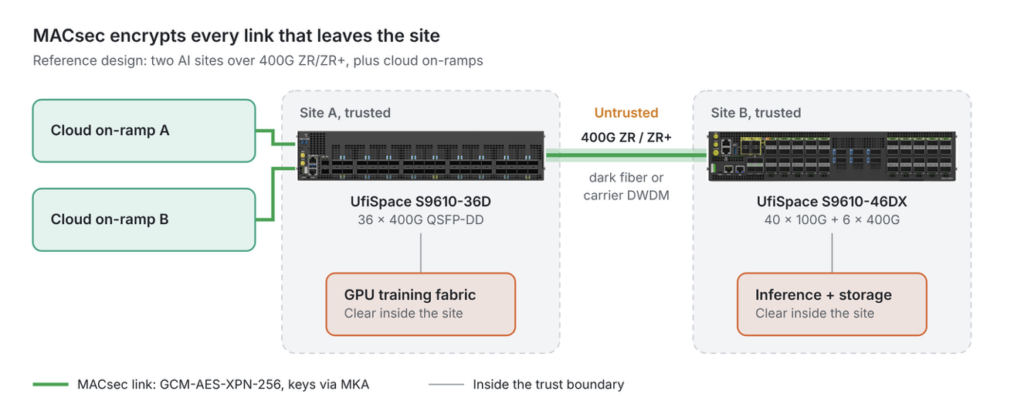
- No extra boxes. Encryption and 400G ZR/ZR+ coherent optics live in the same open router, so there's no separate encryptor or transponder to buy, power, and manage.
- Line rate, no performance tax. MACsec runs in the port hardware, so AI traffic keeps its full bandwidth and low latency.
- One policy for every exit. The same router and the same policy secure site-to-site links and on-ramps to Tier-1 clouds.
- Open and disaggregated. OcNOS runs on open hardware, starting with UfiSpace platforms, so you choose the router that fits each site.
The result is security that keeps pace with the AI buildout instead of slowing it down. Every new site, wavelength, or cloud on-ramp gets the same protection the day it is turned up, with no new appliances in the rack and no change to the GPU fabric. For network teams, encryption stops being a separate project and becomes part of how the link is built.
Available now, built for 800G
MACsec becomes generally available in the upcoming OcNOS 7.1.0 release at the end of November, on platforms including the UfiSpace S9610-36D and S9610-46DX.
As AI DCI moves from 400G to 800G, the same approach scales with it. Broadcom's Qumran3 silicon builds line-rate MACsec into every port, and the next generation of open routers from UfiSpace and Edgecore brings it to 800G in 2027, with the same OcNOS operating model.
Protection that lasts. MACsec uses AES-256, which is considered resistant to known quantum attacks. That matters for model IP that must stay protected for years.
Sovereign AI. Encrypting every link that leaves the operator's control is a simple answer to data-residency and "encrypt in transit" requirements, without changing the GPU fabric.
Built for the AI rack. OcNOS drops into any AI rack design with encryption built in, and model-driven automation provisions every new rack and link the same way.
Don't let the fiber be your weak link
Talk to IP Infusion today to plan MACsec for your AI DCI links and cloud on-ramps, so you're ready to deploy when OcNOS 7.1.0 goes GA. Watch for the technical deep dive at launch.
