
Cell site router 5G aperti con timing di livello operatore integrato.
IP Infusion delivers the complete cell site router mobile operators put at the tower: a disaggregated cell site gateway (DCSG) running OcNOS-SP on a temperature-hardened, validated open box, pre-loaded and supported under one contract. It terminates 4G and 5G xHaul at the tower and carries it to the backhaul, and it holds IEEE 1588v2 PTP e SyncE timing so phase and frequency reach every radio and the cell stays on the air.
Operatori mobili che eseguono trasporto aperto.
Operatori mobili in Asia e Africa eseguono oggi in produzione cell site router aperti.
Un deployment di 5G Cell Site Router su scala nazionale
Asia Pacific Telecom ha selezionato IP Infusion per il suo deployment di 5G Cell Site Router, eseguendo OcNOS su hardware white-box UfiSpace integrato da FHnet e Foxconn, per accelerare la trasformazione della sua rete 5G.
"By adopting open and disaggregated networking, we're able to enhance the flexibility and efficiency of our network infrastructure. This approach not only drives innovation but also allows us to better serve our customers by improving service delivery and expanding access to the latest digital solutions. Our goal is to ensure that the connectivity we provide continues to meet the evolving needs of the communities we serve." Lloyd Mphahlele, General Manager of Group Technology at MTN Group
IP Infusion supporta più di 600 operatori in 60 paesi, sostenuta da 26 anni di ingegneria dei protocolli.
Fronthaul, midhaul e backhaul su un unico router aperto.
Il cell site router trasporta fronthaul a pacchetto classe eCPRI, midhaul SR-MPLS e backhaul SR-MPLS, con timing IEEE 1588v2 PTP e SyncE che funziona su ogni livello.
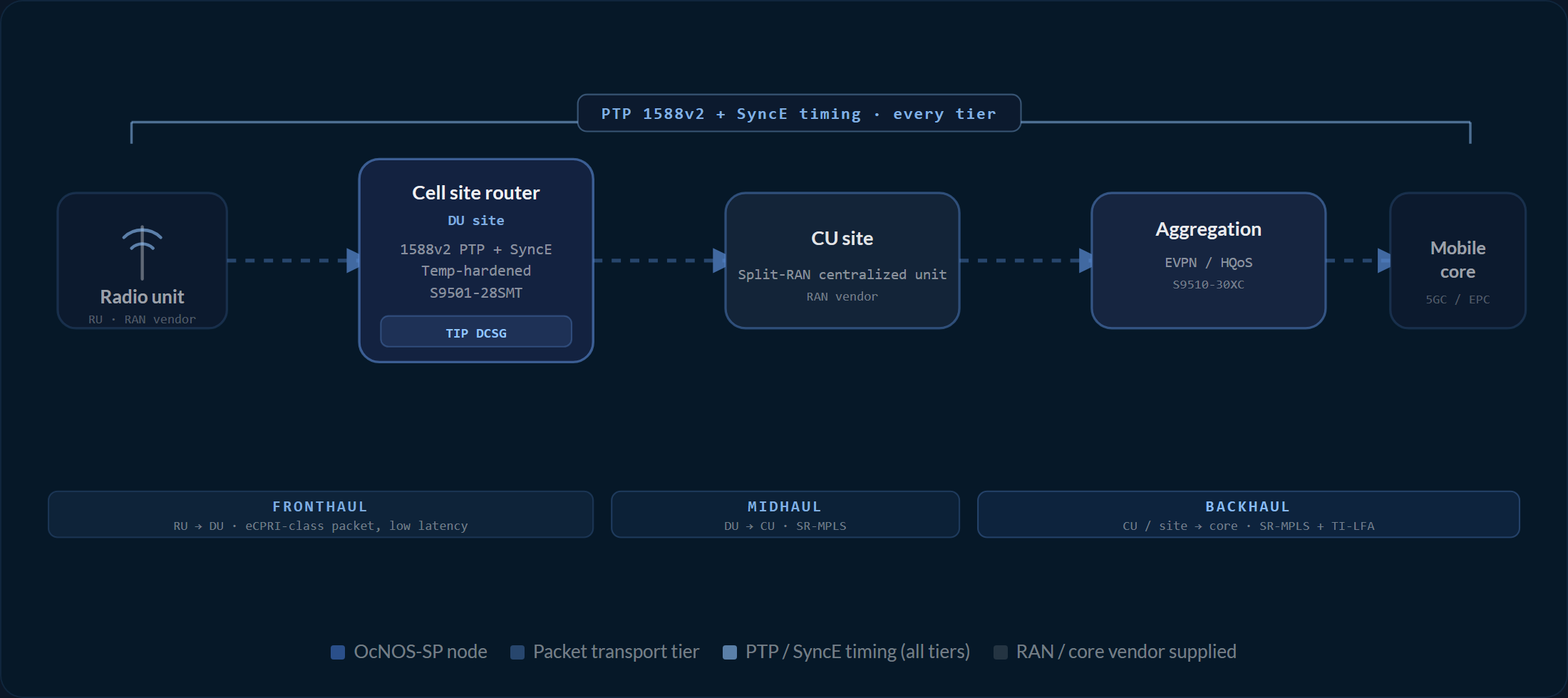
Apri la vista vettoriale per passare il mouse su ogni nodo per i dettagli di ruolo e protocollo.
La stessa immagine router trasporta ogni livello xHaul, concessa in licenza e dimensionata per ruolo. Il fronthaul funziona come Ethernet a bassa latenza, midhaul e backhaul funzionano su SR-MPLS, e il timing PTP e SyncE si estende su tutti e tre.
Fronthaul a pacchetto a bassa latenza
Il router trasporta eCPRI-class packet fronthaul between the radio unit and the distributed unit as low-latency Ethernet with precise timing, not an SR-MPLS domain. The eCPRI radio interface is supplied by the RAN vendor; the router transports the packets.
Midhaul in una RAN split
In una RAN split, il router trasporta Midhaul SR-MPLS between the distributed unit and the centralized unit, so the RAN can distribute its functions across sites.
Backhaul verso il mobile core
Il router trasporta Backhaul SR-MPLS from the cell site to the mobile core, with Flex-Algo and TI-LFA fast reroute. The RAN and core vendors supply the 5G core.
Switch L3 con timing
Il router è il router e switch L3 qualificato per il timing che trasporta PTP and SyncE in the same box. This is what operators mean by an L3 switch with timing at the cell site.
Quale profilo PTP per il percorso davanti a te.
Il cell site router funziona come boundary clock PTP e nodo SyncE su ogni livello xHaul. L'unica decisione che cambia da sito a sito è il profilo telecom PTP: G.8275.1 full timing where every hop is timing-aware, or G.8275.2 partial timing across a brownfield path. Pick a profile below to see the design.
Choose Timing completo G.8275.1 where every node in the path is a PTP-aware boundary clock. It runs over Ethernet with multicast and carries phase, time, and frequency end to end, which is the design for a greenfield timing-aware transport path.
| Aspect | Timing completo G.8275.1 | Timing parziale G.8275.2 |
|---|---|---|
| Delivers | Fase, tempo e frequenza | Fase e tempo, con frequenza da SyncE |
| Network requirement | Ogni nodo è un boundary clock PTP-aware | Alcuni hop non sono timing-aware (brownfield) |
| Transport | Ethernet, multicast | IP, unicast |
| Typical use | Percorso greenfield, completamente timing-aware | Overlay su un percorso di trasporto installato |
Ultima verifica: lug 2026. La classe di clock esatta, l'holdover e la specifica di clock G.8273.2 dipendono dalla piattaforma, dalla release e dal design della rete. Contattaci to confirm the class binding for your deployment. Go deeper on the protocol: PTP and SyncE explained →
Il cell site router come un unico sistema completo.
Il disaggregated cell site gateway è un unico box che trasporta routing e switching L3, timing IEEE 1588v2 PTP e SyncE, accesso SR-MPLS, EVPN Carrier Ethernet e QoS gerarchica. IP Infusion lo fornisce completo, e segue il pattern che il Telecom Infra Project ha standardizzato come stream TIP DCSG.
Accesso SR-MPLS ed EVPN Carrier Ethernet
Il router trasporta SR-MPLS access from the tower and delivers EVPN Carrier Ethernet services over it. Carrier Ethernet service design and MEF 3.0 detail live on the metro Ethernet page; see also EVPN.
QoS gerarchica al cell site
QoS gerarchico shapes and schedules traffic by service and by tenant at the tower, so timing-sensitive and best-effort xHaul share the uplink under a defined policy.
Router, switch e timing in un unico box
Un'unica piattaforma aperta trasporta PTP e SyncE, IP e MPLS con accesso SR-MPLS, EVPN Carrier Ethernet e HQoS insieme, così il cell site funziona su un unico box, sotto un unico contratto, come il Switch L3 con timing.
Un box con protezione termica per il cell site.
Il cell site si trova in un armadio o alla base di una torre, così il cell site router funziona su un box compatto con protezione termica e timing nativo. Pre-aggregazione e aggregazione, che risiedono in un sito controllato, scalano su un box di classe data-center.
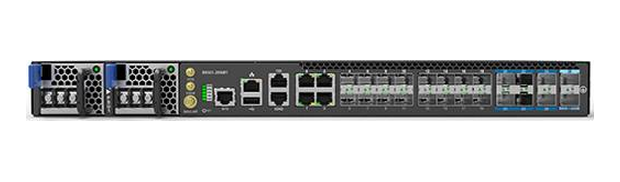
UfiSpace S9501-28SMT
Cell site router · temperature-hardened · Qumran UX (BCM88270)A temperature-hardened, compact box on Broadcom Qumran UX merchant silicon with roughly 120 Gbps of switching capacity, built for the environmental range of a cabinet or tower base. It carries IEEE 1588v2 PTP and SyncE natively as a boundary or ordinary clock, with SR-MPLS access, EVPN Carrier Ethernet, and hierarchical QoS. SFP and SFP+ cages, breakout per platform, optics with proven interoperability per deployment.
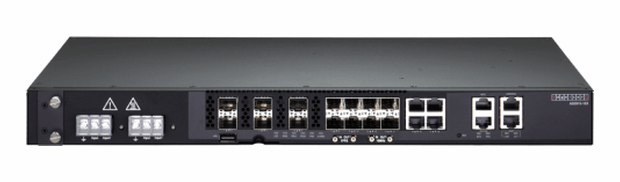
Edgecore AS5915-18X (CSR200)
Cell site router · temperature-hardened · Qumran UX (BCM88272)The Edgecore cell site router at the same tier: a temperature-hardened, compact box on Broadcom Qumran UX merchant silicon with roughly 64 Gbps of switching capacity, built for the environmental range of a cabinet or tower base. It carries IEEE 1588v2 PTP and SyncE natively as a boundary or ordinary clock, with SR-MPLS access, EVPN Carrier Ethernet, and hierarchical QoS. SFP and SFP+ cages, breakout per platform, optics with proven interoperability per deployment.
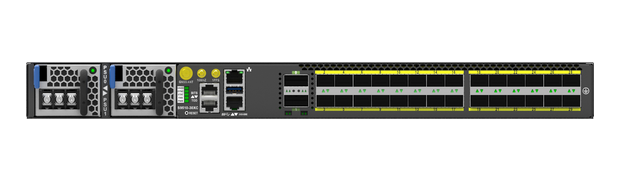
UfiSpace S9510-30XC
Pre-aggregation and aggregation · Qumran 2U (BCM88280)Il box di pre-aggregazione e aggregazione su silicio Broadcom Qumran con circa 360 Gbps of switching capacity, sited in a controlled cabinet rather than at the tower. It carries native timing along with SR-MPLS ed EVPN Carrier Ethernet upstream from the cell sites, with hierarchical QoS toward the core. QSFP28 and SFP+ cages, breakout per platform, optics with proven interoperability per deployment.
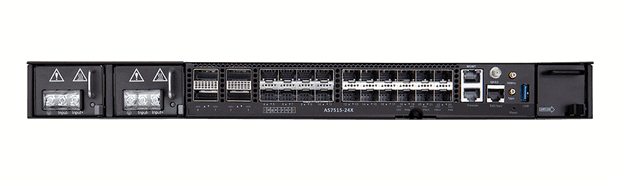
Edgecore AS7515-24X (CSR430)
Pre-aggregation and aggregation · Qumran 2U (BCM88284)The Edgecore pre-aggregation and aggregation box on Broadcom Qumran 2U silicon with roughly 360 Gbps of switching capacity, sited in a controlled cabinet rather than at the tower. It carries native timing along with SR-MPLS ed EVPN Carrier Ethernet upstream from the cell sites, with hierarchical QoS toward the core. QSFP28 and SFP+ cages, breakout per platform, optics with proven interoperability per deployment.
Ogni piattaforma, ASIC e release convalidata è nel hardware compatibility list → Gli uplink fixed-wireless si instradano verso broadband access.
Effettua l'onboarding e gestisci migliaia di siti fin dal primo giorno.
Un rinnovo dei cell site si ripete su migliaia di siti, quindi l'hardware aperto proveniente da più di un fornitore convalidato si traduce in un vantaggio negli approvvigionamenti, e lo Zero Touch Provisioning porta ogni nuovo box in produzione con una baseline Day 0 convalidata.
Onboarding Zero Touch Provisioning
Zero Touch Provisioning brings each new cell site router up with a validated Day 0 baseline over IPv4 or IPv6, so a technician racks the box and it onboards itself across the fleet.
Automazione e telemetria aperte
Il router parla NETCONF and YANG, OpenConfig, and gNMI dial-in and dial-out with streaming telemetry, so the fleet integrates with your own automation and observability stack. NETCONF and YANG →
IP Maestro per gestire la flotta
IP Maestro monitors, configures, and troubleshoots the fleet from one server, NETCONF south and REST north, so operators run thousands of sites from a single management surface. IP Maestro →
Un unico contratto di supporto
Il software e l'hardware convalidato vengono consegnati insieme, così la flotta ha one escalation path and one RMA, and one team owns the fix. Support →
Converti la flotta sito per sito.
I cell site router aperti interoperano con la rete Cisco, Juniper e Nokia installata, così converti la flotta un sito alla volta. Ogni sito effettua la migrazione secondo i propri tempi una volta convalidata la corrispondenza delle sue capacità.
Esegui un sito aperto affiancato alla rete installata
Attiva un cell site router aperto così che OcNOS-SP funzioni affiancato alla rete installata Cisco, Juniper e Nokia equipment, forming standard IS-IS, OSPF, and BGP adjacencies, so the site joins the transport without a redesign.
Converti un cluster di siti in base alla corrispondenza delle capacità
Conferma la corrispondenza delle capacità, Backhaul SR-MPLS, timing PTP e SyncE, e Carrier Ethernet, then cut over a cluster of sites on the operator's own timeline, validating each site before it carries production traffic.
Distribuisci su tutta la flotta con ZTP
Zero Touch Provisioning porta ogni nuovo sito in produzione con una baseline Day 0 convalidata, così il rinnovo si ripete su migliaia di siti mentre gli approvvigionamenti restano multi-vendor. IP Infusion supporta il router a ogni passaggio.
Il modello commerciale è aperto: hardware con protezione termica da fornitori convalidati sotto un unico contratto di supporto, con software e hardware su cicli di rinnovo indipendenti.
Cell site router aperto rispetto a uno chassis proprietario.
Il timing è il requisito più difficile nel sito cellulare, e il router aperto lo soddisfa: mantiene PTP e SyncE su ogni livello xHaul, supporta SR-MPLS e Carrier Ethernet e consente di rinnovare la flotta secondo il proprio ciclo attraverso più di un fornitore, il tutto sotto un unico contratto di supporto.
| Capacità | Cell site router aperto (OcNOS-SP) | Chassis proprietario (Cisco / Juniper / Nokia) |
|---|---|---|
| IEEE 1588v2 PTP G.8275.1/.2 and SyncE | ✓ details → | ✓ |
| SR-MPLS con Flex-Algo e TI-LFA | ✓ details → | ✓ |
| EVPN MEF 3.0 Carrier Ethernet | ✓ details → | ✓ |
| Form factor cell-site con protezione termica | ✓ | ✓ |
| Cicli di rinnovo indipendenti di hardware e software | ✓ refresh each on its own cadence | ✓ vendor-bundled cadence |
| Approvvigionamento hardware multi-vendor su tutta la flotta | ✓ source from validated vendors | ✓ single-vendor chassis |
| Un unico contratto di supporto per software e hardware convalidato | ✓ one escalation path and RMA | ✓ vendor-bundled |
Cisco, NCS 540, Juniper, ACX, Nokia e 7250 IXR sono marchi dei rispettivi proprietari. IP Infusion non è affiliata e non approva questi fornitori; il confronto riflette le capacità di OcNOS-SP verificabili nella matrice delle funzionalità.
Datasheet e solution brief.
Il datasheet OcNOS-SP e due solution brief da condividere con il suo team. Modulo rapido, e il PDF si scarica immediatamente.
Datasheet OcNOS-SP
La panoramica OcNOS-SP completa: ruoli, protocolli, timing e l'hardware convalidato, in un unico PDF.
Ottieni il datasheetUpgrade SR-MPLS con OcNOS
Un percorso di migrazione da SR-MPLS installato a OcNOS su hardware aperto, il trasporto sotto il backhaul xHaul.
Scarica il briefWAN Cloud e Service Provider
Trasporto aperto per la WAN cloud e service provider, il backhaul che trasporta il traffico mobile verso il core.
Scarica il briefDomande sul cell site router e sul timing di livello operatore.
Metti un cell site router aperto sul tuo hardware.
Scopra come IP Infusion fornisce il cell site router completo con timing di livello operatore e xHaul SR-MPLS, oppure ci contatti per mappare i suoi siti sulle piattaforme convalidate e sulle licenze corrette.
Datasheet OcNOS-SP
Modulo breve. il PDF verrà scaricato subito dopo l'invio.
✓ Opening your PDF in a new tab.
Se non si è aperto, usi il link qui sotto.
Upgrade SR-MPLS con OcNOS
Modulo breve. il PDF verrà scaricato subito dopo l'invio.
✓ Opening your PDF in a new tab.
Se non si è aperto, usi il link qui sotto.
WAN Cloud e Service Provider
Modulo breve. il PDF verrà scaricato subito dopo l'invio.
✓ Opening your PDF in a new tab.
Se non si è aperto, usi il link qui sotto.
Correlati dal blog
Precisione di clock al nanosecondo per reti 4G/5G: PTP e SyncE con OcNOS
Timing di livello operatore IEEE 1588 PTP e SyncE per xHaul 5G al cell site
Leggi il post →Cell Site Router fanless per backhaul 5G in ambienti rugged
Cell site router con protezione termica per l'accesso xHaul 5G in deployment difficili
Leggi il post →