
Routeurs de site cellulaire 5G ouverts avec synchronisation de niveau opérateur intégrée.
IP Infusion delivers the complete cell site router mobile operators put at the tower: a disaggregated cell site gateway (DCSG) running OcNOS-SP on a temperature-hardened, validated open box, pre-loaded and supported under one contract. It terminates 4G and 5G xHaul at the tower and carries it to the backhaul, and it holds IEEE 1588v2 PTP and SyncE timing so phase and frequency reach every radio and the cell stays on the air.
Des opérateurs mobiles exploitant un transport ouvert.
Des opérateurs mobiles à travers l'Asie et l'Afrique exploitent aujourd'hui des routeurs de site cellulaire ouverts en production.
Un déploiement de routeur de site cellulaire 5G à l'échelle nationale
Asia Pacific Telecom a choisi IP Infusion pour son déploiement de routeur de site cellulaire 5G, exécutant OcNOS sur du matériel white-box UfiSpace intégré par FHnet et Foxconn, afin d'accélérer la transformation de son réseau 5G.
"By adopting open and disaggregated networking, we're able to enhance the flexibility and efficiency of our network infrastructure. This approach not only drives innovation but also allows us to better serve our customers by improving service delivery and expanding access to the latest digital solutions. Our goal is to ensure that the connectivity we provide continues to meet the evolving needs of the communities we serve." Lloyd Mphahlele, General Manager of Group Technology chez MTN Group
IP Infusion prend en charge plus de 600 opérateurs dans 60 pays, fort de 26 ans d'ingénierie de protocoles.
Fronthaul, midhaul et backhaul sur un seul routeur ouvert.
Le routeur de site cellulaire transporte le fronthaul par paquets de classe eCPRI, le midhaul SR-MPLS et le backhaul SR-MPLS, avec la synchronisation IEEE 1588v2 PTP et SyncE fonctionnant sur chaque couche.
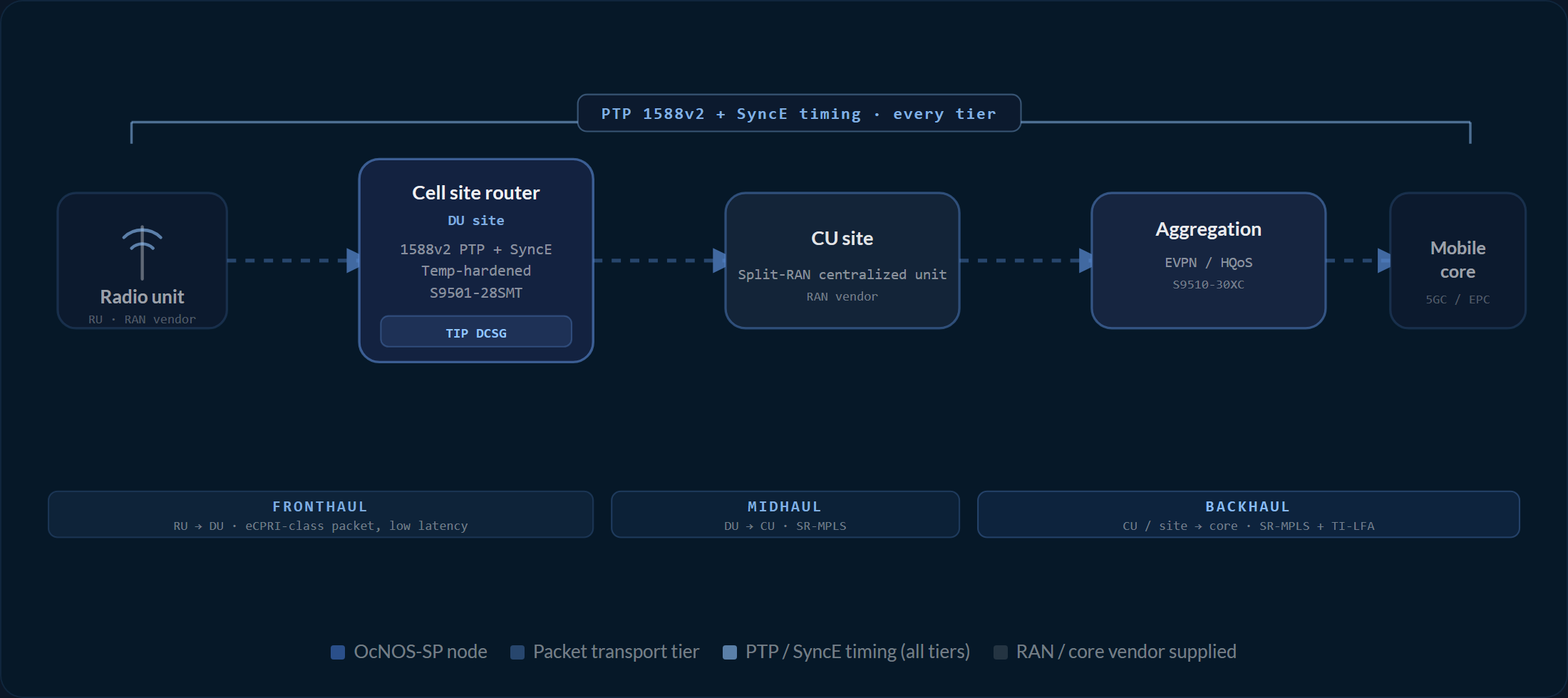
Ouvrez la vue vectorielle pour survoler chaque nœud et obtenir les détails de rôle et de protocole.
La même image de routeur prend en charge chaque niveau xHaul, licencié et dimensionné par rôle. Le fronthaul fonctionne en Ethernet à faible latence, le midhaul et le backhaul fonctionnent sur SR-MPLS, et la synchronisation PTP et SyncE couvre les trois.
Fronthaul par paquets à faible latence
Le routeur transporte eCPRI-class packet fronthaul between the radio unit and the distributed unit as low-latency Ethernet with precise timing, not an SR-MPLS domain. The eCPRI radio interface is supplied by the RAN vendor; the router transports the packets.
Midhaul dans un RAN décomposé
Dans un RAN divisé, le routeur porte Midhaul SR-MPLS between the distributed unit and the centralized unit, so the RAN can distribute its functions across sites.
Backhaul vers le cœur mobile
Le routeur transporte Backhaul SR-MPLS from the cell site to the mobile core, with Flex-Algo and TI-LFA fast reroute. The RAN and core vendors supply the 5G core.
Commutateur L3 avec synchronisation
Le routeur est le routeur et commutateur L3 qualifié pour la synchronisation qui transporte PTP and SyncE in the same box. This is what operators mean by an L3 switch with timing at the cell site.
Quel profil PTP pour le chemin devant vous.
Le routeur de site cellulaire fonctionne comme une horloge de frontière PTP et un nœud SyncE sur chaque couche xHaul. La seule décision qui change d'un site à l'autre est le profil télécom PTP : G.8275.1 full timing where every hop is timing-aware, or G.8275.2 partial timing across a brownfield path. Pick a profile below to see the design.
Choose Synchronisation complète G.8275.1 where every node in the path is a PTP-aware boundary clock. It runs over Ethernet with multicast and carries phase, time, and frequency end to end, which is the design for a greenfield timing-aware transport path.
| Aspect | Synchronisation complète G.8275.1 | Synchronisation partielle G.8275.2 |
|---|---|---|
| Delivers | Phase, temps et fréquence | Phase et temps, avec la fréquence issue de SyncE |
| Network requirement | Chaque nœud est une horloge de frontière compatible PTP | Certains sauts ne prennent pas en charge la synchronisation (brownfield) |
| Transport | Ethernet, multicast | IP, unicast |
| Typical use | Chemin greenfield, entièrement compatible synchronisation | Overlay sur un chemin de transport déjà installé |
Dernière vérification : juillet 2026. La classe d'horloge exacte, le maintien et la spécification d'horloge G.8273.2 dépendent de la plateforme, de la version et de la conception du réseau. Contactez-nous to confirm the class binding for your deployment. Go deeper on the protocol: PTP and SyncE explained →
Le routeur de site cellulaire comme un système complet unique.
La passerelle de site cellulaire désagrégée est un boîtier unique qui assure le routage et la commutation L3, la synchronisation IEEE 1588v2 PTP et SyncE, l'accès SR-MPLS, l'EVPN Carrier Ethernet et la QoS hiérarchique. IP Infusion la fournit complète, et elle suit le modèle que le Telecom Infra Project a normalisé sous le flux TIP DCSG.
Accès SR-MPLS et EVPN Carrier Ethernet
Le routeur transporte SR-MPLS access from the tower and delivers EVPN Carrier Ethernet services over it. Carrier Ethernet service design and MEF 3.0 detail live on the metro Ethernet page; see also EVPN.
QoS hiérarchique au site cellulaire
QoS hiérarchique shapes and schedules traffic by service and by tenant at the tower, so timing-sensitive and best-effort xHaul share the uplink under a defined policy.
Routeur, switch et synchronisation dans un seul boîtier
Une seule plateforme ouverte achemine ensemble PTP et SyncE, IP et MPLS avec accès SR-MPLS, EVPN Carrier Ethernet et HQoS, de sorte que le site cellulaire fonctionne sur un seul boîtier, sous un seul contrat, en tant que Commutateur L3 avec synchronisation.
Un équipement durci en température pour le site cellulaire.
Le site cellulaire se trouve dans une armoire ou au pied d'un pylône, de sorte que le routeur de site cellulaire s'exécute sur un boîtier compact durci en température avec synchronisation native. La pré-agrégation et l'agrégation, qui se trouvent dans un site contrôlé, montent en charge sur un boîtier de classe centre de données.
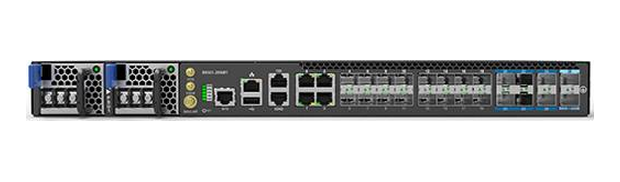
UfiSpace S9501-28SMT
Cell site router · temperature-hardened · Qumran UX (BCM88270)A temperature-hardened, compact box on Broadcom Qumran UX merchant silicon with roughly 120 Gbps of switching capacity, built for the environmental range of a cabinet or tower base. It carries IEEE 1588v2 PTP and SyncE natively as a boundary or ordinary clock, with SR-MPLS access, EVPN Carrier Ethernet, and hierarchical QoS. SFP and SFP+ cages, breakout per platform, optics with proven interoperability per deployment.
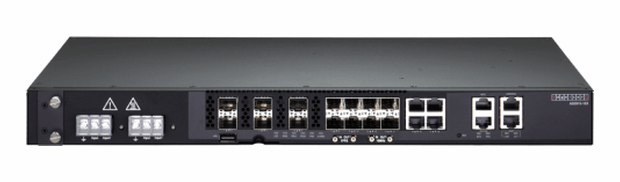
Edgecore AS5915-18X (CSR200)
Cell site router · temperature-hardened · Qumran UX (BCM88272)The Edgecore cell site router at the same tier: a temperature-hardened, compact box on Broadcom Qumran UX merchant silicon with roughly 64 Gbps of switching capacity, built for the environmental range of a cabinet or tower base. It carries IEEE 1588v2 PTP and SyncE natively as a boundary or ordinary clock, with SR-MPLS access, EVPN Carrier Ethernet, and hierarchical QoS. SFP and SFP+ cages, breakout per platform, optics with proven interoperability per deployment.
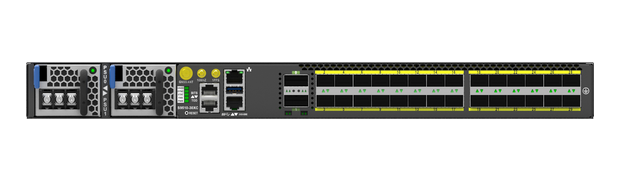
UfiSpace S9510-30XC
Pre-aggregation and aggregation · Qumran 2U (BCM88280)Le boîtier de pré-agrégation et d'agrégation sur silicon Broadcom Qumran avec environ 360 Gbps of switching capacity, sited in a controlled cabinet rather than at the tower. It carries native timing along with SR-MPLS et EVPN Carrier Ethernet upstream from the cell sites, with hierarchical QoS toward the core. QSFP28 and SFP+ cages, breakout per platform, optics with proven interoperability per deployment.
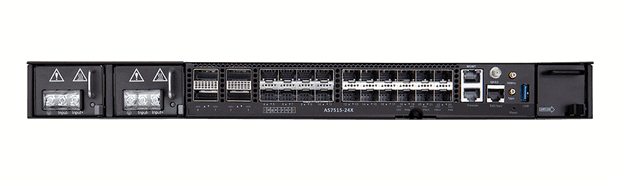
Edgecore AS7515-24X (CSR430)
Pre-aggregation and aggregation · Qumran 2U (BCM88284)The Edgecore pre-aggregation and aggregation box on Broadcom Qumran 2U silicon with roughly 360 Gbps of switching capacity, sited in a controlled cabinet rather than at the tower. It carries native timing along with SR-MPLS et EVPN Carrier Ethernet upstream from the cell sites, with hierarchical QoS toward the core. QSFP28 and SFP+ cages, breakout per platform, optics with proven interoperability per deployment.
Chaque plateforme, ASIC et version validés figure dans la hardware compatibility list → Les liaisons montantes fixes sans fil sont routées vers broadband access.
Intégrez et exploitez des milliers de sites dès le premier jour.
Un renouvellement de site cellulaire se répète sur des milliers de sites, de sorte que le matériel ouvert provenant de plusieurs fournisseurs validés se cumule en levier d'achat, et le Zero Touch Provisioning met en service chaque nouvel équipement avec une base de référence Jour 0 validée.
Intégration par Zero Touch Provisioning
Provisionnement zéro contact brings each new cell site router up with a validated Day 0 baseline over IPv4 or IPv6, so a technician racks the box and it onboards itself across the fleet.
Automatisation et télémétrie ouvertes
Le routeur parle NETCONF and YANG, OpenConfig, and gNMI dial-in and dial-out with streaming telemetry, so the fleet integrates with your own automation and observability stack. NETCONF and YANG →
IP Maestro pour exploiter la flotte
IP Maestro monitors, configures, and troubleshoots the fleet from one server, NETCONF south and REST north, so operators run thousands of sites from a single management surface. IP Maestro →
Un seul contrat de support
Le logiciel et le matériel validé sont livrés ensemble, de sorte que le parc dispose de one escalation path and one RMA, and one team owns the fix. Support →
Convertir la flotte site par site.
Les routeurs de site cellulaire ouverts interopèrent avec le réseau Cisco, Juniper et Nokia installé, ce qui vous permet de convertir le parc un site à la fois. Chaque site bascule selon votre propre calendrier une fois sa correspondance de capacités validée.
Exploitez un site ouvert en parallèle du réseau déjà installé
Mettez en service un routeur de site cellulaire ouvert pour qu'OcNOS-SP fonctionne aux côtés du réseau installé Cisco, Juniper et Nokia equipment, forming standard IS-IS, OSPF, and BGP adjacencies, so the site joins the transport without a redesign.
Convertir un cluster de sites sur correspondance des capacités
Confirmer la correspondance des capacités, Backhaul SR-MPLS, synchronisation PTP et SyncE, et Carrier Ethernet, then cut over a cluster of sites on the operator's own timeline, validating each site before it carries production traffic.
Déployez sur l'ensemble du parc avec ZTP
Le Zero Touch Provisioning met en service chaque nouveau site avec une base Day 0 validée, de sorte que le renouvellement se répète sur des milliers de sites tandis que l'approvisionnement reste multi-fournisseurs. IP Infusion prend en charge le routeur à chaque étape.
Le modèle commercial est ouvert : du matériel durci en température provenant de fournisseurs validés sous un contrat de support unique, avec le logiciel et le matériel sur des cycles de renouvellement indépendants.
Routeur de site cellulaire ouvert face à un châssis propriétaire.
Le timing est l'exigence la plus difficile sur le site cellulaire, et le routeur ouvert la satisfait : il maintient PTP et SyncE sur chaque niveau xHaul, prend en charge SR-MPLS et Carrier Ethernet, et permet de renouveler le parc selon son propre cycle auprès de plusieurs fournisseurs, le tout sous un seul contrat de support.
| Capacité | Routeur de site cellulaire ouvert (OcNOS-SP) | Châssis propriétaire (Cisco / Juniper / Nokia) |
|---|---|---|
| IEEE 1588v2 PTP G.8275.1/.2 and SyncE | ✓ details → | ✓ |
| SR-MPLS avec Flex-Algo et TI-LFA | ✓ details → | ✓ |
| EVPN MEF 3.0 Carrier Ethernet | ✓ details → | ✓ |
| Format de site cellulaire durci en température | ✓ | ✓ |
| Cycles de renouvellement indépendants du matériel et du logiciel | ✓ refresh each on its own cadence | ✓ vendor-bundled cadence |
| Approvisionnement matériel multi-fournisseurs sur l'ensemble du parc | ✓ source from validated vendors | ✓ single-vendor chassis |
| Un seul contrat de support pour le logiciel et le matériel validé | ✓ one escalation path and RMA | ✓ vendor-bundled |
Cisco, NCS 540, Juniper, ACX, Nokia et 7250 IXR sont des marques de leurs propriétaires respectifs. IP Infusion n'est pas affilié à ces fournisseurs et ne les approuve pas ; la comparaison reflète les capacités d'OcNOS-SP vérifiables dans la matrice de fonctionnalités.
Fiche technique et notes de solution.
La fiche technique OcNOS-SP et deux fiches de solution à partager avec votre équipe. Formulaire rapide, et le PDF se télécharge immédiatement.
Datasheet OcNOS-SP
La vue d'ensemble complète OcNOS-SP : rôles, protocoles, synchronisation et matériel validé, dans un seul PDF.
Obtenir la fiche techniqueMise à niveau SR-MPLS avec OcNOS
Un chemin de migration depuis le SR-MPLS installé vers OcNOS sur matériel ouvert, le transport sous le backhaul xHaul.
Obtenir le briefWAN cloud et opérateur
Transport ouvert pour le WAN cloud et fournisseur de services, le backhaul qui achemine le trafic mobile vers le cœur.
Obtenir le briefQuestions sur le routeur de site cellulaire et la synchronisation niveau opérateur.
Déployez un routeur de site cellulaire ouvert sur votre propre matériel.
Découvrez comment IP Infusion fournit le routeur de site cellulaire complet avec la synchronisation de niveau opérateur et le xHaul SR-MPLS, ou contactez-nous pour associer vos sites aux bonnes plateformes validées et aux bonnes licences.
Datasheet OcNOS-SP
Formulaire court. votre PDF se télécharge immédiatement après l'envoi.
✓ Opening your PDF in a new tab.
S'il ne s'est pas ouvert, utilisez le lien ci-dessous.
Mise à niveau SR-MPLS avec OcNOS
Formulaire court. votre PDF se télécharge immédiatement après l'envoi.
✓ Opening your PDF in a new tab.
S'il ne s'est pas ouvert, utilisez le lien ci-dessous.
WAN cloud et opérateur
Formulaire court. votre PDF se télécharge immédiatement après l'envoi.
✓ Opening your PDF in a new tab.
S'il ne s'est pas ouvert, utilisez le lien ci-dessous.
À lire aussi sur le blog
Précision d'horloge à la nanoseconde pour les réseaux 4G/5G : PTP et SyncE avec OcNOS
Synchronisation opérateur IEEE 1588 PTP et SyncE pour le xHaul 5G au site cellulaire
Lire l'article →Cell Site Routers sans ventilateur pour le backhaul 5G en environnements difficiles
Routeurs de site cellulaire durcis en température pour l'accès xHaul 5G dans les déploiements en conditions difficiles
Lire l'article →