Timing and synchronization are non-negotiable requirements for successful 4G and 5G network deployments. Unlike 4G LTE which required only frequency synchronization, 5G NR requires phase synchronization accurate to ±1.5 microseconds (1,500 nanoseconds) at the antenna port. Delivering this accuracy across a multi-hop packet-switched transport network requires a coordinated approach combining two complementary technologies: IEEE 1588v2 PTP and SyncE.
Why 5G Requires Nanosecond Accuracy
5G NR base stations (gNBs) use Time Division Duplex (TDD) for most frequency bands. In TDD, both uplink and downlink transmissions share the same frequency spectrum, separated in time. If adjacent cell sites are not synchronised to a common time reference, their TDD uplink/downlink transitions occur at different times — causing interference at cell boundaries that degrades network capacity and user experience.
The ITU-T G.8271 standard specifies that the maximum time error (TE) at the air interface must be within ±1.5μs for most 5G NR configurations, and as tight as ±130ns for some advanced 5G features. This is stricter than 4G LTE which required only ±1.5μs frequency accuracy.
The Two-Layer Timing Architecture
| Tecnologia | What it Distributes | Standard | Supporto OcNOS |
|---|---|---|---|
| SyncE | Frequency (clock rate) | ITU-T G.8261/G.8262 | ✓ All SP platforms |
| IEEE 1588v2 PTP | Phase and time-of-day | ITU-T G.8265/G.8275 | ✓ Hardware timestamping |
SyncE distributes a highly accurate frequency reference over the Ethernet physical layer — essentially making the Ethernet clock as accurate as a GPS-referenced source. IEEE 1588v2 PTP then distributes phase (the precise time of day) over the packet network, using hardware timestamping to compensate for packet delay variation.
OcNOS PTP Configuration for 5G Transport
! OcNOS -- ITU-T G.8275.1 telecom PTP profile for 5G fronthaul
! (Full-timing support: every network element on the path is PTP aware)
!
configure terminal
!
! PTP clock instance 0, running the ITU-T G.8275.1 telecom profile
ptp clock 0 profile g8275.1
!
! SyncE on the ports that carry the frequency layer
! xe1 and xe2 are example port names; show interface brief lists the platform's own
interface xe1
  synce
  exit
!
interface xe2
  synce
  exit
!
commit
exit
!
! Verify the timing chain:
show ptp clock 0
! Check: clock class and offset from master
!
show synce details
show synce input-sources
! Check: the selected input source and its quality level (QL-PRC or QL-SSU-A for 5G)Timing Budget: How Many Hops Are Possible
ITU-T G.8271.1 specifies maximum time error budgets per network element. With OcNOS hardware-assisted PTP timestamping, each boundary clock introduces approximately 20–30ns of residual time error. This allows a timing chain of 10+ hops from grandmaster to gNB while remaining within the ±1.5μs budget.
- Fanless Cell Site Router Guide
- OcNOS 6.5 for Service Providers
- OcNOS-SP Product Page
- Contatta IP Infusion
IP Infusion Engineering Team
Approfondite. Portatelo con voi.
Il datasheet di prodotto e download tecnici e sintetici che vanno oltre questa pagina.
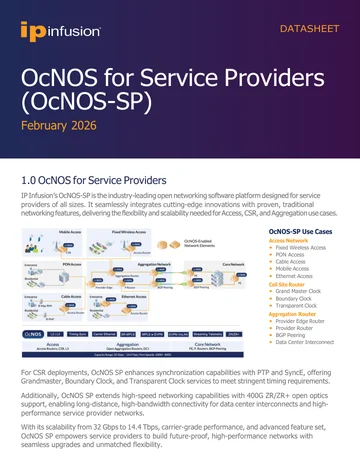
Datasheet OcNOS-SP
Specifica completa di OcNOS-SP: il set di funzionalità access, cell site e aggregazione, gli SKU software, le piattaforme hardware supportate e la guida all'ordine della soluzione.
Ottieni il datasheet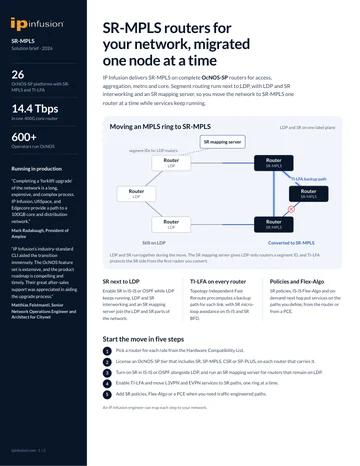
Upgrade SR-MPLS con OcNOS
Migrate SR-MPLS su OcNOS con hardware aperto: Flex-Algo, TI-LFA e un cutover nodo per nodo.
Scarica il brief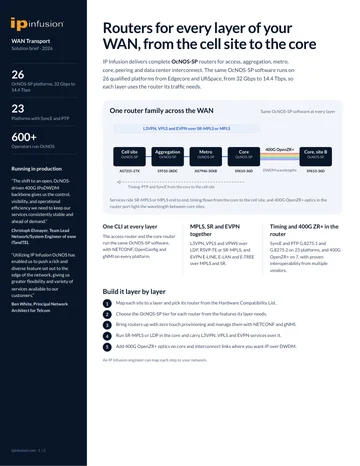
Trasporto WAN cloud & service provider
Trasporto WAN per cloud e service provider su hardware aperto: SR-MPLS, EVPN e forwarding testato su scala.
Scarica il briefDatasheet OcNOS-SP
Modulo rapido. Il vostro PDF si apre in una nuova scheda subito dopo l'invio.
✓ Apertura del vostro PDF in una nuova scheda…
Se non si è aperto, usate il link qui sotto.
Upgrade SR-MPLS con OcNOS
Modulo rapido. Il vostro PDF si apre in una nuova scheda subito dopo l'invio.
✓ Apertura del vostro PDF in una nuova scheda…
Se non si è aperto, usate il link qui sotto.
Trasporto WAN cloud & service provider
Modulo rapido. Il vostro PDF si apre in una nuova scheda subito dopo l'invio.
✓ Apertura del vostro PDF in una nuova scheda…
Se non si è aperto, usate il link qui sotto.