Part of IP Infusion's guide to Segment Routing.
In Part 2, we used TE-metric to optimize paths for bandwidth capacity. Part 3 takes this further: instead of a statically configured cost, we use measured link delay, the actual microsecond latency of each link, as the Flex-Algo optimization metric. OcNOS can source that delay two ways: a static per-interface value, or a live value measured with TWAMP (Two-Way Active Measurement Protocol) using TWAMP-light. When a link's delay changes, IS-IS re-advertises it and the per-algorithm SPF automatically recomputes the lowest-delay path.
Link Delay vs. TE-Metric: Key Difference
| Metric | Source | Dynamic? | Best For |
|---|---|---|---|
| IGP metric | Static config | Nein | Default routing |
| TE metric | Static config | Nein | Capacity-based steering |
| Link delay | Static value or TWAMP measurement | Yes, updates dynamically | Latency-sensitive apps (5G, VoIP, gaming) |
How Delay-Based Flex-Algo Works

The validated lab below runs a seven-node IS-IS Segment Routing core (R1-R7, IS-IS instance OCNOS) with three delay-optimized Flexible Algorithms, 132, 133 and 134, each using metric-type link-delay. Some links carry a static configured delay, others are measured live with TWAMP-light.
Run this post's commands in your browser
The OcNOS CLI Lab is a simulation of the OcNOS command line, set up with this post's network. There is nothing to install, and you can move and resize the lab window while you read.
OcNOS CLI Lab öffnen
The lab opens in a window next to this post, set up with this post's network.
Step 1: Define the Delay-Optimized Flex-Algorithms
Each node enables capability flex-algo routing and defines the algorithms under router isis. Every algorithm uses metric-type link-delay and enables ti-lfa for fast reroute. segment-routing mpls is enabled under the IS-IS instance.
! OcNOS -- Flex-Algo definitions on a participating node (R4).
! All three algorithms optimize on measured/advertised link delay.
R4#show running-config router isis
!
router isis OCNOS
 is-type level-2-only
 capability flex-algo routing
 flex-algo 132
  metric-type link-delay
  ti-lfa
 exit-flex-algo
 !
 flex-algo 133
  metric-type link-delay
  ti-lfa
 exit-flex-algo
 !
 flex-algo 134
  metric-type link-delay
  ti-lfa
 exit-flex-algo
 !
 metric-style wide
 mpls traffic-eng router-id 10.10.100.4
 mpls traffic-eng level-2
 capability cspf
 dynamic-hostname
 fast-reroute ti-lfa level-2 proto ipv4
 bfd all-interfaces
 net 49.0001.0000.0000.0004.00
 segment-routing mpls
!
R4#
One node is elected as the definition winner for each algorithm using a higher priority. In this lab R7 wins with priority 101. R7 also constrains algorithm 134 with exclude-maximum-delay 25, so any link whose delay exceeds 25 is pruned from the 134 topology.
! OcNOS -- Definition-winner node (R7): priority 101 plus a delay
! constraint on algorithm 134 (exclude-maximum-delay 25).
R7#sh run router isis
!
router isis OCNOS
 is-type level-2-only
 capability flex-algo routing
 flex-algo 132
  metric-type link-delay
  priority 101
  ti-lfa
 exit-flex-algo
 !
 flex-algo 133
  metric-type link-delay
  priority 101
  ti-lfa
 exit-flex-algo
 !
 flex-algo 134
  metric-type link-delay
  priority 101
  ti-lfa
  exclude-maximum-delay 25
 exit-flex-algo
 !
 metric-style wide
 mpls traffic-eng router-id 10.10.100.7
 mpls traffic-eng level-2
 capability cspf
 dynamic-hostname
 fast-reroute ti-lfa level-2 proto ipv4
 bfd all-interfaces
 net 49.0001.0000.0000.0007.00
 segment-routing mpls
!
R7#
Step 2: Assign Per-Algorithm Prefix-SIDs
Each node advertises a Segment Routing prefix-SID for the base algorithm (SPF, algorithm 0) and a separate prefix-SID for each Flex-Algorithm on its loopback. A headend selects a delay-optimized path simply by pushing the corresponding per-algorithm SID.
! OcNOS -- Loopback prefix-SIDs (R4): base SID plus one SID per Flex-Algo.
! algorithm-num can take an SRGB index or an absolute label value.
R4#show running-config interface loopback1
!
interface loopback1
 ip address 10.10.100.4/32
 prefix-sid index 104
 prefix-sid algorithm-num 132 index 2804
 prefix-sid algorithm-num 133 absolute 18904
 prefix-sid algorithm-num 134 absolute 18954
 ip router isis OCNOS
!
R4#
Step 3: Provide Link Delay (Static and TWAMP-Measured)
OcNOS advertises link delay in the IS-IS TE sub-TLVs (enabled by metric-style wide). The delay value itself is sourced per interface either as a static minimum/maximum with isis te-minimum-delay flex-algo und isis te-maximum-delay flex-algo, or measured live with delay-measurement dynamic twamp.
! OcNOS -- Per-interface delay (R4).
! cd0 uses a static configured min/max delay; xe25 measures delay with TWAMP-light.
R4#show running-config interface cd0
!
interface cd0
 description To-R2-cd0
 load-interval 30
 ip address 10.66.24.4/24
 mtu 9216
 label-switching
 isis network point-to-point
 isis circuit-type level-2-only
 ip router isis OCNOS
 no isis hello padding
 isis te-minimum-delay flex-algo 30
 isis te-maximum-delay flex-algo 40
!
R4#show running-config interface xe25
!
interface xe25
 description To-R1-xe25
 load-interval 30
 ip address 10.66.14.4/24
 mtu 9216
 label-switching
 isis network point-to-point
 isis circuit-type level-2-only
 ip router isis OCNOS
 no isis hello padding
 delay-measurement dynamic twamp reflector-ip 10.66.14.1 reflector-port 1141
!
R4#
Dynamic measurement uses TWAMP-light. Each node runs a reflector (answering delay probes) and a controller (sending them). The reflector-name/reflector-ip/reflector-port entries pair each session with its neighbor.
! OcNOS -- TWAMP-light on R4 (single measured neighbor, xe25 to R1).
R4#show running-config twamp
twamp-light reflector
 reflector-admin-state enable
  reflector-name R41 reflector-ip ipv4 10.66.14.4 reflector-port 1114
twamp-light control
 control-admin-state enable
 interface xe25
  delay-measurement dynamic twamp reflector-ip 10.66.14.1 reflector-port 1141
!
R4#

! OcNOS -- TWAMP-light on R1 (three measured neighbors: ce0, ce1, xe25).
R1#show running-config twamp
twamp-light reflector
 reflector-admin-state enable
  reflector-name R12 reflector-ip ipv4 10.66.12.1 reflector-port 1121
  reflector-name R13 reflector-ip ipv4 10.66.13.1 reflector-port 1131
  reflector-name R14 reflector-ip ipv4 10.66.14.1 reflector-port 1141
twamp-light control
 control-admin-state enable
interface ce0
 delay-measurement dynamic twamp reflector-ip 10.66.12.2 reflector-port 1112
!
interface ce1
 delay-measurement dynamic twamp reflector-ip 10.66.13.3 reflector-port 1113
!
interface xe25
 delay-measurement dynamic twamp reflector-ip 10.66.14.4 reflector-port 1114
!
R1#
Step 4: Verify Delay-Based Flex-Algo
Confirm the IS-IS adjacencies, then check that each algorithm is defined with the link-delay metric, that the correct definition winner is elected, and that per-algorithm routes and label paths are installed.
! OcNOS -- IS-IS neighbors on R4.
R4#show clns neighbors

Total number of L1 adjacencies: 0
Total number of L2 adjacencies: 3
Total number of adjacencies: 3
Tag OCNOS:  VRF : default
System Id   Interface  SNPA            State  Holdtime  Type  Protocol
R2          cd0        e8c5.7a92.4692  Up     24        L2    IS-IS
R3          cd1        e8c5.7a46.9246  Up     28        L2    IS-IS
R1          xe25       e8c5.7a49.b768  Up     21        L2    IS-IS
R4#
! OcNOS -- Per-interface delay. cd0/cd1 show the static configured min/max;
! xe25 shows the value measured by TWAMP-light (4). 4294967295 = not measured.
R4#show isis interface | include line|Delay
cd0 is up, line protocol is up
Level-2 Minimum Delay : 30
Level-2 Maximum Delay : 40
Measured Minimum-Delay :4294967295
Measured Maximum-Delay :4294967295
Measured Unidir-Link-Delay :4294967295
cd1 is up, line protocol is up
Level-2 Minimum Delay : 20
Level-2 Maximum Delay : 30
Measured Minimum-Delay :4294967295
Measured Maximum-Delay :4294967295
Measured Unidir-Link-Delay :4294967295
xe25 is up, line protocol is up
Measured Minimum-Delay :4
Measured Maximum-Delay :4
Measured Unidir-Link-Delay :4
loopback1 is up, line protocol is up
Measured Minimum-Delay :4294967295
Measured Maximum-Delay :4294967295
Measured Unidir-Link-Delay :4294967295
R4#! OcNOS -- Local flex-algo definitions: all three use metric-type link-delay.
R4#show isis flex-algo all status usercfg summary
ISIS Instance : OCNOS
Algorithm Number : 132
Metric Type : link-delay
Calculation Type : spf
Priority : 5
Prefix Metric Flag: No
Algorithm Number : 133
Metric Type : link-delay
Calculation Type : spf
Priority : 5
Prefix Metric Flag: No
Algorithm Number : 134
Metric Type : link-delay
Calculation Type : spf
Priority : 5
Prefix Metric Flag: No
R4#! OcNOS -- Elected definition winner: R7 (priority 101) wins all three algos.
R4#show isis flex-algo all status winner summary
ISIS Instance : OCNOS
Router-ID : 10.10.100.7, System-ID : 0000.0000.0007
Algorithm Number : 132
Metric Type : link-delay
Calculation Type : spf
Priority : 101 (Winner)
Prefix Metric Flag : No
Router-ID : 10.10.100.7, System-ID : 0000.0000.0007
Algorithm Number : 133
Metric Type : link-delay
Calculation Type : spf
Priority : 101 (Winner)
Prefix Metric Flag : No
Router-ID : 10.10.100.7, System-ID : 0000.0000.0007
Algorithm Number : 134
Metric Type : link-delay
Calculation Type : spf
Priority : 101 (Winner)
Prefix Metric Flag : No
R4#! OcNOS -- Per-algorithm topology (algo 132). R1/R2 do not participate in 132,
! so they show ** (unreachable in this algorithm's topology).
R4#show isis topology algorithm 132
Tag OCNOS: VRF : default
IS-IS paths to level-2 routers
Flex-algo 132
System Id Metric Next-Hop Interface SNPA
R1 **
R2 **
R3 20 R3 cd1 e8c5.7a46.9246
R4 --
R5 24 R3 cd1 e8c5.7a46.9246
R6 24 R3 cd1 e8c5.7a46.9246
R7 22 R3 cd1 e8c5.7a46.9246
R4#! OcNOS -- Per-algorithm route table (algo 134). Metrics are the accumulated
! link delay along each delay-optimized path.
R4#show ip isis route algorithm 134
Codes: C - connected, E - external, L1 - IS-IS level-1, L2 - IS-IS level-2
ia - IS-IS inter area, D - discard, e - external metric
** - invalid
Tag OCNOS: VRF : default
Total number of routes: 21
Destination Metric Next-Hop Interface Tag
L2 10.10.100.1/32 13 10.66.14.1 xe25 0
L2 10.10.100.2/32 16 10.66.14.1 xe25 0
C 10.10.100.4/32 10 -- loopback1 0
L2 10.10.100.5/32 20 10.66.14.1 xe25 0
L2 10.10.100.6/32 19 10.66.14.1 xe25 0
L2 10.10.100.7/32 18 10.66.14.1 xe25 0
R4#! OcNOS -- Data-plane check: label-switched ping and traceroute along the
! algorithm-134 path to R5 (10.10.100.5). The trace shows the SR label stack.
R4#ping mpls isis-sr ipv4 10.10.100.5/32 algorithm 134 detail
Sending 5 MPLS Echos to 10.10.100.5, timeout is 5 seconds
Codes:
'!' - Success, 'Q' - request not sent, '.' - timeout,
'x' - Retcode 0, 'M' - Malformed Request, 'm' - Errored TLV,
'N' - LBL Mapping Err, 'D' - DS Mismatch,
'U' - Unknown Interface, 'R' - Transit (LBL Switched),
'B' - IP Forwarded, 'F' No FEC Found, 'f' - FEC Mismatch,
'P' - Protocol Error, 'X' - Unknown code,
'Z' - Reverse FEC Validation Failed
Type 'Ctrl+C' to abort
! seq_num = 1 10.66.35.5 1.12 ms
! seq_num = 2 10.66.35.5 0.88 ms
! seq_num = 3 10.66.35.5 1.01 ms
! seq_num = 4 10.66.35.5 0.95 ms
! seq_num = 5 10.66.35.5 0.88 ms
Success Rate is 100.00 percent (5/5)
round-trip min/avg/max = 0.88/1.00/1.12
R4#
R4#trace mpls isis-sr ipv4 10.10.100.5/32 detail
Tracing MPLS Label Switched Path to 10.10.100.5, timeout is 5 seconds
Type 'Ctrl+C' to abort
0 10.66.34.4 [Labels: 16105]
R 1 10.66.34.3 [Labels: implicit-null] 0.80 ms
! 2 10.66.35.5 1.07 ms
R4#Steering Traffic onto a Delay-Optimized Path
In this validated lab, traffic is steered onto a delay-optimized path by using that algorithm's prefix-SID from Step 2. A headend that pushes the algorithm-134 SID for R5 sends the packet along the 134 (delay-optimized) topology, and every transit node forwards it using its own per-algorithm SPF result. No separate SR-TE policy or policy-based routing is required for basic Flex-Algo steering.
- Flex-Algo Part 1: Fundamentals
- Flex-Algo Part 2: TE-Metric Optimization
- Performance Measurement: TWAMP Guide
- SR-MPLS Fundamentals
- OcNOS-SP Product Page
- IP Infusion kontaktieren
IP Infusion Engineering Team
Tiefer einsteigen. Zum Mitnehmen.
Das Produktdatenblatt und kurze, technische Downloads, die über diese Seite hinausgehen.
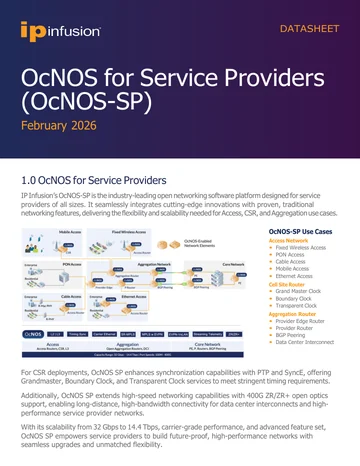
OcNOS-SP-Datenblatt
Vollständige OcNOS-SP-Spezifikation: Funktionsumfang für Access, Cell Site und Aggregation, Software-SKUs, unterstützte Hardware-Plattformen und der Solution Ordering Guide.
Datenblatt abrufen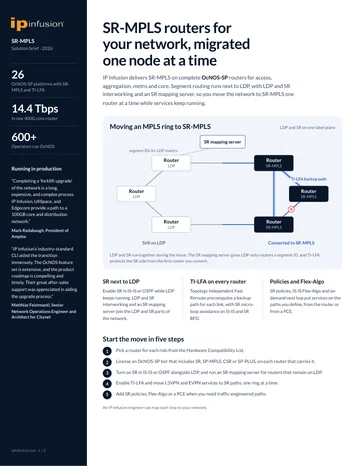
SR-MPLS-Upgrade mit OcNOS
Migrieren Sie SR-MPLS auf OcNOS auf offener Hardware: Flex-Algo, TI-LFA und eine Umstellung Knoten für Knoten.
Brief anfordern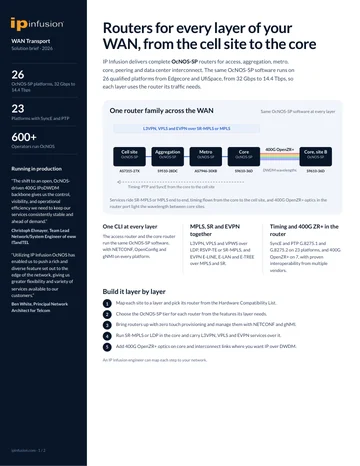
Cloud- & Service-Provider-WAN-Transport
Cloud- und Service-Provider-WAN-Transport auf offener Hardware: SR-MPLS, EVPN und im Maßstab getestetes Forwarding.
Brief anfordernOcNOS-SP-Datenblatt
Kurzes Formular. Ihr PDF öffnet sich unmittelbar nach dem Absenden in einem neuen Tab.
✓ Ihr PDF wird in einem neuen Tab geöffnet…
Falls es sich nicht geöffnet hat, nutzen Sie den untenstehenden Link.
SR-MPLS-Upgrade mit OcNOS
Kurzes Formular. Ihr PDF öffnet sich unmittelbar nach dem Absenden in einem neuen Tab.
✓ Ihr PDF wird in einem neuen Tab geöffnet…
Falls es sich nicht geöffnet hat, nutzen Sie den untenstehenden Link.
Cloud- & Service-Provider-WAN-Transport
Kurzes Formular. Ihr PDF öffnet sich unmittelbar nach dem Absenden in einem neuen Tab.
✓ Ihr PDF wird in einem neuen Tab geöffnet…
Falls es sich nicht geöffnet hat, nutzen Sie den untenstehenden Link.