


For decades, Simple Network Management Protocol (SNMP) has been the undisputed standard for network monitoring. However, as networks scale, transition to cloud-like architectures, and collapse optical layers directly into routing hardware, the limitations of legacy, “pull-based” monitoring protocols have become a severe bottleneck. Relying on SNMP to monitor a modern, high-speed network is like trying to analyze a Formula 1 race by taking a Polaroid picture every five minutes—by the time you see the snapshot, the crash has already happened. If you are running AI workloads in your Data Center, SNMP is actively sabotaging your compute investment. You cannot run a high-performance GPU fabric on 5-minute polling intervals; gNMI streaming telemetry is the only way to catch the micro-congestion that stalls AI training models.
Enter gNMI (gRPC Network Management Interface) based streaming telemetry. By shifting from a model where a server repeatedly asks a device for data to a model where the device continuously streams high-fidelity data to the server, gNMI is revolutionizing network visibility.
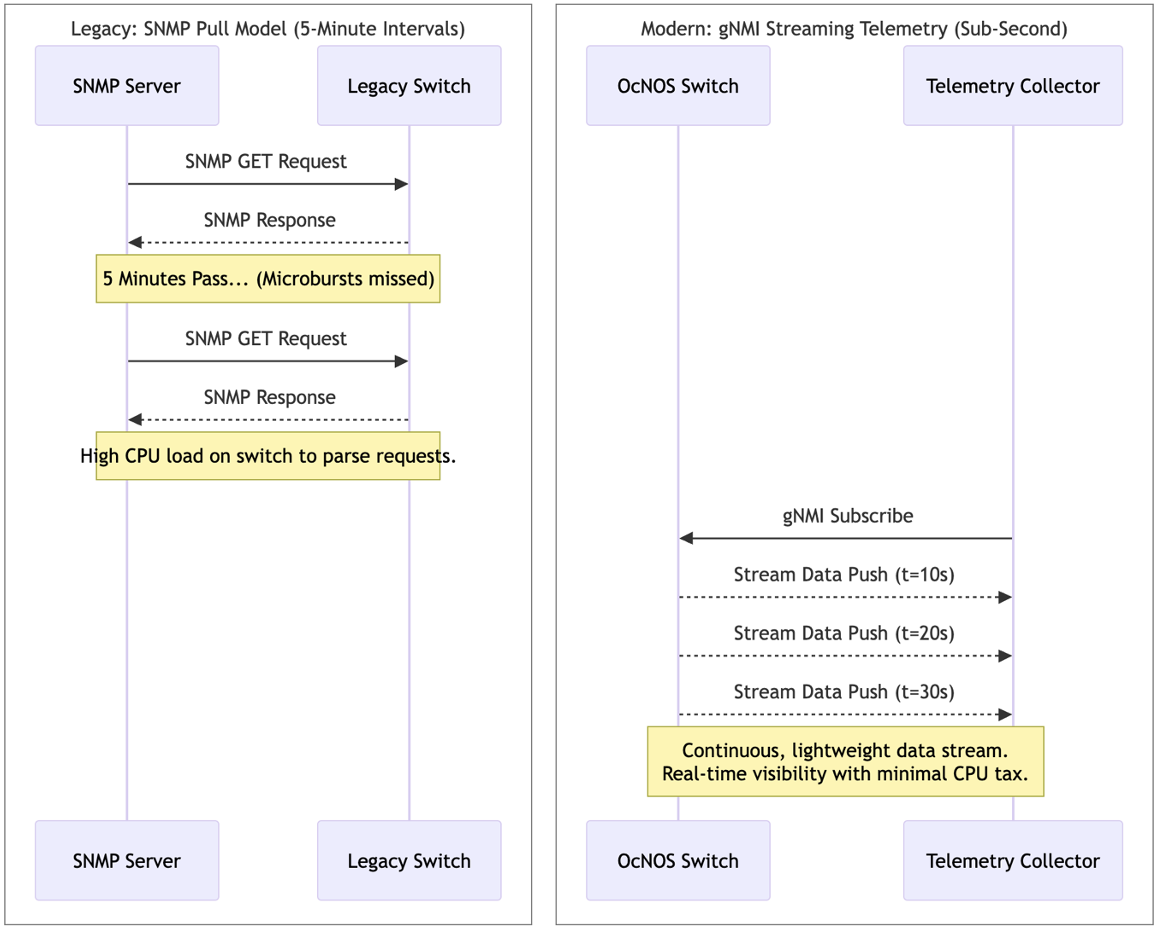
Here is a look at the critical customer problems gNMI streaming telemetry solves, why the rise of IPoDWDM makes it mandatory, and the specific Streaming Telemetry features available in IP Infusion’s OcNOS.
The 5 Customer Problems Solved by gNMI Streaming Telemetry
- The “Microburst” Blind Spot (Data Averaging)
Traditional polling asks devices for metrics every 1 to 5 minutes. If a massive traffic spike (a microburst) drops packets for 8 seconds, that spike gets mathematically averaged out over the 5-minute interval. The dashboard shows “green,” but users experience application lag. gNMI streams data at high frequencies, providing high-definition visibility to catch transient packet drops the moment they occur.
- Crippling CPU Load on Network Devices
Continuously polling a device for thousands of data points requires the device’s CPU to constantly parse requests and package responses. gNMI uses a highly efficient “push” model over a single, long-lived gRPC connection. This process reduces the CPU tax on the network infrastructure by offloading the heavy lifting.
- Delayed Alerting and Reactive Troubleshooting
In a polling model, if a link goes down right after a poll, the monitoring system won’t alert the team until the next poll cycle minutes later. gNMI streams updates instantly, enabling immediate incident response and laying the foundation for automated, self-healing networks.
- Multi-Vendor Automation Nightmares
Historically, engineers wrote custom scripts to parse highly fragmented, vendor-specific SNMP MIBs. gNMI pairs seamlessly with standardized YANG data models (like OpenConfig). The exact same gNMI subscription request works identically across different hardware vendors, neutralizing vendor lock-in.
- Unstructured Data That Blocks AI Automation
Legacy SNMP spits out messy, unorganized data. To make sense of it, engineers have to write complex translation scripts, which makes it incredibly difficult to feed that data into modern AI or Machine Learning tools. gNMI fixes this by streaming data in clean, highly structured formats. When gNMI data arrives from your network devices, it is already perfectly organized and instantly ready for AI engines to analyze—no manual translation required.
The IPoDWDM Catalyst: Why Optical Integration Needs Streaming Telemetry
One of the biggest trends in modern networking is IP over DWDM (IPoDWDM). In the past, service providers had to buy an IP router and a separate, expensive optical transport box to send data over long distances. Today, operators are simply plugging high-powered optical transceivers (like 400G ZR/ZR+) directly into their routers.
This collapses two physical network layers into one, saving massive amounts of money, power, and rack space. However, it creates a huge new challenge for network monitoring.
The Problem with SNMP in IPoDWDM
Because the router is now doing the job of the optical transport box, it is no longer just tracking basic IP traffic. It now has to monitor sensitive physical optical health—like laser temperatures, signal-to-noise ratios, and optical error rates.
Legacy SNMP wasn’t built for this. Forcing a router to gather and process this massive volume of optical data every 5 minutes overwhelms its CPU. Furthermore, waiting 5 minutes to find out an optical laser is degrading is entirely unacceptable. By the time the SNMP poll alerts the team, customer traffic has already been dropping for minutes.
The Streaming Telemetry Solution
This is why gNMI streaming telemetry is absolutely mandatory for IPoDWDM architectures. By continuously pushing both standard IP data and optical health metrics, operators get a unified, high-definition view of their entire network. If a fiber signal starts to fade, the router instantly pushes an alert to the collector, allowing automated software to reroute the IP traffic instantly—long before a customer ever notices a performance drop.
OcNOS Streaming Telemetry Features
To help Service Providers and Data Center operators make this important evolution, IP Infusion has heavily invested in robust gNMI support natively within OcNOS.
From persistent Dial-Out subscriptions and high-frequency sub-second granularity to converged IPoDWDM telemetry and OpenConfig YANG support, OcNOS provides everything required to build a modern, AI-ready network monitoring stack.
For a complete, up-to-date breakdown of supported streaming telemetry modes, encoding formats (like JSON and Protobuf), and platform-specific capabilities, explore the official OcNOS Feature Matrix.
The Future is Streaming
Migrating to open networking and IPoDWDM delivers massive CapEx savings by decoupling software from hardware and eliminating legacy optical transport boxes. However, pairing those modern architectures with legacy SNMP monitoring severely limits your operational potential. Whether you are running complex transport or a high-performance AI data center fabric, you need sub-second visibility. By combining the agility of white-box networking with the high-definition visibility of OcNOS gNMI streaming telemetry, operators can finally build predictable, automated, and AI-ready networks.

Rishi Narain is the Vice President of Product Management for IP Infusion.