


Introduction
Networks based on 2nd-generation Packet Optical Transport Network (P-OTN, or OTN 2.0) are ready for refreshment in the context of current industry trends and increasing bandwidth demands.
- Many platforms are legacy — even if not officially “sunset,” many modules may already be at or near EOL; spare‑part availability is likely limited.
- Support is uncertain — some platforms do not have a public, vendor-published support lifecycle, relying on long-term maintenance, patches, or hardware replacement may be risky.
- Security, compatibility, scalability risk — as the industry evolves (coherent 400G/800G optics), existing networks may struggle to interoperate or scale.
- Planning for migration is prudent — whether to a newer P‑OTN platform or to an IP‑over‑DWDM architecture.
The industry is actively evolving to next-generation technologies to meet the exponential growth in network traffic, particularly due to the emergence of AI/ML applications and 5G networks.
P-OTN Overview
- Packet-Optical Transport Networks combine optical transport (DWDM/ROADM) with packet switching capabilities.
- Key features:
- Efficient aggregation of Ethernet, OTN, and sometimes IP traffic.
- Traffic engineering and SLA support via TDM-like deterministic behavior.
- MEF 3.0 service delivery: E-Line, E-LAN, and E-Tree services with SLA guarantees.
- Use case: High-capacity metro or long-haul networks requiring deterministic service guarantees, often bridging legacy TDM and Ethernet.
Limitations:
- While P-OTN can handle packet-based services, it is less flexible in dynamic traffic routing compared to pure IP/MPLS networks.
- Adding new services may require hardware upgrades or manual provisioning.
Why Move to SR-MPLS?
Segment Routing (SR) over MPLS simplifies traffic engineering while keeping carrier-grade performance.
Key benefits:
- Simpler control plane: No need for complex LDP or RSVP-TE signaling; SR uses the source node to define the path.
- Flexible traffic engineering: Explicit paths for low-latency, high-availability, or capacity-optimized routing.
- Integration with IP services: SR-MPLS can natively carry Layer 2 (Ethernet VPNs), Layer 3 (IP VPNs), and even Layer 4-aware services.
- Network programmability: Works well with SDN controllers for automation.
- Cost efficiency: Reduces operational complexity vs. P-OTN’s more rigid service provisioning.
Evolution Plan:
- Optical network becomes a “dumb” transport layer with flex-grid ROADM or coherent DWDM.
- SR-MPLS handles all packet service routing, TE, and SLA enforcement.
- End-to-end service provisioning can be automated with SDN.
Key Considerations:
- Traffic Engineering: SR-MPLS allows fine-grained TE, but path computation must account for optical constraints.
- Service SLA Mapping: P-OTN’s TDM-like SLAs must be replicated over SR-MPLS using TE paths and fast reroute mechanisms.
- Operational Shift: Operators need new skill sets (MPLS, SR, SDN) vs. legacy P-OTN operations. This operational transition is aided by using SDN network controller applications, which provide similar functionality to the P-OTN NMS applications.
Delivering MEF Ethernet Services
Architectural Comparison
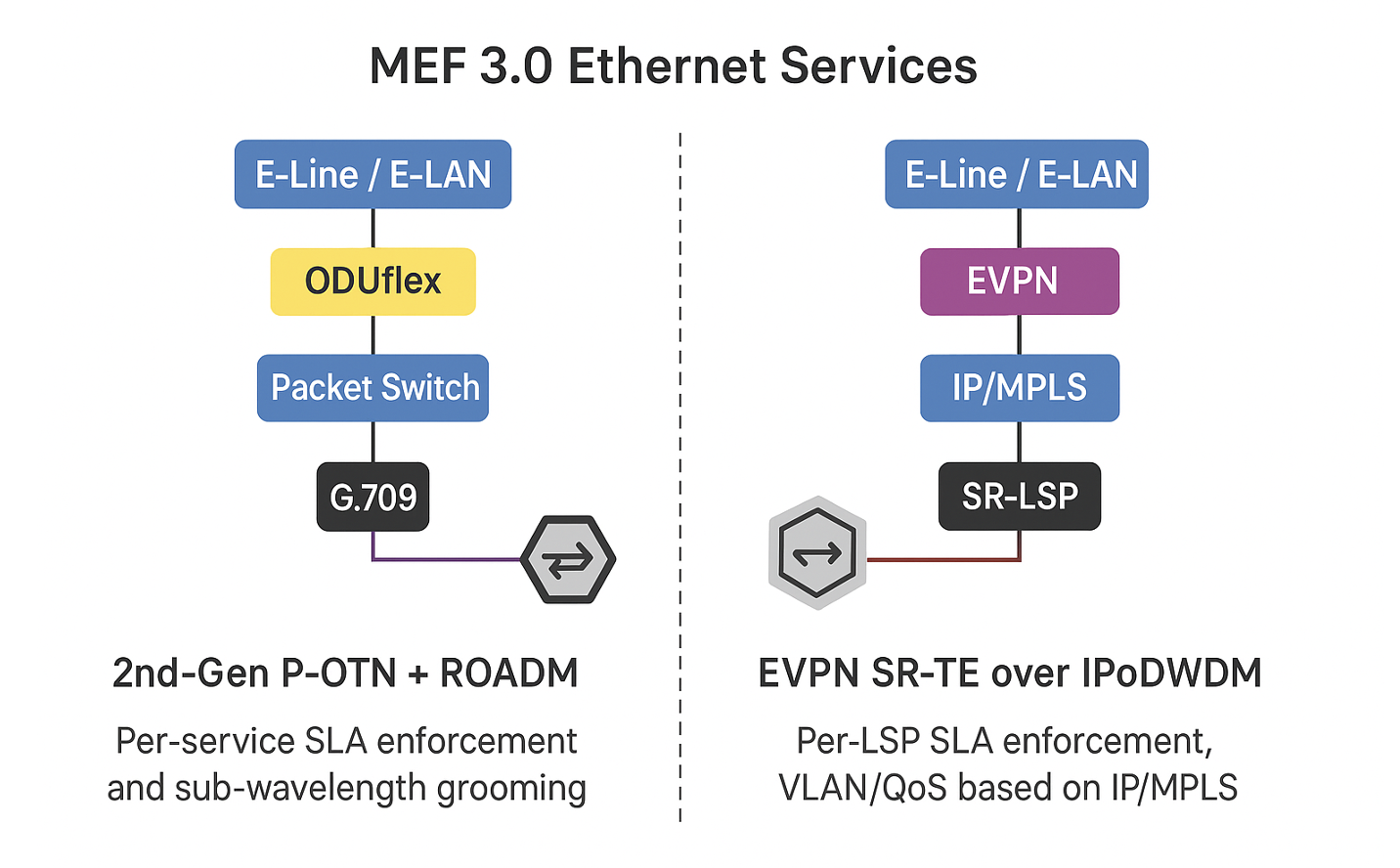
| Feature | 2nd-Gen P-OTN + ROADM | EVPN SR-TE IPoDWDM |
|---|---|---|
| Core concept | Hybrid packet-optical network: native packet/MPLS-TP switching + OTN grooming + DWDM | IP/MPLS routed network with EVPN overlay, Segment Routing Traffic Engineering, and DWDM pluggables |
| Ethernet service mapping | Services mapped into ODUflex/ODUk containers, switched in packet fabric | EVPN-VPWS/VPLS for E-Line/E-LAN services; IP/MPLS SR-TE LSPs mapped directly over DWDM wavelengths |
| ROADM usage | Multi-degree ROADMs for dynamic wavelength routing; sub-wavelength grooming possible | ROADMs route wavelengths between routers; wavelengths are point-to-point; no sub-wavelength grooming |
| Control plane | GMPLS/SDN for OTN + packet + optical layers | Segment Routing + IP/MPLS control plane; SDN optional for wavelength assignment |
MEF 3.0 Service Delivery
| SLA Aspect | 2nd-Gen P-OTN | EVPN SR-TE IPoDWDM |
|---|---|---|
| Bandwidth guarantee | Deterministic via ODUflex/ODUk; per-service CIR/EIR control | Per-LSP bandwidth reservation using SR-TE; dynamic service creation SPF with per-service CIR/EIR control with statistical multiplexing allowing for the support of strict-SLAs as well oversubscription of best effort services. |
| Latency & jitter | Deterministic: packet fabric + OTN grooming ensures predictable latency and low jitter | Low base latency due to direct DWDM paths; jitter depends on queueing at routers, especially with shared LSPs |
| Loss / protection | OTN protection (1+1, 1:N, SNCP) + packet FRR 50ms service disruption | IP/MPLS FRR, ECMP, or SR-TE fast reroute; optional optical protection; allows for 50ms service disruption |
| OAM / performance monitoring | Full end-to-end Y.1731, CFM, BFD; OTN PM available per flow | EVPN OAM (Y.1731, Y.1564, BFD) at the Ethernet service layer; optical PM via pluggables; per-flow SLA visibility |
| Sub-wavelength grooming | Yes — multiple Ethernet/MPLS services aggregated into ODU containers | No – however, each EVPN flow mapped to LSP; flows share point-to-point wavelength which supports both L2 and L3 services with scale |
| Multi-service support | Ethernet + MPLS-TP + TDM + storage + mobile backhaul | Ethernet with EVPN (VXLAN and MPLS), traditional MPLS VPWS and VPLS, and EVPN and VPLS-based L3 VPN services. Support for DCBX enables HPC/Storage support and timing and synchronization enables mobile fronthaul, midhaul, and backhaul functionality. |
| Scalability | Large metro mesh and backbone networks with multi-degree ROADMs | High throughput per router port + DWDM wavelength allow for interworking with multi-degree ROADMs in support of large metro ring, mesh, and backbone networks. Scales from Access to Edge |
| Packet-level protection | MPLS-TP FRR, deterministic OTN cross-connect protection | RSVP-TE/TI-LFA fast-reroute for dynamic services and SR-TE fast reroute for deterministic services requiring protection. |
| Optical protection | OTN 1+1, SNCP; ROADM-based restoration | Optional: 1+1 wavelength protection, colorless/directionless ROADMs |
| SLA guarantee under failure | High: deterministic restoration and minimal loss | High: deterministic restoration and minimal loss for SR-TE based services. Moderate: restoration of dynamic services depends on LSP reroute; multiple EVPN flows may be affected. Restoration is still expected to be within 50ms. |
| OPEX | High: requires expertise in packet + OTN + optical layers | Moderate: IP-centric operations; simpler than multi-layer P-OTN. Multi-layer SDN applications help to automate the IP and optical layers. |
| Provisioning | Multi-layer coordination; SDN automation can simplify | Faster: LSP + EVPN configuration; SR-TE path computation can be automated. |
| Monitoring & SLA enforcement | End-to-end per-service KPIs aligned with MEF 3.0 | End-to-end per-service KPIs aligned with MEF 3.0 |
| Automation | Multi-layer SDN orchestration | Multi-layer SDN Orchestration including ROADM and EVPN layers |
Summary
If the goal is to deliver carrier-grade Ethernet, L2VPN, L3VPN, and MEF 3.0 services with high scale, automation, and lower cost, then an SR-MPLS + ROADM-based IPoDWDM network with EVPN services is a complete replacement for P-OTN.
Key Strengths vs. P-OTN:
- Ethernet Service Flexibility (MEF 3.0)
- EVPN (E-LINE, E-LAN, E-TREE, E-ACCESS) matches or exceeds P-OTN’s EPL/EVPL capabilities.
- Supports hierarchical services, wholesale handoff, and multi-domain service stitching.
- Deterministic transport using SR-TE
- SR-TE provides deterministic paths very close to OTN-style engineered circuits.
- Bandwidth steering, latency constraints, and disjointness can be enforced by the controller.
- Coherent optics with IPoDWDM eliminates separate OTN shelf
- Reduces cost, space, and power.
- SLA capabilities comparable to OTN
- A well-designed SR-MPLS network now supports:
- sub-50ms protection (TI-LFA, MRT, or SR-TE Fast Reroute)
- per-service performance monitoring (TWAMP/Y.1731)
- deterministic latency engineering
- strict path isolation using dedicated Flex-Algo / policy steering.
- A well-designed SR-MPLS network now supports:
- Multi-domain automation
- Modern Network Controllers (1Finity Virtuora NC) provide full-stack automation for:
- SR-policy provisioning
- ROADM layer path-finding
- service assurance
- closed-loop protection.
- This is a major advantage over legacy P-OTN systems.
- Modern Network Controllers (1Finity Virtuora NC) provide full-stack automation for:
Ready to evaluate your path to IPoDWDM? Transitioning from legacy P-OTN requires a strategic roadmap. Contact our engineering team today for a Network Modernization Assessment to identify the most cost-effective way to scale your infrastructure for the 400G/800G era.

William Graves is the PartnerInfusion Technical Solutions Lead, Americas, APAC, & GSI at IP Infusion.