Qu'est-ce que RDMA ?
RDMA (Remote Direct Memory Access) permet à une machine de lire ou d'écrire directement la mémoire d'une autre machine sur le réseau, en contournant à la fois les CPU et le système d'exploitation. L'adaptateur réseau déplace les octets directement entre la mémoire applicative des deux extrémités, de sorte que la latence est très faible et la charge CPU quasi nulle. Sur Ethernet, RoCEv2 transporte le RDMA pour qu'il puisse être routé, et comme RDMA suppose qu'aucun paquet n'est perdu, il fonctionne sur un fabric sans perte.
Zéro copie, contournement du CPU, et pourquoi c'est l'essentiel
Un transfert réseau normal copie les données à travers le noyau et sollicite le CPU aux deux extrémités. RDMA supprime les deux. L'adaptateur lit directement dans la mémoire applicative de l'émetteur et écrit directement dans la mémoire applicative du récepteur, sans que rien ne traverse le CPU sur le chemin de données. C'est ce qui procure à RDMA sa combinaison de très faible latence, de très haut débit et de coût CPU quasi nul, et c'est pourquoi RDMA est devenu la norme pour la communication GPU-à-GPU.
- Zéro copie : les octets se déplacent directement entre la mémoire applicative des deux extrémités, sans jamais transiter par des buffers intermédiaires du noyau.
- Contournement du noyau : c'est l'adaptateur réseau, et non le système d'exploitation, qui pilote le transfert, de sorte que le CPU est hors du chemin de données.
- Charge quasi nulle : le CPU est libéré pour exécuter la charge de travail plutôt que de brasser des paquets, ce qui est décisif à l'échelle GPU.
Comment RoCEv2 transporte le RDMA sur Ethernet
RoCEv2 (RDMA over Converged Ethernet, version 2) encapsule le RDMA dans UDP et IP, en utilisant le port UDP de destination 4791, afin qu'il puisse être routé à travers un fabric Ethernet Layer 3 standard sans réseau distinct requis. L'opération RDMA s'exécute toujours d'adaptateur à adaptateur avec le même comportement zéro copie ; RoCEv2 lui donne simplement un chemin Ethernet routable. C'est ce qui permet à un fabric Ethernet multi-fournisseurs de remplacer InfiniBand sur les clusters GPU.
Transport routable
RDMA circule dans UDP et IP sur le port 4791, de sorte qu'il traverse un data center routé standard au lieu de nécessiter un fabric dédié.
Réseau sans perte
RDMA suppose que le réseau ne perd jamais de paquet, il fonctionne donc sur un fabric sans perte avec PFC et ECN qui maintiennent chaque saut sans perte.
Le fabric IA
Ce transport est le fondement d'un fabric IA: le réseau GPU à GPU qui transporte chaque opération collective pendant l'entraînement.
Pourquoi les collectifs IA dépendent de RDMA, et pourquoi le fabric doit être sans perte
L'entraînement IA exécute des opérations collectives telles qu'AllReduce : après chaque étape, les gradients de chaque GPU sont combinés sur l'ensemble des GPU, puis tous attendent cet échange avant l'étape suivante. Les volumes de données sont importants et le calendrier est serré, RDMA maintient donc chaque échange rapide et hors du CPU. Comme un seul paquet perdu force une reprise qui fait grimper la latence de queue et peut bloquer tout le collectif, le RDMA sur Ethernet fonctionne généralement sur un fabric sans perte.
- Les collectifs bloquent chaque GPU jusqu'à ce que l'échange s'achève, de sorte que une latence plus faible raccourcit l'étape que l'ensemble du cluster attend.
- RDMA maintient l'échange hors du CPU et sans copies, ce qui, multiplié sur des millions d'étapes, constitue un levier direct sur le temps total d'entraînement.
- OcNOS-DC fournit le fabric sans perte avec PFC, ECN et équilibrage de charge dynamique sur Broadcom Tomahawk 5, en éloignant les flux des liens saturés.
Qu'est-ce que RDMA, la réponse
Qu'est-ce que RDMA ?
Comment RoCEv2 transporte-t-il le RDMA sur Ethernet ?
Pourquoi le zéro copie et le contournement du CPU sont-ils importants pour l'IA ?
Pourquoi RDMA a-t-il besoin d'un fabric sans perte ?
Vous concevez un fabric RDMA ? Construisons-le sans perte
Indiquez-nous la charge de travail et l'échelle GPU, et un ingénieur IP Infusion parcourra avec vous la conception RoCEv2 et du fabric sans perte sur du matériel ouvert exécutant OcNOS-DC.
Concevez tout le fabric IA avec OcNOS
Du dossier économique au calcul du nombre de ports, reprenez où vous en êtes dans la construction.
Approfondissez. Emportez-le avec vous.
Deux téléchargements techniques et concis qui vont plus loin que cette page : la fiche technique complète OcNOS-DC et l'architecture de fabric IA 800G sans perte.
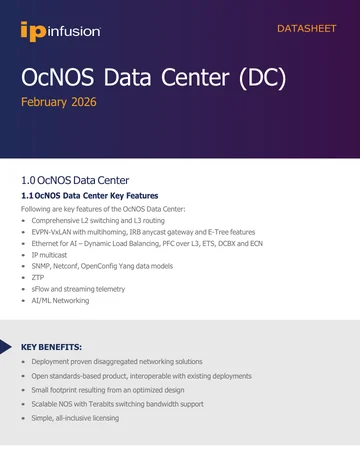
Datasheet OcNOS-DC
Spécification complète OcNOS-DC : l'ensemble des fonctionnalités EVPN-VXLAN et Ethernet for AI, les SKU logiciels, les plateformes matérielles prises en charge et le guide de commande de la solution.
Obtenir la fiche technique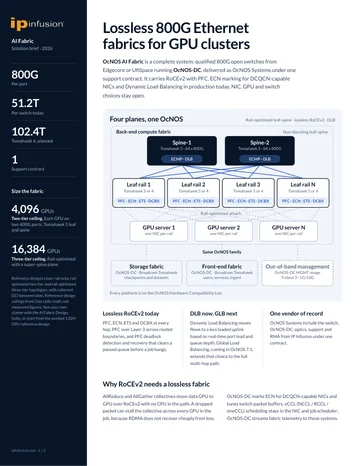
OcNOS 800G Fabric IA sans perte
Fabric RoCEv2 sans perte sur des spines Tomahawk 5 : niveaux de SKU, plateformes qualifiées et architecture de déploiement.
Obtenir le briefDatasheet OcNOS-DC
Formulaire rapide. Votre PDF s'ouvre dans un nouvel onglet immédiatement après l'envoi.
✓ Ouverture de votre PDF dans un nouvel onglet…
S'il ne s'est pas ouvert, utilisez le lien ci-dessous.
OcNOS 800G Fabric IA sans perte
Formulaire rapide. Votre PDF s'ouvre dans un nouvel onglet immédiatement après l'envoi.
✓ Ouverture de votre PDF dans un nouvel onglet…
S'il ne s'est pas ouvert, utilisez le lien ci-dessous.