Service providers are deploying open networking in production networks that carry commercial traffic, beyond pilots and proofs of concept. Their reasons for adopting it reflect changes in the carrier equipment market.
Driver 1: 5G Infrastructure Economics
5G deployment requires a large expansion of the transport and backhaul network. Every cell site needs a cell site router. Every region needs aggregation capacity. For most operators outside the Tier-1 carriers, the cost of building this infrastructure with proprietary equipment can be difficult to justify.
Disaggregated cell site routers let operators choose hardware and software separately and buy each at its own price. Across hundreds or thousands of cell sites, that choice can affect the pace of a 5G rollout.
Driver 2: Broadband Access Expansion (BEAD and Similar Programs)
The US BEAD program (Broadband Equity, Access, and Deployment) is a $42.45 billion NTIA grant program that supports broadband deployment to unserved and underserved locations. Since June 2025, the program has been technology-neutral, and projects can include the middle mile needed to reach an interconnection point. Similar programs exist in Europe, Asia, and Latin America. ISPs and electric co-ops building out fiber access networks are adopting OcNOS-based aggregation platforms for these builds. See the routers by site and sourced RFP answers for BEAD builds.
Driver 3: Legacy Platform End-of-Life
When a platform reaches end of life, operators face a replacement decision. Juniper announced end of life for the MX204 on June 15, 2026 (TSB107750). The last order date for the hardware is June 15, 2027 and end of support is June 30, 2032. Operators who had previously evaluated open networking but deferred adoption are now actively migrating rather than re-entering another proprietary vendor cycle.
Driver 4: Supply Chain Diversification
The 2020 to 2023 semiconductor shortage made single-vendor dependency a business risk, not just a procurement preference. With a disaggregated architecture, an operator can qualify hardware from more than one ODM and keep deploying when one supply line is short. That experience led many operators to consider sourcing from multiple vendors.
Driver 5: Operational Maturity of Open NOS
Five years ago, a common objection to open networking was that the software was not mature enough for production SP use cases. That objection has weakened. IP Infusion is registered to TL 9000, OcNOS earned MEF 3.0 Carrier Ethernet certification (E-Line, E-LAN, E-Tree) on the UfiSpace S9510-28DC, IP Infusion's disaggregated cell site gateway was validated for open fronthaul use cases at the O-RAN Global PlugFest in spring 2022, and more than 900 operators run OcNOS. Operators also consider the risks of not adopting open networking as other providers reduce infrastructure costs.
- ¿Qué es la desagregación de red?
- OcNOS 7.0 for Service Providers
- OcNOS-SP Product Page
- Contactar con IP Infusion
IP Infusion Marketing Team
Profundice. Llévelo consigo.
El datasheet del producto y descargas técnicas y breves que profundizan más que esta página.
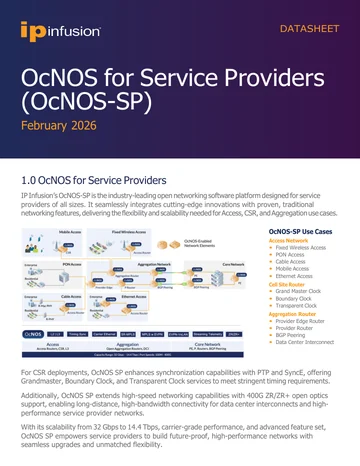
Datasheet de OcNOS-SP
Especificación completa de OcNOS-SP: el conjunto de funciones de acceso, cell site y agregación, los SKU de software, las plataformas de hardware compatibles y la guía de pedido de la solución.
Obtener el datasheet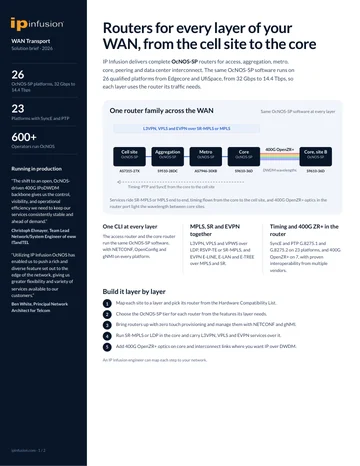
Transporte WAN para Cloud y Operadores
Transporte WAN para la nube y los service provider sobre hardware abierto: SR-MPLS, EVPN y reenvío probado a escala.
Obtener el brief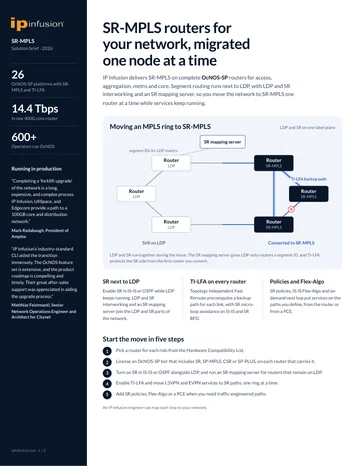
Actualización SR-MPLS con OcNOS
Migre SR-MPLS a OcNOS sobre hardware abierto: Flex-Algo, TI-LFA y una migración nodo a nodo.
Obtener el briefDatasheet de OcNOS-SP
Formulario rápido. Su PDF se abre en una pestaña nueva inmediatamente después de enviarlo.
✓ Abriendo su PDF en una pestaña nueva…
Si no se ha abierto, utilice el enlace de abajo.
Transporte WAN para Cloud y Operadores
Formulario rápido. Su PDF se abre en una pestaña nueva inmediatamente después de enviarlo.
✓ Abriendo su PDF en una pestaña nueva…
Si no se ha abierto, utilice el enlace de abajo.
Actualización SR-MPLS con OcNOS
Formulario rápido. Su PDF se abre en una pestaña nueva inmediatamente después de enviarlo.
✓ Abriendo su PDF en una pestaña nueva…
Si no se ha abierto, utilice el enlace de abajo.